
VoxClone AI Voice Agent API vs OpenAI Realtime API: Which Is Better for Voice Agents in 2026?
You are building a voice agent. Maybe it is a customer support bot that handles inbound calls, a restaurant ordering system, or an outbound sales dialer. The core question you will hit early in architecture planning is which API to build on. Two options keep coming up in developer communities: the OpenAI Realtime API, which lets you build speech-to-speech agents backed by GPT-4o, and the VoxClone AI Voice Agent API, which is purpose-built for production voice agent deployments with deep customization for brand voice and multilingual support.
Both are legitimate choices with real production deployments behind them. Neither is obviously better for every use case. What they are better for differs in ways that depend on your specific priorities around latency, voice quality customization, pricing structure, integration flexibility, and the complexity of the conversations your agent needs to handle.
This article compares them directly across the dimensions that actually matter in production voice agent development. Not feature checklists, but the specific technical and product decisions that determine whether your deployment succeeds or struggles.
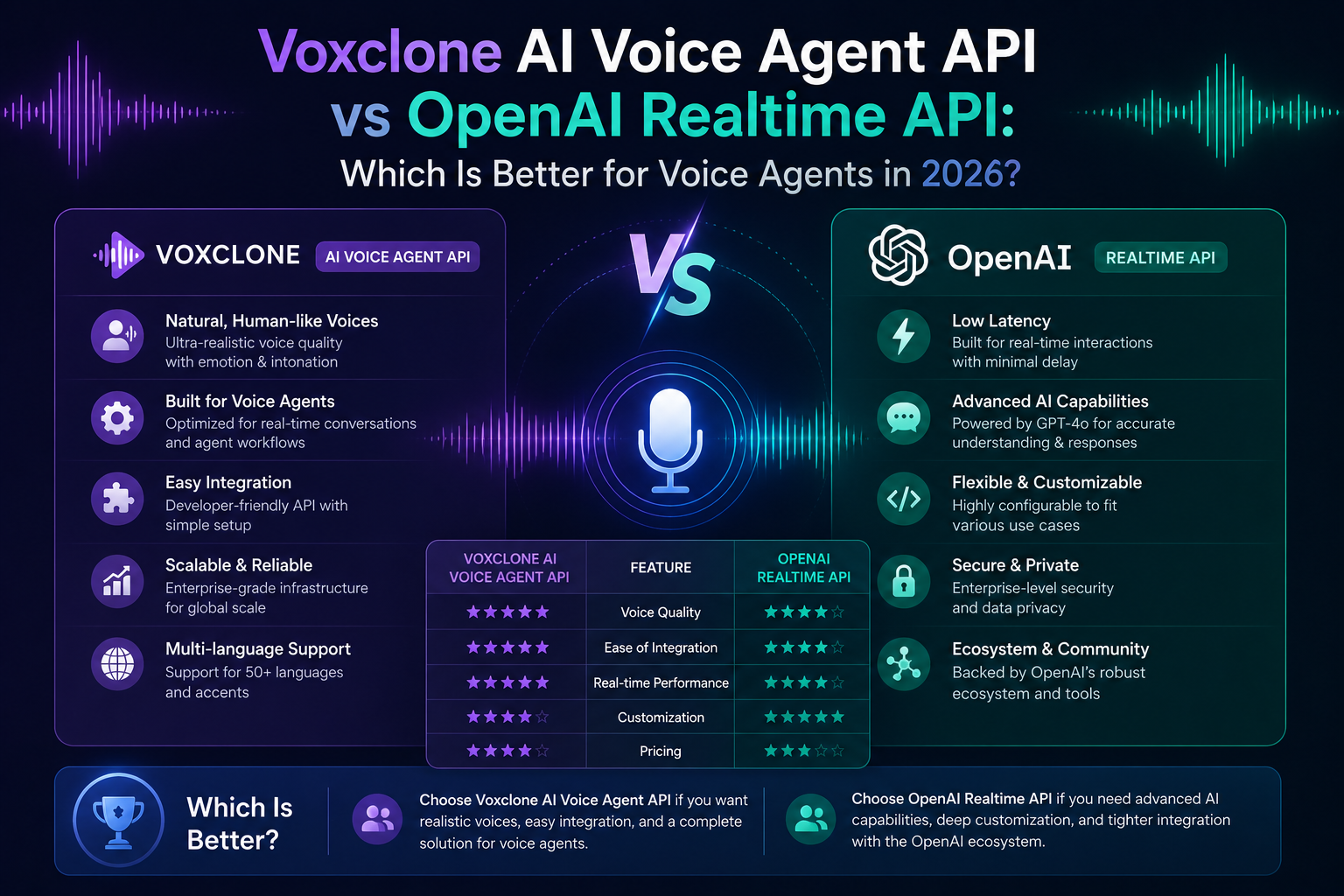
What Each API Actually Does: Architecture Overview
Before comparing them, it helps to be precise about what each platform actually provides at the architectural level, because they solve the voice agent problem from different starting points.
OpenAI Realtime API: Speech-to-Speech Through GPT-4o
The OpenAI Realtime API establishes a persistent WebSocket connection through which audio streams in and audio responses stream back out. The underlying model is GPT-4o operating in a native audio mode where it processes speech directly rather than transcribing to text, reasoning, and synthesizing output. This end-to-end audio processing is the key technical differentiator: the model handles ASR, language understanding, reasoning, and TTS within a single neural pass, which reduces the latency that accumulates when these steps are handled by separate systems.
The API supports function calling, which allows the voice agent to trigger external actions, look up information, and integrate with backend systems during a conversation. It includes server-side voice activity detection and turn management. The default voices are OpenAI's built-in options: Alloy, Echo, Fable, Onyx, Nova, and Shimmer.
VoxClone AI Voice Agent API: Voice-First Agent Infrastructure
VoxClone AI's Voice Agent API is built specifically around the use case of deploying voice agents in production telephony and web audio contexts. Rather than a single end-to-end model, it provides an orchestration layer that connects best-of-class ASR, LLM reasoning, and neural TTS components with voice cloning as the synthesis layer. The key distinction is voice customization: you can deploy an agent that speaks in a cloned, branded voice rather than a generic built-in voice, and that voice remains consistent across all interactions regardless of what the agent says.
The platform also handles telephony integration directly, with connectors for SIP, Twilio, and WebRTC, and includes built-in conversation management, escalation routing, and analytics. It is designed for teams who want a complete voice agent platform rather than a single API they wire into their own stack.
The fundamental architectural difference is control. OpenAI Realtime API gives you GPT-4o's native audio capability with limited voice customization. VoxClone AI's Voice Agent API gives you a composable platform with deep voice customization at the cost of slightly more integration complexity.
Latency: The Number That Determines Whether Your Agent Feels Natural
In voice agents, latency is not just a performance metric. It is a product experience metric. Humans are highly sensitive to conversational timing. A response delay above 500 milliseconds starts to feel like a pause. Above 800 milliseconds, it starts to feel broken. Above 1.5 seconds, users begin to think the agent has crashed.
OpenAI Realtime API Latency Profile
The OpenAI Realtime API's end-to-end audio processing architecture eliminates the latency contribution of running ASR and TTS as separate sequential steps. Published developer benchmarks show response latencies in the range of 300 to 600 milliseconds from end of user speech to start of agent audio output in optimized deployments. This is genuinely fast for a real-time AI voice interaction.
The caveat is that this latency assumes a high-quality, low-jitter network connection with close geographic proximity to OpenAI's servers. Users on mobile connections, or agents deployed in regions far from OpenAI's data center locations, will see higher practical latency. OpenAI currently offers Realtime API access through US East and EU West regions, which limits optimization options for Asia-Pacific deployments.
VoxClone AI Voice Agent API Latency Profile
VoxClone AI's orchestrated architecture introduces the sequential latency of running ASR, LLM, and TTS as distinct steps, but the platform compensates through aggressive pipelining: TTS synthesis begins on the first sentence of the LLM response while the LLM is still generating the remainder, and audio starts streaming to the user before the complete response is synthesized. End-to-end response latencies in production deployments typically range from 400 to 900 milliseconds, slightly higher than OpenAI Realtime's best-case but competitive for most telephony-based use cases where users have higher latency tolerance than web audio contexts.
The Interruption Handling Difference
A related latency dimension is interruption handling: how quickly does the agent stop speaking and respond when the user speaks over it? OpenAI Realtime API handles interruptions at the model level, which allows very low-latency interruption detection and recovery. VoxClone AI's platform uses voice activity detection at the audio pipeline level, which achieves comparable interruption response times but through a different technical pathway. Both handle this acceptably for most use cases.
Voice Quality and Customization: Where the Platforms Diverge Most
Voice quality and customization is the dimension where the two platforms differ most significantly, and it is often the deciding factor for teams building brand-facing voice agents.
OpenAI Realtime API Voice Options
OpenAI's built-in voices are high quality by any measure. They sound natural, handle prosody well, and maintain consistency across long interactions. The limitation is that they are shared voices available to any OpenAI API customer. Your competitor building their own voice agent on the Realtime API may choose the same voice. There is no mechanism for voice cloning, voice customization, or creating a proprietary voice identity for your brand.
Additionally, the native audio voices are optimized for the speaking style of a general-purpose AI assistant. They may not match the desired tone for specific verticals: a clinical healthcare agent voice, a warm hospitality agent voice, or a confident financial services agent voice all have distinct characteristics that the generic OpenAI voices do not specifically target.
VoxClone AI Voice Customization
VoxClone AI's primary differentiator is voice cloning and custom voice creation. Organizations can create a proprietary voice persona, distinct from any shared voice library, and deploy that voice exclusively in their agent. This means your agent sounds like itself rather than like OpenAI's Alloy voice, which may also be the voice your competitor deployed last month.
The platform supports multilingual voice synthesis that maintains the same voice persona across languages. A customer calling in Spanish hears the same brand voice as one calling in English. This cross-lingual voice consistency is technically difficult and represents one of VoxClone AI's most distinctive platform capabilities. Most alternative platforms either switch to a different voice for different languages or produce inconsistent accent and tone across languages.
Voice Quality at the Synthesis Level
Both platforms produce high-quality voice output. OpenAI's native audio processing benefits from joint training of the understanding and synthesis components, which can produce more naturally timed responses. VoxClone AI's neural TTS synthesis is comparable to leading standalone TTS providers like ElevenLabs and Google WaveNet in terms of naturalness scores. The practical difference in voice quality perception between the two platforms is less significant than the difference in voice identity and customization flexibility.
Conversational Intelligence and LLM Flexibility
Voice agents are not just audio pipelines. They are reasoning systems that need to understand context, maintain conversation state, access external information, and handle the full complexity of real customer conversations.
OpenAI Realtime API: GPT-4o Native Reasoning
The OpenAI Realtime API's biggest advantage is access to GPT-4o's reasoning capabilities in a native audio context. GPT-4o is among the most capable general-purpose language models available, with strong performance on instruction following, multi-step reasoning, and handling of complex, ambiguous requests. For voice agents that need to handle genuinely complex conversations, nuanced customer situations, or domain-general queries, GPT-4o's reasoning depth is a meaningful advantage.
The API supports function calling, which allows the agent to trigger backend integrations during a conversation. A customer asking about their account balance can trigger a database lookup; a booking request can trigger a calendar check and reservation creation. Function calling response times in the Realtime API typically add 200 to 400 milliseconds to the turn, depending on the external API latency.
VoxClone AI: LLM Flexibility and Model Choice
VoxClone AI's orchestrated architecture allows you to choose which LLM powers the conversational reasoning layer. You can use GPT-4o, Claude, Gemini, or an open-source model deployed on your own infrastructure. This flexibility matters for several reasons. Cost optimization: a smaller, faster, cheaper model may be sufficient for a narrow-domain voice agent. Data privacy: routing conversations through your own LLM deployment rather than a third-party API may be required for healthcare or financial services use cases. Model specialization: fine-tuned domain-specific models may outperform general-purpose models for highly specialized voice agent tasks.
Conversation State and Memory Management
Both platforms manage conversation context through a session model. OpenAI Realtime API maintains session state through the WebSocket connection lifetime, with configurable context management for long conversations. VoxClone AI's platform provides explicit conversation state management with built-in support for cross-session memory, allowing an agent to remember a returning customer's preferences from a previous call. This cross-session memory is a platform capability OpenAI Realtime API requires you to build yourself.
Integration, Deployment, and Telephony Support
How you deploy a voice agent matters as much as how it sounds and reasons. The integration and deployment differences between these platforms are significant.
OpenAI Realtime API: WebRTC and WebSocket Only
The OpenAI Realtime API is designed for web and application contexts where the end-user device establishes a WebSocket or WebRTC connection to the API endpoint. For browser-based voice agents, this is clean and direct. For telephony deployments, you need to build a media bridge that converts between the telephone audio stream (typically SIP or RTP) and the WebSocket/WebRTC connection the Realtime API requires. This bridge layer adds complexity and potential latency.
Building and maintaining this telephony bridge is non-trivial engineering work. It requires handling codec conversion between telephony audio formats and WebRTC audio formats, managing SIP signaling, and handling the reliability requirements of telephone-grade infrastructure. Teams deploying on telephony typically use a middleware layer like Twilio Voice SDK or Vonage with a custom server-side bridge.
VoxClone AI: Native Telephony Integration
VoxClone AI's platform was designed with telephony as a primary deployment context, not an afterthought. Native connectors for SIP trunking, Twilio, and WebRTC eliminate the custom bridge engineering that OpenAI Realtime deployments on telephony require. For teams deploying voice agents on phone numbers, this represents a meaningful reduction in time-to-production and ongoing maintenance burden.
The platform also provides call routing, transfer to human agent, call recording, and conversation analytics as built-in features rather than requiring separate integrations for each. For a complete voice agent product, these platform capabilities reduce the amount of infrastructure you need to build and maintain.
SDK and Language Support
OpenAI provides official Python and Node.js SDKs with Realtime API support, plus community SDKs for other languages. VoxClone AI provides REST API access with SDKs for the primary deployment contexts. Both have adequate developer tooling for the majority of voice agent development contexts.
Pricing and Cost Structure at Scale
Pricing at prototype scale and pricing at production scale are very different conversations. Understanding the cost structure of each platform is essential before committing to an architecture.
OpenAI Realtime API Pricing Model
OpenAI Realtime API is priced per token of audio input and audio output, with audio tokens significantly more expensive than text tokens. As of mid-2026, audio input is priced at approximately $0.06 per minute of audio and audio output at approximately $0.24 per minute of audio. A 5-minute customer service call at these rates costs approximately $1.50 in API fees alone, before any infrastructure costs.
For high-volume deployments handling thousands of calls per day, these per-minute costs scale linearly with no volume discounts at standard tiers. A deployment handling 10,000 calls per day of average 5-minute duration would generate approximately $15,000 per day in API costs at standard rates. Enterprise pricing negotiations may reduce this significantly, but entry-level production deployments face the standard per-minute pricing.
VoxClone AI Pricing Structure
VoxClone AI uses a platform-based pricing model that includes the voice synthesis component alongside the agent orchestration infrastructure. The pricing varies by deployment scale and specific feature usage, but the structure is designed for production deployments where per-minute costs need to be predictable and scalable. For teams building on Android and exploring the platform's capabilities before committing to a full deployment, the VoxClone AI app on Google Play provides direct access to the voice synthesis features.
Cost Optimization Strategies
Teams deploying at scale on OpenAI Realtime API typically explore cost optimization through call duration reduction, silence detection to pause billing during hold periods, and tiered model usage where simple exchanges use a cheaper model and complex reasoning escalates to GPT-4o. VoxClone AI's LLM flexibility means you can route simple agent conversations through cheaper LLMs and reserve premium models for genuinely complex interactions, which can significantly reduce the effective per-call cost at scale.
Head-to-Head: Use Case Fit Analysis
Rather than declaring an overall winner, the more useful question is which platform fits which type of voice agent deployment.
Where OpenAI Realtime API Has the Advantage
OpenAI Realtime API is the stronger choice for web-native voice interactions where WebRTC/WebSocket delivery is natural, where the built-in GPT-4o voices are acceptable for the brand context, where conversational complexity is high and GPT-4o's general reasoning capability is important, and where development speed matters more than cost optimization at production scale. Developer tools, documentation, and community resources are more mature for OpenAI Realtime compared to newer platform entrants.
Where VoxClone AI Voice Agent API Has the Advantage
VoxClone AI is the stronger choice for telephony deployments on SIP or Twilio infrastructure, for brand-sensitive deployments where voice identity is a differentiator, for multilingual deployments requiring consistent voice persona across languages, for deployments requiring LLM flexibility and cost optimization, and for teams that need a complete platform with built-in analytics, call routing, and escalation management rather than individual API components they compose themselves.
Real Deployment Contexts
A fintech startup building a real-time investment assistant in a web application, where users expect immediate, conversational responses to complex financial questions and brand voice matters less than reasoning quality: OpenAI Realtime API is likely the right starting point.
A healthcare network building a patient scheduling and pre-intake agent that handles calls across a Spanish and English-speaking patient population, where HIPAA compliance, consistent brand voice, and telephony integration are all requirements: VoxClone AI's platform is the better fit.
What the Next Two Years Will Look Like for Both Platforms
Both platforms are developing rapidly, and the comparison landscape will shift meaningfully by 2028.
OpenAI Realtime API Trajectory
Expect OpenAI to add more voice options and potentially voice customization features as the competitive pressure from voice-specialized platforms increases. Geographic expansion of Realtime API availability will reduce latency for non-US deployments. Pricing will likely decrease as the underlying model costs drop with scale. The core limitation of generic voices is likely to persist as a strategic choice, as OpenAI's business model favors platform-level differentiation over helping individual customers build proprietary voice identities.
VoxClone AI Platform Trajectory
VoxClone AI is positioned to deepen its telephony integration, expand its voice cloning capabilities, and extend into proactive outbound voice agent use cases alongside inbound handling. The platform's voice identity differentiation becomes more valuable as more enterprises recognize that their voice agent is a customer-facing brand touchpoint that deserves the same care as their visual identity. Cross-language voice consistency, real-time speaker adaptation, and personalized voice personas at the customer level are on the roadmap for the next product cycle.
The Convergence Question
A reasonable question is whether these platforms converge over time: OpenAI adding voice customization, VoxClone AI adding stronger LLM reasoning integration. Partial convergence is likely. Full convergence is unlikely because the fundamental business models and design philosophies are different. OpenAI is building a general-purpose AI platform; VoxClone AI is building specialized voice agent infrastructure. Both can coexist and serve different primary use cases for the foreseeable future.
Decision Framework: How to Choose
Use these questions to guide your platform decision rather than trying to pick the objectively better option.
- Is your primary delivery channel telephony (SIP, PSTN) or web audio (WebRTC, browser)? Telephony favors VoxClone AI, web audio favors either.
- Does your brand require a proprietary, exclusive voice identity? Yes means VoxClone AI.
- Do you serve a multilingual customer base that needs consistent voice persona across languages? Yes means VoxClone AI.
- Is conversational complexity and general reasoning depth your primary concern? Yes favors OpenAI Realtime with GPT-4o native audio.
- Do you need LLM flexibility or the option to run private models for compliance reasons? Yes means VoxClone AI.
- Are you optimizing for fastest time to a working prototype with mature tooling? OpenAI Realtime may be faster to start.
- Are you optimizing for production cost at high call volumes? VoxClone AI's LLM flexibility allows more cost optimization.
- Do you need built-in platform features like analytics, call routing, and CRM integration? VoxClone AI provides these; OpenAI Realtime requires you to build them.
Conclusion
OpenAI Realtime API and VoxClone AI Voice Agent API are both serious, production-capable platforms. Choosing between them is not about finding the better option in the abstract. It is about finding the better option for your specific deployment context.
If you are building a web-native AI assistant where GPT-4o's reasoning depth and fast latency are the primary requirements, and your brand is comfortable with a shared voice from OpenAI's library, the Realtime API gives you a fast path to a high-quality voice agent with excellent developer tooling and a mature ecosystem.
If you are deploying on telephony infrastructure, serving a multilingual customer base, building a voice identity that needs to be proprietary and consistent, or need the flexibility to swap LLM providers for cost or compliance reasons, VoxClone AI's Voice Agent API is built for exactly those requirements.
The voice agent market in 2026 is large enough for both platforms to thrive. Your job is not to pick the platform that wins the market. It is to pick the platform that wins for your use case.
Tags:
#VoiceAgentAPI #OpenAIRealtimeAPI #VoxCloneAI #VoiceAI #ConversationalAI #APIComparison #VoiceCloning #TextToSpeech #AIVoiceAgent #GPT4o #VoiceTechnology #DeveloperTools