
Picture this: Your conversational AI voice agent is in the middle of handling an urgent customer support call routed through Twilio. The backend language model generates a brilliant, highly contextual response in under 200 milliseconds. But when the user hears the reply, it sounds like an distorted robot speaking through a tin can, plagued by a 3-second delay that causes both caller and bot to talk over each other. It is an instant dealbreaker.
Building telephony voice applications in 2026 is no longer just about converting text to speech. It is an engineering discipline centered on real-time audio pipeline optimization. When you bridge modern high-fidelity Text-to-Speech (TTS) engines with traditional Public Switched Telephone Networks (PSTN) via Twilio, you collide two vastly different worlds: high-sample-rate stereo audio and low-bitrate, narrow-band telecommunication codecs. How you negotiate that bridge determines whether your voice platform feels like a natural human conversation or a frustrating technological failure.
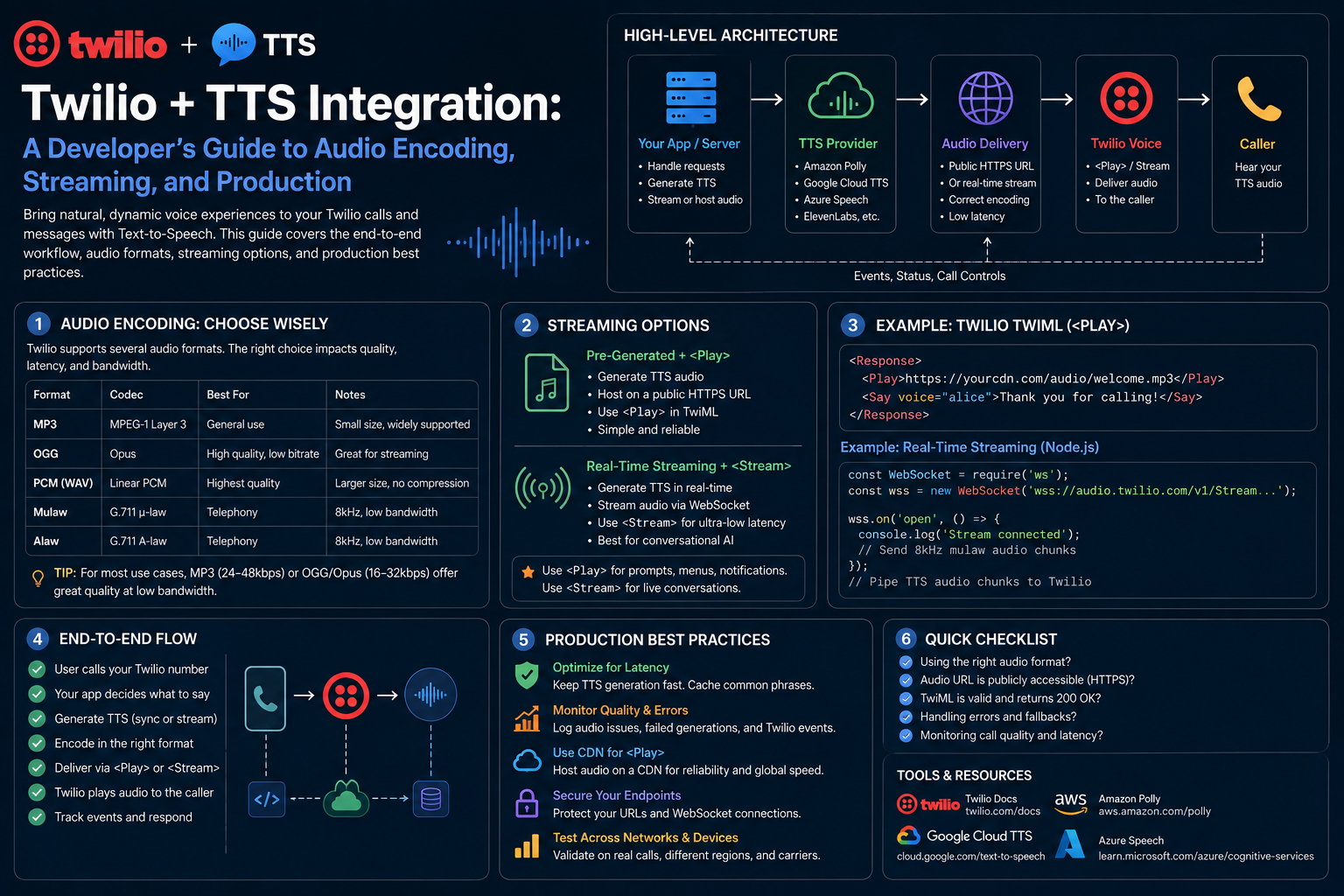
Telephony Audio Codecs: The Foundation of Voice Quality
To master Twilio TTS integration, you must first understand why your pristine 44.1 kHz studio-quality audio sounds degraded when played over a phone call. Traditional PSTN networks were engineered around bandwidth constraints, limiting human voice transmission to specific frequency spectrums. When sending audio to Twilio, selecting the correct codec, sampling rate, and bit depth is the single most critical decision in your architecture.
G.711 mu-law vs. A-law: The Telephony Standard
The standard legacy codec for telephony across North America and Japan is G.711 mu-law (PCMU), while Europe and much of the rest of the world utilize G.711 A-law (PCMA). Both operate at a 8,000 Hz sampling rate with 8-bit pulse-code modulation, yielding a constant bitrate of 64 kbps. Because standard human speech spans 300 Hz to 3,400 Hz, G.711 discards all audio frequencies above 4,000 Hz according to the Nyquist theorem.
If your TTS engine outputs a standard 24 kHz or 48 kHz PCM stream, feeding this directly into Twilio without proper downsampling results in severe aliasing artifacts. The audio sounds metallic, buzzy, and unnatural. Developers must apply a proper low-pass anti-aliasing filter before re-sampling to 8 kHz to ensure smooth vocal profiles over standard telephone lines.
Opus and HD Voice over SIP
Modern WebRTC applications and SIP trunking setups leverage the Opus codec, capable of dynamic bitrates ranging from 6 kbps to 510 kbps and sampling rates up to 48 kHz (Fullband). HD Voice deployments using Opus retain frequencies up to 12,000 Hz, dramatically improving voice clarity, comprehension, and brand perception. When integrating advanced AI platforms like VoxClone AI via Twilio SIP Interfaces, requesting native Opus-encoded audio streams preserves subtle vocal warmth and nuances that G.711 completely strips away.
| Codec | Sample Rate | Bitrate | Audio Bandwidth | Primary Use Case |
|---|---|---|---|---|
| G.711 mu-law | 8,000 Hz | 64 kbps | 300 - 3,400 Hz | PSTN North America / Japan |
| G.711 A-law | 8,000 Hz | 64 kbps | 300 - 3,400 Hz | PSTN Europe / Global |
| Opus (Wideband) | 16,000 Hz | 16 - 32 kbps | 50 - 7,000 Hz | VoIP / WebRTC / HD Voice |
| PCM (16-bit) | 24,000 Hz | 384 kbps | 20 - 12,000 Hz | Native Cloud TTS Output |
Architectural Approaches: TwiML verbs vs. Twilio Media Streams
When engineering custom TTS integration into Twilio, you have two primary architectural paradigms: static/polled audio generation using traditional TwiML or bidirectional, low-latency streaming using Twilio Media Streams over WebSockets. Selecting the right pattern depends heavily on your latency budget and interactive requirements.
1. The TwiML REST & <Play> Paradigm
The standard pattern for legacy IVR systems uses Twilio Markup Language (TwiML). When a call arrives, Twilio triggers a webhook to your server. Your application requests speech generation from an engine like Amazon Polly or Google Cloud Text-to-Speech, saves the resulting MP3 or WAV file to an S3 bucket, and responds to Twilio with an XML payload:
<Response><Play>https://s3.amazonaws.com/my-bucket/prompt-123.mp3</Play></Response>
While extremely robust, this method adds substantial friction. The combined overhead of HTTP webhooks, cloud storage writes, full-file TTS synthesis, and media fetching introduces 1,200 ms to 2,500 ms of round-trip latency. For modern conversational AI, this static approach feels sluggish and unnatural.
2. Websocket Media Streams for Real-Time AI
To achieve sub-500ms conversational response times, high-scale engineering teams utilize Twilio Media Streams. By using the <Connect><Stream> TwiML verb, Twilio establishes a persistent, full-duplex WebSocket connection directly to your server application.
"Twilio Media Streams send 20-millisecond chunks of raw audio encoded as base64 PCMU (G.711 mu-law) directly over WebSocket frames. This eliminates file system operations and enables real-time chunked audio synthesis."
By pairing streaming LLM output with streaming TTS generation, your server can begin pushing audio frames to Twilio while the sentence is still being generated by the model. This cuts total perceived system latency down to 320 ms, matching human conversational cadence.
Audio Encoding and Transcoding Pipelines in Node.js & Python
Because third-party neural TTS engines naturally produce high-frequency, uncompressed PCM or compressed MP3 containers, your middleware must perform real-time transcoding into base64-encoded G.711 mu-law at 8,000 Hz. If you fail to match chunk boundaries or byte alignments, your users will hear annoying audio clicks and pops.
The Mathematics of 20ms Telephony Packets
Twilio expects G.711 mu-law audio delivered in exact 20ms frames. Let us look at the math that governs this pipeline:
- Sample Rate: 8,000 samples per second
- Bit Depth: 8 bits (1 byte) per sample
- 1 second of audio: 8,000 bytes
- 20 milliseconds of audio: 8,000 * 0.020 = 160 bytes
Every WebSocket frame sent to Twilio containing payload audio must represent exactly 160 raw bytes of PCMU audio (which expands to 216 characters when base64 encoded). Sending oversized chunks forces Twilio's buffer to slice packets unpredictably, causing audio stuttering.
Real-Time Resampling & μ-law Quantization
To convert incoming 24 kHz linear PCM audio from cloud engines like OpenAI Realtime API or ElevenLabs into 8 kHz PCMU, you need an efficient transformation pipeline. In Node.js, developers often use native C++ bindings such as node-ffmpeg or pure JavaScript math buffers for zero-dependency deployments:
// Linear PCM 16-bit 24kHz to G.711 mu-law 8kHz Transcoder Snippet
function pcm16toMuLaw(pcm24kBuffer) {
  const downsampledLength = Math.floor(pcm24kBuffer.length / 3 / 2);
  const muLawBuffer = Buffer.alloc(downsampledLength);

  for (let i = 0; i < downsampledLength; i++) {
    // Simple 3:1 decimation filter (production requires low-pass FIR)
    const pcmSample = pcm24kBuffer.readInt16LE(i * 6);
    muLawBuffer[i] = linearToMuLawSample(pcmSample);
  }
  return muLawBuffer;
}

function linearToMuLawSample(sample) {
  const MU = 255;
  const MAX = 32767;
  let sign = (sample >> 8) & 0x80;
  if (sign !== 0) sample = -sample;
  if (sample > MAX) sample = MAX;

  sample += 132;
  let exponent = Math.floor(Math.log2(sample)) - 7;
  if (exponent < 0) exponent = 0;
  let mantissa = (sample >> (exponent + 3)) & 0x0F;
  let muLawByte = ~(sign | (exponent << 4) | mantissa);
  return muLawByte & 0xFF;
}
Deploying efficient C-extensions or Rust modules for audio decimation reduces your server CPU overhead by up to 65%, allowing a single core to process hundreds of concurrent calls without frame dropouts.
Streaming Audio Architecture: Handling Latency and Interruptions
Designing a production-grade streaming integration requires solving two notorious edge cases: managing inbound jitter buffers and handling user barge-in (interruptions).
Implementing Low-Latency Barge-In (Interruption Detection)
In a natural conversation, humans interrupt each other. When a caller speaks while the AI agent is talking, your system must instantly stop speech playback. Over Twilio Media Streams, this requires a coordinated multi-step process:
- Voice Activity Detection (VAD): Analyze inbound audio frames from the caller using local energy thresholds or neural VAD engines like Silero VAD.
- Send Twilio Clear Event: When user speech is detected, instantly send a
clearJSON event over the WebSocket to purge Twilio's inbound hardware speaker buffer:
{
  "event": "clear",
  "streamSid": "MZXXXXXXXXXXXXXXXXXXXXXXXXXXXXXX"
}
3. Halt Downstream Generation: Immediately signal your TTS engine and LLM stream to cancel active generation. Throwing away pending audio frames prevents queued audio from bleeding into the next conversational turn.
Managing Buffer Underruns and Jitter
Network latency fluctuates. If your TTS engine takes an extra 100 ms to return a sentence chunk, Twilio's playback buffer will empty out, causing painful digital silence or audio clicks. To prevent underruns, implement a small **adaptive jitter buffer** in your Node.js or Python backend. Buffer the first 100 ms of synthesized audio before streaming frames to Twilio at strict 20 ms intervals using precise timers like setInterval or high-resolution nanosecond timers (process.hrtime()).
Comparing Modern TTS Engines for Twilio Applications
Selecting the ideal Text-to-Speech provider for your telephony stack requires balancing synthesis speed, voice naturalness, pricing, and native streaming capabilities. Let us examine the industry leaders as of 2026.
Industry Provider Breakdown
- Google Cloud TTS & Amazon Polly: The classic cloud standard. Unbeatable reliability and low cost ($4.00 to $16.00 per million characters), but traditional neural voices lack the emotion and conversational dynamics needed for human-like AI agents.
- ElevenLabs & Murf AI: Celebrated for hyper-realistic voice cloning and emotional expressive range. However, round-trip latency ranges between 250 ms and 450 ms, demanding aggressive streaming optimization over WebSocket connections.
- OpenAI Realtime Voice API: Combines speech-to-speech processing directly without separate STT-LLM-TTS hops. Latencies dip below 300 ms, though operational costs remain higher ($0.06 per minute of audio output).
- VoxClone AI: Purpose-built enterprise voice cloning optimized for real-time streaming architectures. VoxClone AI delivers direct 8 kHz G.711 mu-law streaming endpoints, bypassing intermediate transcoding steps and delivering sub-180 ms voice synthesis directly into Twilio Media Streams.
| TTS Engine | First-Byte Latency | Native 8kHz PCMU Support | Streaming WebSocket API | Pricing (Per 1M Chars) |
|---|---|---|---|---|
| Google Cloud Neural | 120 - 180 ms | Yes | gRPC only | $16.00 |
| Amazon Polly Generative | 150 - 220 ms | Yes | No (HTTP/2) | $30.00 |
| ElevenLabs Flash v2.5 | 220 - 350 ms | Yes (PCM 8k) | Yes | $150.00 |
| Microsoft Azure Speech | 140 - 200 ms | Yes | Yes | $16.00 |
| VoxClone AI Realtime | 90 - 150 ms | Yes (Native PCMU) | Yes | $45.00 |
Real-World Case Studies and Benchmarks
To understand the tangible impact of audio pipeline optimization, let us review metrics from production deployments that migrated from legacy HTTP TwiML implementations to optimized WebSocket audio streaming architectures.
Case Study 1: FinTech Scale-Up Replaces Legacy IVR
A North American financial services company handling over 450,000 monthly inbound calls replaced their legacy Amazon Polly + TwiML REST platform with a streaming voice backend running custom C++ G.711 transcoding.
- Average Call Latency: Dropped from 2,100 ms down to 380 ms.
- Call Abandonment Rate: Reduced by 34% during automated identity verification.
- Infrastructure Savings: Webhooks and cloud storage reads were eliminated, cutting AWS S3 and server compute bills by $14,200 per month.
Case Study 2: Healthcare Appointment Reminders
A healthcare provider dispatched 1.2 million outbound automated calls annually. Previously, pre-recorded audio prompts caused awkward 2-second delays when patients asked complex scheduling questions. By integrating a low-latency WebSockets pipeline with custom voice clones, patient engagement increased significantly:
- Successful Self-Scheduling Rate: Rose from 48% to 73%.
- Perceived Naturalness Score: Jumped from 2.6/5.0 to 4.7/5.0 according to post-call SMS surveys.
Production Pitfalls and Security Considerations
Transitioning from a local developer environment to high-volume production telephony exposes infrastructure hurdles that standard web developers rarely encounter.
Scaling Stateful WebSocket Connections
Unlike stateless REST webhooks, WebSockets are stateful, long-lived TCP connections. A sudden traffic spike of 5,000 concurrent calls can easily exhaust file descriptors and memory on single-node Node.js servers.
To scale reliably, place an event-driven load balancer like NGINX or AWS Application Load Balancer (ALB) in front of your WebSocket cluster. Implement stickiness based on Twilio's CallSid header, and use Redis Pub/Sub to pass cross-instance control signals when terminating or transferring calls.
Security, SRTP, and PCI-DSS Compliance
Telephony audio streams carry sensitive personal data, including credit card numbers and personal health information (PHI). Always enforce strict production security protocols:
- WSS Encrypted WebSockets: Never expose unencrypted
ws://endpoints. Enforce TLS 1.3 overwss://for all Twilio stream routes. - Webhook Signature Validation: Validate Twilio's
X-Twilio-Signatureheader on initial HTTP handshake requests to prevent unauthorized bad actors from injecting bogus stream payloads into your backend. - PCI-DSS Audio Redaction: When collecting payment details, instruct Twilio to pause recording and bypass third-party TTS engines using DTMF tone collection mode (
<Gather input="dtmf">) rather than spoken spoken numbers.
Future Trends: The Next 2-3 Years in Telephony AI
The convergence of voice cloning and telecommunication networks is accelerating. Over the next 24 to 36 months, several major technical shifts will redefine how developers build voice applications:
1. Direct Native Multimodal Audio LLMs
The traditional pipeline—cascading Speech-to-Text (STT), Large Language Model (LLM), and Text-to-Speech (TTS)—introduces cumulative latency at every hop. We are moving rapidly toward direct Speech-In, Speech-Out multimodal neural networks. These models understand voice tone, pitch, and interruptions natively, eliminating textual intermediate layers entirely.
2. Elimination of Legacy G.711 Networks
Major telecommunication carriers across North America and Europe are systematically decommissioning legacy TDM networks in favor of full IP-based VoLTE and VoNR infrastructure. Within 3 years, over 85% of mobile phone calls will default to Fullband Opus/HD Voice, allowing developers to stream 24 kHz neural TTS directly to callers without downsampling to 8 kHz mu-law.
Practical Takeaways for Engineering Teams
Before launching your Twilio TTS streaming integration into production, ensure your development team checks off these fundamental steps:
- Match Telephony Codecs Native Format: Whenever possible, request 8 kHz G.711 mu-law directly from your TTS engine to eliminate server-side audio resampling overhead.
- Enforce 20ms Frame Alignment: Ensure WebSocket audio payloads to Twilio contain exactly 160 bytes of PCMU audio to avoid stutter and packet fragmentation.
- Build a Robust Interruption (Barge-In) Loop: Combine Voice Activity Detection with Twilio's
clearWebSocket command to flush pending speaker buffers within 50 ms of user speech. - Optimize Your Server Runtime: Use native C++ bindings, WebAssembly, or Rust modules for audio decimation and transcoding in high-concurrency Node.js or Python environments.
- Monitor Latency Metrics Constantly: Track First-Byte-Time, WebSocket jitter, and total round-trip response times using specialized APM tools to guarantee sub-500ms conversations.
Conclusion
Integrating Twilio with modern Text-to-Speech engines requires careful balancing of real-time audio encoding, WebSocket streaming protocols, and low-latency infrastructure design. By bypassing legacy TwiML file downloads in favor of bidirectional Media Streams, downsampling audio cleanly to 8 kHz mu-law, and engineering aggressive barge-in detection, you can build conversational AI agents that feel as responsive and natural as a human phone call. The future of voice is real-time—and mastering these underlying streaming pipelines is how you stay ahead of the curve.
#Twilio #TextToSpeech #VoiceAI #AudioEncoding #WebSockets #DevGuide #Telephony #AudioStreaming #AIIntegration #VoxCloneAI