
Transform Regional Content Into Global Experiences Without Language Barriers
By VoxClone AI Team · 2026-05-26
Picture this: a documentary filmmaker in Lagos spends two years creating a powerful film about West African oral traditions. The storytelling is unforgettable. The interviews are raw and human. And almost nobody outside Nigeria ever watches it not because the content lacks quality, but because it speaks only one language in a world that speaks thousands.
This is not a hypothetical. It happens every day to creators, educators, and businesses who produce brilliant regional content that never escapes its linguistic borders. The internet promised to connect the world. Language kept that promise conditional.
That condition is changing fast. AI voice technology including neural text-to-speech, voice cloning, and automated dubbing now makes it possible to take content built for one region and make it feel genuinely native to another, at a fraction of the traditional cost and time. The question is no longer whether you can go global. It's how quickly and how well.
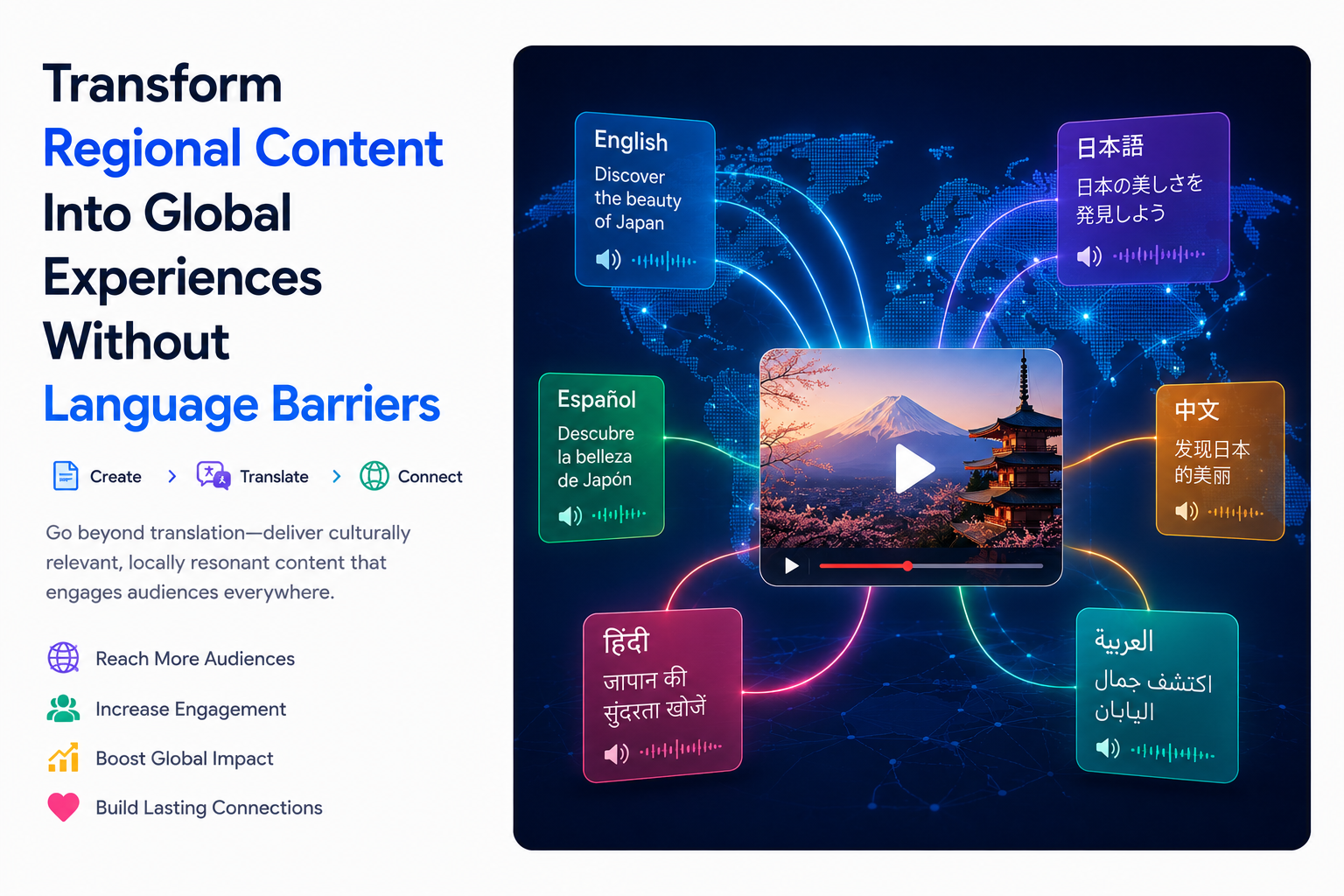
AI-powered voice technology is enabling creators to break language barriers and deliver regional content to global audiences with authentic, natural-sounding localization.
The Scale of the Language Problem in Global Content
Most people assume English dominates the internet. In terms of published content, it does roughly 55% of all websites use English. But here's what that figure misses: only about 25% of the world's population speaks English with any real proficiency. That's a 30-percentage-point gap between the language the internet speaks and the language most of its users actually think in.
A study by Common Sense Advisory found that 65% of consumers prefer content in their native language, even when the quality is lower than available alternatives. That's a striking result. People will accept worse production quality, slower loading, or less polished design as long as the content speaks to them in the language they grew up with.
Who Is Coming Online and What They Want
The next billion internet users are arriving from regions where English is nobody's first language: Southeast Asia, Sub-Saharan Africa, Latin America, South Asia. India alone is adding hundreds of millions of new users who communicate primarily in Hindi, Bengali, Tamil, Telugu, or one of the country's 20+ other scheduled languages.
YouTube's own research shows that creators who add captions or dubbed audio see an average 15% increase in views from international audiences. For some creators the jump is far more dramatic particularly when they move from subtitles to native-language dubbing, which removes the cognitive friction of reading while watching.
The Hidden Cost of Staying Monolingual
Consider what staying monolingual costs in practice. A corporate training team produces 40 hours of e-learning content in English. Their teams in Brazil, Germany, and Japan either skip it, skim translated transcripts, or sit through content they can only partially follow. Knowledge transfer suffers. Safety compliance drops. Productivity stalls.
Traditional localization hiring professional voiceover artists per language, booking studio time, coordinating translations and re-recordings costs anywhere from $1,500 to $4,000 per finished hour of audio content and takes weeks to complete. For a company with 200 hours of training content and teams spread across 8 languages, that arithmetic becomes paralyzing very quickly.
How AI Voice Technology Is Rewriting Localization
The shift happening right now isn't incremental improvement in translation software. It's a structural change in what localization costs, how long it takes, and what quality it delivers. Three technologies are driving this change: neural text-to-speech, AI voice cloning, and automated dubbing pipelines.
Neural Text-to-Speech at Scale
Amazon Polly now offers over 90 voices across 37 languages. Microsoft Azure TTS supports more than 400 neural voices in 140+ languages and locales. Google Cloud TTS provides 380+ voices covering over 50 languages. The quality these platforms produce today would have passed for professional voiceover work as recently as 2020.
Speed is equally transformative. A 30-minute narration that once required a voice actor, a recording session, and post-production mixing can now be generated in under two minutes. That's not a 10% efficiency improvement it's a 99% reduction in production time, and it fundamentally changes which content gets localized and which doesn't.
“The question for content teams is no longer whether AI can produce acceptable voice quality it clearly can. The question is how to build workflows around it that preserve the human judgment that still matters most.” Common perspective across enterprise localization directors
AI Voice Cloning and Speaker Consistency
Neural TTS gives you high-quality generic voices. Voice cloning takes it further: it replicates a specific person's vocal characteristics their timbre, cadence, and emotional expression and applies those characteristics to new content in new languages.
For a brand that has spent years building recognition around a particular spokesperson's voice, this matters enormously. Listeners in Germany or Japan aren't just hearing accurate content they're hearing a voice that sounds like the person they trust, speaking their language. ElevenLabs, one of the leading providers in this space, supports voice cloning across 29+ languages with models that capture not just tone but speaking patterns and emotional range.
Platforms like VoxClone AI are built precisely around this need: giving creators and businesses the ability to clone a voice once and deploy it across languages without losing the authenticity that makes that voice recognizable and trustworthy in the first place.
Dubbing vs. Subtitles: What the Engagement Data Actually Shows
For years, the default approach to making video content accessible across languages was subtitles. Cheap, fast, requiring no audio work. But “accessible” and “engaging” are not the same thing, and the data on how audiences actually behave with subtitled versus dubbed content tells a clear, consistent story.
Completion Rates and Viewer Retention
Netflix has been one of the most systematic collectors of multilingual viewing data, and its findings shaped an aggressive investment in dubbing. Internal research, referenced widely in industry press, showed that dubbed content consistently achieves 20–40% higher completion rates than the same content with subtitles only particularly for long-form series and films.
The cognitive load explanation is intuitive: reading subtitles while processing visuals forces the brain to split its attention in two. Dubbed audio removes that split. For educational content the effect is even more pronounced comprehension testing shows material presented in a viewer's native spoken language outperforms the same material presented with subtitles by up to 35%.
Cultural Connection and Emotional Response
Beyond completion rates there's a qualitative dimension that numbers only partially capture. Language isn't just a delivery mechanism for information it's culturally loaded. The cadence of a sentence, the warmth in a voice, the way emphasis falls on certain words these carry meaning that subtitles can approximate but cannot fully transmit.
Emotional advertising research consistently shows that ads dubbed in a viewer's native language generate significantly higher brand recall and purchase intent than the same ads with subtitles. When a character's voice matches what the viewer expects based on cultural context, the content lands differently and more deeply.
Subtitles vs. Dubbing: Key Comparison | |||
Factor | Subtitles | Traditional Dubbing | AI Dubbing |
|---|---|---|---|
Cost per hour | $50–$300 | $1,500–$4,000 | $50–$400 |
Turnaround time | 1–3 days | 2–6 weeks | Hours to 2 days |
Completion rate lift | Baseline | +20–40% | +15–35% |
Speaker voice consistency | N/A | New actor per language | Same cloned voice |
Scalability across languages | High | Low | Very High |
Building Voice Experiences That Feel Genuinely Local
There's a version of multilingual content that technically works and a version that actually resonates. The gap between them comes down to how well localized audio respects the cultural and linguistic expectations of its audience. Getting the words right is the floor, not the ceiling.
Preserving Tone, Pacing, and Emotional Weight
Direct translation is the easy part. Carrying over tone is the hard part. A motivational speech in English builds energy through rhythm and repetition. Translated word-for-word into Japanese or Arabic, those same words may feel awkward or flat not because the translation is wrong, but because different languages construct emotional impact through different mechanisms entirely.
Good AI voice localization handles this in two layers. First, culturally aware translation (increasingly powered by large language models from OpenAI and Google DeepMind) adapts not just words but phrasing, formality levels, and rhetorical structure. Second, the voice synthesis captures emotional register a rising inflection that signals excitement, a softer delivery that signals intimacy and applies it appropriately to the target language version.
Regional Accents and Dialect Sensitivity
“Spanish” is not one thing. Neither is “Arabic,” “French,” or “Portuguese.” Brazilian Portuguese and European Portuguese are mutually intelligible, but they sound and feel completely different and a Brazilian listener hearing a European Portuguese voice narrating content meant for them will notice immediately.
Microsoft Azure TTS now includes regional variants covering Latin American Spanish, Castilian Spanish, Rioplatense Spanish, and multiple Portuguese dialects reflecting a genuine maturation in how the industry thinks about language. The same sophistication is emerging for Arabic (Modern Standard vs. Egyptian, Gulf, Levantine), French (continental vs. Québécois), and Chinese (Mandarin vs. Cantonese).
For brands operating in these regions, choosing the right dialect is not a technical detail. It's a signal of respect proof that you understand your audience well enough to speak their version of the language, not just any version of it.
When Voice Cloning Makes Cultural Sense
There's an important practical distinction between deploying a generic TTS voice in a new language and cloning a specific human speaker. The latter creates strong continuity the same “person” speaking across markets but it requires informed consent from the original speaker and quality control to ensure the cloned voice handles phonemes it wasn't originally trained on.
When done well, voice cloning enables something subtitles and generic TTS simply cannot: a consistent brand voice that travels globally without fragmenting into different personalities per region. That consistency is itself a form of trust-building.
Real-World Applications: Industries Already Running at Scale
AI voice localization has moved well past the proof-of-concept stage. Across entertainment, education, marketing, and enterprise training, organizations are running full production pipelines with AI-generated multilingual audio. Here's where adoption is most visible and what the numbers show.
Streaming and Entertainment
Netflix's investment in AI-assisted dubbing has been widely reported in the industry. The company now offers content in over 36 languages, with original series from Korea, Spain, Brazil, and Germany routinely reaching top-10 charts in markets where those languages aren't spoken. Squid Game produced entirely in Korean became the most-watched series in Netflix history at the time of its release, with dubbed versions available in more than 30 languages within weeks of launch.
Disney+ and Amazon Prime Video have made parallel multilingual investments, recognizing that subscriber growth in new markets depends on content that feels local to non-English-speaking audiences. Amazon Prime's India expansion specifically demonstrates this: Hindi, Tamil, and Telugu originals now represent a significant portion of South Asian viewer engagement on the platform.
E-Learning and Corporate Training
The global e-learning market is projected to reach $848 billion by 2030. A meaningful portion of that growth depends on multilingual content delivery. Corporate learning management systems at companies like Coursera and LinkedIn Learning are integrating AI voice generation to automatically produce localized audio tracks from English master courses.
Coursera has reported partnerships that include AI-generated audio tracks in Spanish, French, and Portuguese for their most popular courses cutting localization costs by an estimated 60–70% compared to traditional studio production. Course completion rates in Latin America improved measurably after audio dubbing replaced subtitle-only delivery.
Marketing, Advertising, and Brand Content
For global brands running campaigns across 20+ markets, recreating video ads with local voiceover artists for each market used to require months of coordination and budgets only large multinationals could sustain. AI dubbing changes this arithmetic entirely.
Platforms like Murf AI let marketing teams generate localized audio in 20+ languages from a single script, with voice options that match different demographic targets. The result is consistent campaign messaging across markets with production timelines measured in days rather than months and a cost structure accessible to teams that aren't running Fortune 500 budgets.
AI Voice Platforms: Language and Feature Comparison | |||
Platform | Languages | Voice Cloning | Key Strength |
|---|---|---|---|
Amazon Polly | 37 | Limited | Developer API, AWS integration |
Microsoft Azure TTS | 140+ | Yes (Custom Neural Voice) | Enterprise scale, dialect range |
Google Cloud TTS | 50+ | Limited | WaveNet quality, Google ecosystem |
ElevenLabs | 29 | Yes (advanced) | Emotional range, creator tools |
Murf AI | 20+ | Partial | Ease of use, video sync |
VoxClone AI | Multiple | Yes (core feature) | Speaker-consistent multilingual cloning |
The Real Challenges And Honest Solutions
None of this means the transition to AI-driven multilingual voice is friction-free. There are genuine technical, cultural, and ethical challenges that any serious practitioner needs to understand before committing to an AI-first localization strategy.
Lip Sync and Timing in Video Content
Dubbing video content as opposed to audio-only material requires matching spoken audio to on-screen lip movements. This is technically difficult even in traditional dubbing. AI dubbing adds a layer of complexity: generated speech needs to align with original mouth movements formed by speaking a different language with different phoneme structures entirely.
Current state-of-the-art lip-sync AI, including commercial solutions from HeyGen and others, achieves satisfactory alignment in the majority of cases but still struggles with tight close-up shots and rapid speech. The practical solution most production teams adopt is a hybrid approach: AI-generated audio as the foundation, with human review flagging segments that need timing corrections.
Cultural Sensitivity Beyond Translation
Translation accuracy is the minimum requirement. The harder problem is cultural sensitivity ensuring localized content doesn't carry unintended connotations, offensive idioms, or inappropriate references in the target market.
A phrase perfectly acceptable in one cultural context can be confusing or even offensive when translated literally into another language. This is where pure AI pipelines still need human oversight. Localization specialists who understand both the source culture and the target culture remain essential for final review particularly for advertising, content touching on social topics, and anything with political dimensions.
Quality Control at Scale
Running quality control across 15 languages simultaneously is a real coordination challenge. AI-generated audio can produce mispronunciations of proper nouns, brand names, and technical terminology that a general-purpose model hasn't encountered enough of to handle reliably. The solution is custom pronunciation dictionaries most enterprise-grade TTS platforms support them combined with automated phoneme testing before content goes live. A 10-minute human review pass per hour of generated content is realistic for most enterprise workflows and catches the majority of errors before they reach audiences.
The Next Two to Three Years: Where This Is Heading
AI voice localization is already practical and cost-effective today. But the current state is likely to look primitive within 36 months. Several developments currently in research or early commercial deployment are about to change the calculus again.
Real-Time Multilingual Voice
The gap between pre-produced multilingual audio and real-time speech translation is closing rapidly. OpenAI's work on speech-to-speech translation, Google's demonstrated real-time translation capabilities, and Microsoft's Azure speech services are all moving toward sub-second latency translation that preserves original speaker voice characteristics.
The practical implications are significant. Live events conferences, product launches, webinars could be broadcast in 20 languages simultaneously, with each version sounding like the actual speaker. Customer service calls could route seamlessly across language barriers without human interpreters. Real-time voice translation at scale is not a 10-year project; it's a 2–3 year commercial reality in the making.
Hyper-Personalized Localization
Beyond language, the next frontier is personalization within languages. Rather than one dubbed Spanish track serving all Spanish speakers, future systems will generate dynamic versions that adjust for regional dialect, listener age, and individual preference history served in real time from the same underlying content asset.
This kind of personalization is already emerging in text interfaces, where large language models adjust formality and vocabulary based on user signals. Applying the same logic to voice is a natural extension. Content that automatically speaks in your dialect, at a pace you find comfortable, in a voice style you respond to emotionally that's the trajectory the technology is on.
Regulatory and Consent Frameworks
Growth in AI voice capability will be accompanied by growing regulatory attention. The EU AI Act, which took effect in stages through 2024 and 2025, includes provisions directly relevant to synthetic voice and deepfake audio. More jurisdictions are developing specific disclosure requirements for AI-generated voice content particularly in political advertising and news media.
For content creators and businesses, this isn't a threat to the technology it's a prompt to build consent and transparency into workflows now, before compliance becomes a legal requirement rather than a best practice.
Practical Takeaways: Where to Start
If you're looking at this space and wondering how to begin, the barrier to entry is lower than you might expect. Here's a practical framework for moving from intent to implementation.
Audit your highest-value content first. Don't try to localize everything at once. Identify the 10–20% of your content library that drives the most engagement, revenue, or strategic value and start there.
Choose the right tool for your content type. Audio-only content (podcasts, training modules, course narration) is the easiest starting point. Video requires additional lip-sync consideration and review workflows before scaling.
Start with two or three target markets. Pick markets where you have existing audience signals or clear business opportunity. Validate your workflow and quality standards before expanding to 15 or 20 languages.
Build human review into the pipeline from the start. AI generates the audio; humans catch the mispronunciations, cultural missteps, and timing errors. Plan for this review time it's modest but essential.
Establish consent and attribution protocols now. If you're cloning specific voices, document consent clearly. If you're publishing AI-generated audio, be transparent about that in your content metadata both for audience trust and regulatory preparedness.
Measure the metrics that matter. Track completion rates, engagement depth, and conversion behavior in localized markets. These numbers will tell you which languages and content types deliver the best return and guide your next investment decision.
The brands and creators who treat multilingual voice as infrastructure not a one-time project are the ones building sustainable global audience relationships. A dubbed video is a campaign. A localized content system is a competitive advantage.
Conclusion
The language barrier in global content has always been solvable in theory. The problem was cost, time, and scale three constraints that made true multilingual content accessible only to organizations with significant resources. AI voice technology has dismantled all three at once.
What was once a $4,000-per-hour production challenge is now a workflow that completes in hours at a fraction of that cost. What required different voice actors in every market can now be a single cloned voice deployed consistently everywhere. What took weeks of studio coordination now runs as an automated pipeline with human review built in at the final stage.
The creators and businesses that will define global content over the next decade are the ones treating language not as a boundary but as a variable something to be adapted, localized, and personalized at scale. Platforms like VoxClone AI are making that shift practical today, not as a future promise but as something you can build into a real production workflow right now.
Your audience is out there. Most of them don't speak your language but they could hear your voice.
Tags:
#AIVoice #VoiceCloning #TextToSpeech #ContentLocalization #MultilingualContent #AITechnology #GlobalContent #LanguageBarriers #AIAudio #VoxCloneAI #ContentCreation #DigitalLocalization