
The Hidden Costs of Managed Voice Agents: What You're Really Paying For
Published July 29, 2026 · VoxClone AI
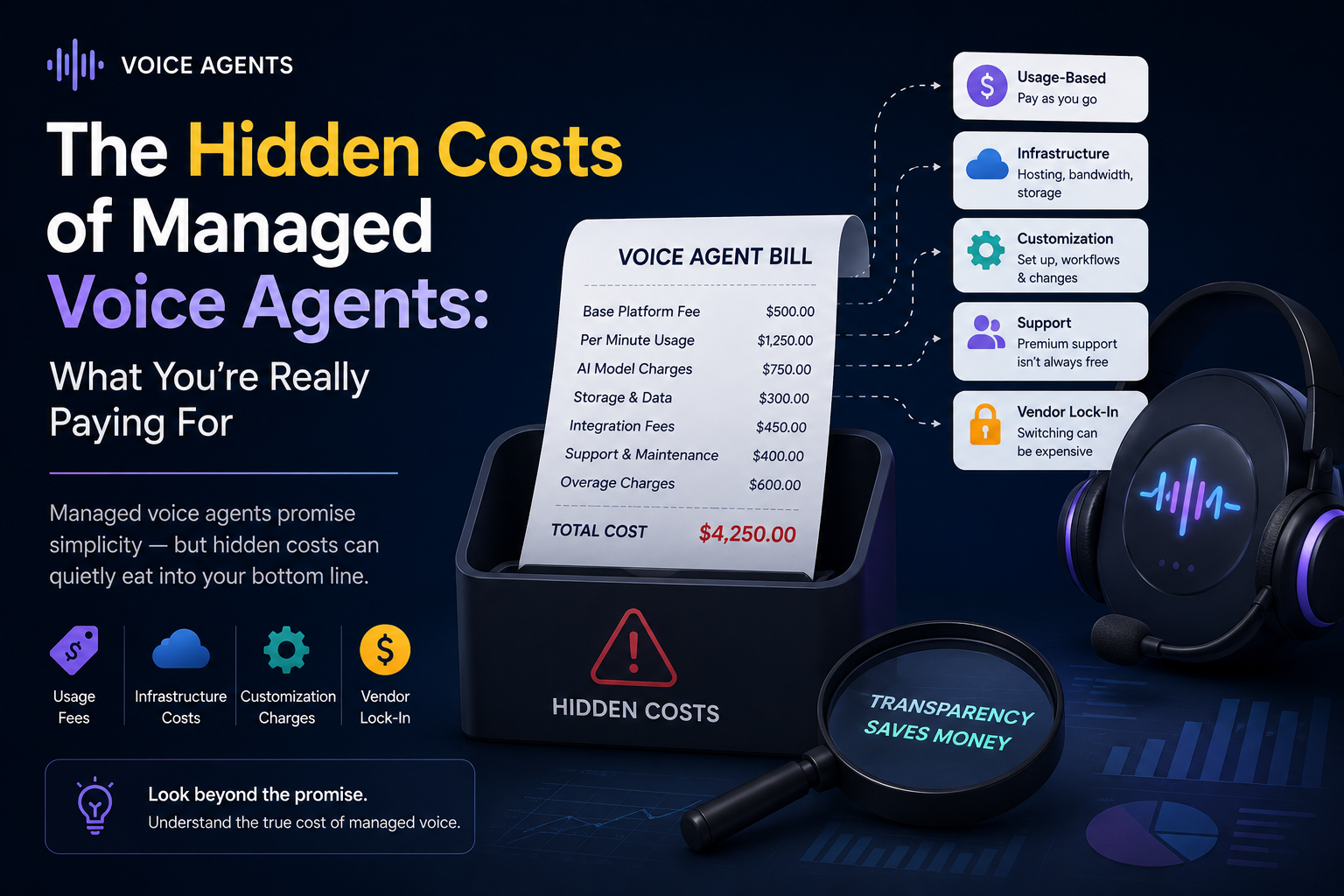
A founder signs up for a managed voice agent platform advertising a clean, simple per-minute rate. The pitch is straightforward: plug in a script, connect a phone number, and let the agent handle customer calls. Three months later, the invoice looks nothing like the pricing page promised, concurrency fees, integration surcharges, per-seat dashboard access, and a data export fee nobody mentioned during the sales call. This isn't a rare story. It's close to the default experience for teams that pick a managed voice agent based on the headline number alone.
Managed voice agents, the fully hosted platforms that handle everything from speech recognition to conversation logic to text-to-speech in one bundled product, have genuinely made it easier to launch a voice AI project without building a pipeline from scratch. But "easier to launch" and "cheaper to operate at scale" are two very different claims, and the gap between them is exactly where the hidden costs live. This article breaks down what you're actually paying for once you look past the per-minute rate on the pricing page.
Background and Context: Why Managed Voice Agents Took Off
The managed voice agent category exploded once large language models got good enough to hold a coherent phone conversation, and speech recognition and synthesis got fast enough to keep up in real time. Platforms bundling all three layers together, transcription, reasoning, and voice output, into a single hosted product removed a huge amount of integration work that used to require an in-house engineering team.
The Appeal of "Just Plug It In"
For a small business or a lean startup, the appeal is obvious. Instead of stitching together a speech-to-text vendor, a language model provider, and a text-to-speech engine, a managed voice agent platform promises a single dashboard, a single bill, and a working phone agent within days rather than months. That speed advantage is real and shouldn't be dismissed, plenty of businesses genuinely don't have the engineering bandwidth to build and maintain a custom voice pipeline, and for them, a managed platform is a legitimate trade of some cost transparency for a working product much faster.
Why the Cost Structure Is Harder to Predict Than It Looks
The trouble is that a fully managed platform bundles several genuinely variable costs, model inference, telephony minutes, concurrency limits, and support, into a single quoted number that only tells part of the story. A per-minute rate is easy to advertise and hard to translate into an actual monthly bill, because call volume, call length, and concurrency all move independently of each other. Companies including Google and Microsoft, both of which offer their own conversational AI building blocks, have long priced components separately for exactly this reason, since bundling variable costs into one flat number tends to understate what heavy users actually pay. A buyer evaluating a single advertised rate has no easy way to see which of these underlying variables is driving the bulk of their eventual bill until several billing cycles have already gone by.
The Pricing Model That Hides the Real Cost
Most managed voice agent pricing pages lead with a single number, a rate per minute of conversation. That number is real, but it's rarely the number that determines your actual bill.
Per-Minute Rate Versus Total Cost of Ownership
A quoted rate of a few cents per minute sounds inexpensive until you multiply it by real call volume and add every adjacent fee the pricing page didn't lead with. A contact center running 5,000 calls a month averaging four minutes each is processing 20,000 minutes, and even a modest per-minute markup compounds fast once concurrency surcharges and add-on fees stack on top.
What's Actually Bundled Into That Rate, and What Isn't
The advertised rate typically covers base transcription and voice generation for a call. It frequently excludes concurrency above a set number of simultaneous calls, custom voice cloning add-ons, advanced analytics dashboards, priority support tiers, and any calls that exceed a monthly volume threshold before dropping into a higher-priced bracket.
Visible Versus Hidden Cost Categories
| Cost Category | Usually Advertised | Often Hidden or Underemphasized |
|---|---|---|
| Base per-minute rate | Yes | No |
| Concurrency overage fees | Rarely front and center | Yes |
| Custom voice cloning add-on | Sometimes | Often priced separately |
| Integration and setup fees | Rarely | Yes |
| Data export or migration fees | Almost never | Yes |
Where the Hidden Infrastructure Costs Actually Come From
Behind every managed voice agent sits a stack of underlying services, and each one has its own cost curve that doesn't always scale linearly with your usage.
Concurrency Limits and Overage Charges
Most platforms cap the number of simultaneous calls included in a base plan, often somewhere between 5 and 20 concurrent conversations, and charge a separate, sometimes steep, fee per additional concurrent line beyond that. A marketing campaign that triggers a sudden spike in inbound calls can push a business well past its included concurrency overnight, generating an unexpectedly large bill for a single busy week. Because concurrency overage is usually billed per line rather than per minute, the cost impact of a single busy day can dwarf what a business expected to pay for an entire month, and it's one of the easiest categories to underestimate when reading a pricing page for the first time.
Telephony Passthrough Fees
Many managed platforms don't own the underlying telephony infrastructure themselves, they resell capacity from carriers and pass those costs through, often with a markup. That passthrough fee is rarely broken out clearly on a pricing page, showing up instead as a slightly higher blended per-minute rate that's harder to audit against what raw telephony would actually cost. A business that later compares its managed voice agent bill against raw carrier rates for the same call volume sometimes discovers the telephony markup alone accounts for a meaningful share of the total, well beyond what a reasonable resale margin would explain.
Underlying Model Inference Costs
The language model powering the agent's conversation logic, whether it's built on infrastructure from OpenAI, Google, or another provider, has its own token-based cost that scales with conversation length and complexity. Longer, more complex conversations quietly cost more to run even at a flat advertised per-minute rate, since the platform is absorbing variable inference costs that don't always track cleanly with call duration alone.
Integration, Maintenance, and the Cost of Keeping an Agent Good
The bill doesn't stop at usage-based fees. Getting a voice agent to actually perform well, and keeping it that way, carries its own ongoing cost.
Setup, Prompt Engineering, and Tuning
A voice agent rarely works well out of the box. Getting conversation flows, tone, and edge-case handling right typically takes weeks of iteration, either from an in-house team or a vendor's professional services group, and that time is billable one way or another, whether as a line item or as internal engineering hours that could have gone elsewhere.
Ongoing Monitoring and Quality Drift
Voice agents degrade in quality over time if nobody's watching, a script that worked well at launch can start failing against new customer phrasing patterns, product changes, or edge cases nobody anticipated. Budgeting for regular review and retuning, rather than treating launch as the finish line, is a cost most teams underestimate until they've already shipped.
Premium Support Tiers
Basic support is usually included, but faster response times, a dedicated account manager, or priority bug fixes are frequently gated behind a higher-priced enterprise tier, one that often isn't visible on the public pricing page at all and only surfaces once a business tries to negotiate a contract.
Vendor Lock-In and Data Portability Costs
Some of the most expensive costs in this category never show up on an invoice at all, they show up the day you try to leave.
Proprietary Conversation Formats
Conversation flows, voice profiles, and call logs built inside a managed platform's proprietary system frequently don't export cleanly to a competitor's format, meaning switching vendors often means rebuilding conversation logic from scratch rather than migrating it.
Voice Profile and Data Portability
If a business has invested in a custom cloned voice for its brand, checking whether that voice profile is portable to another platform, or locked entirely to the vendor that trained it, matters before signing a long contract. Platforms differ significantly here, and it's worth asking directly rather than assuming portability exists. VoxClone AI takes an API-first approach specifically to keep voice assets and usage data exportable, so a switch in provider later doesn't mean starting a custom voice project over from zero.
The Real Cost of an Exit
Migration cost isn't just an engineering line item, it's downtime risk, retraining time for any team members who learned the old platform's interface, and the very real chance that call quality dips during a transition period. Factoring a realistic exit cost into a vendor decision up front is one of the most consistently skipped steps in the buying process.
Real-World Applications and Case Studies
These cost categories stop being abstract once you look at how they actually play out across different business sizes.
A Small Business Scenario
A local service business quoted a rate of roughly 9 cents per minute expects a bill of around 450 dollars for 5,000 minutes of monthly call volume. After concurrency overage during a seasonal spike, a voice cloning add-on for brand consistency, and a support tier upgrade, the actual bill commonly lands 30 to 60 percent higher than that initial estimate, a gap that catches most first-time buyers off guard. That kind of overshoot is rarely the result of any single dramatic fee, it's usually three or four smaller add-ons stacking together across a single billing cycle.
An Enterprise-Scale Scenario
At enterprise volume, tens of thousands of minutes a month, the same hidden cost categories compound at a much larger scale, and companies at this size frequently negotiate custom contracts specifically to convert unpredictable usage-based line items into more predictable committed-volume pricing, trading some flexibility for budget certainty. A committed-volume contract also gives an enterprise buyer real leverage to push back on passthrough fees and support tier gating, leverage that a small business rarely has access to when negotiating against the same standard pricing page.
A Simplified Cost Example, Quoted Versus Actual
| Line Item | Initially Quoted | Often Added Later |
|---|---|---|
| Base minutes (5,000 min at ~9 cents) | ~450 dollars | Baseline, rarely changes |
| Concurrency overage | Not included in quote | Variable, spikes with demand |
| Custom voice add-on | Sometimes a separate quote | Flat monthly fee, common |
| Support tier upgrade | Rarely mentioned upfront | Added after first support ticket |
Questions Worth Asking Before Signing
- What happens to my bill if call volume spikes 3x in a single month?
- Is my custom voice profile portable if I switch providers later?
- What's included in the base support tier, and what triggers an upgrade?
- Are there fees for exporting call logs or conversation data?
- How is concurrency measured, and what's the overage rate per additional line?
Challenges and Solutions
None of this means managed voice agents are a bad choice, it means going in with clear eyes about where the costs actually sit.
Comparing Vendor Quotes Apples to Apples
The single most useful thing a buyer can do is request a full pricing breakdown, not just the headline rate, and run it against a realistic estimate of actual call volume, average call length, and expected concurrency, rather than comparing quoted per-minute rates in isolation.
Considering a Modular, API-First Alternative
For teams with some engineering capacity, building on individual API components, speech-to-text, a language model, and text-to-speech, rather than a single bundled managed platform, can trade some convenience for meaningfully more cost transparency, since each component's pricing is visible and controllable independently rather than bundled into an opaque blended rate. This approach also means you can swap out a single underperforming or overpriced component, say a language model provider that raises prices, without rebuilding your entire voice stack from scratch, which is a real advantage over a fully bundled platform where every layer is tied to one vendor's roadmap and pricing decisions.
Fully Managed Versus API-First: Cost Structure at a Glance
| Factor | Fully Managed Platform | API-First, Modular Stack |
|---|---|---|
| Setup speed | Fast, days | Slower, requires integration work |
| Pricing transparency | Often bundled and opaque | Each component priced independently |
| Vendor lock-in risk | Higher | Lower, components swappable |
| Ongoing engineering need | Minimal | Ongoing maintenance required |
| Best fit | Small teams, fast launch | Teams with engineering capacity, cost-sensitive scale |
Negotiating Leverage Most Buyers Don't Use
Vendors selling managed voice agents generally have more pricing flexibility than the public page suggests, especially for annual commitments or predictable volume. Asking directly for a volume-based discount or a concurrency cap increase at no extra charge is a normal negotiation, not an unusual request, and most sales teams expect it.
Future Trends, Practical Takeaways, and Conclusion
Where Voice Agent Pricing Is Headed
Expect pricing transparency to become more of a competitive differentiator over the next two to three years, as more buyers get burned by surprise invoices and start demanding itemized cost breakdowns before signing. As underlying model inference costs continue falling, following the trend already visible across providers like OpenAI and Google, expect some of that savings to reach customers directly, and expect vendors who pass those savings through clearly to win more enterprise trust than those who quietly keep margins wide behind a flat rate.
Practical Takeaways
- Always request a full itemized pricing breakdown before signing, not just the advertised per-minute rate.
- Model your actual expected concurrency and call volume against the vendor's tier structure before committing to a plan.
- Confirm voice profile and data portability in writing before investing in a custom cloned voice.
- Budget for ongoing tuning and monitoring as a recurring cost, not a one-time setup expense.
- Negotiate, since most vendors have more flexibility on volume pricing and concurrency limits than their public page suggests.
Conclusion
The headline rate on a managed voice agent's pricing page was never meant to be a complete answer, it's a starting point for a conversation you still have to have yourself. Concurrency limits, telephony passthrough, ongoing tuning, and the cost of leaving all sit underneath that single advertised number, and none of them show up until you're already a customer. None of this is a reason to avoid managed voice agents entirely, plenty of businesses genuinely benefit from the speed and simplicity they offer. It's a reason to go in with the right questions ready, rather than discovering the real cost structure one surprise invoice at a time. Ask the itemized questions before you sign, model your real usage pattern against the tier structure, and you'll end up with a bill that actually matches what you were told to expect. If you want to explore a more transparent, API-first approach to voice AI pricing, the VoxClone AI app is available for download on the Google Play Store.
#VoiceAI #VoxCloneAI #HiddenCosts #VoiceAgents #SaaSPricing #AIcosts #VendorLockIn #BusinessStrategy #VoiceTechnology #CostTransparency