Text-to-Speech vs. Voice Cloning: What's the Difference?
You type a sentence, click generate, and a voice reads it back to you. That is text-to-speech. But what happens when you want the result to sound like a particular person rather than a generic synthetic speaker? That is where voice cloning enters the picture.
The two technologies are closely related, which is why they are often treated as the same thing. They are not. Both can turn written language into spoken audio, but they solve different problems. Understanding the distinction helps you choose the right tool for YouTube videos, podcasts, courses, accessibility features, virtual assistants, product demos and real-time applications.
1. Text-to-Speech and Voice Cloning: The Basic Difference
What text-to-speech means
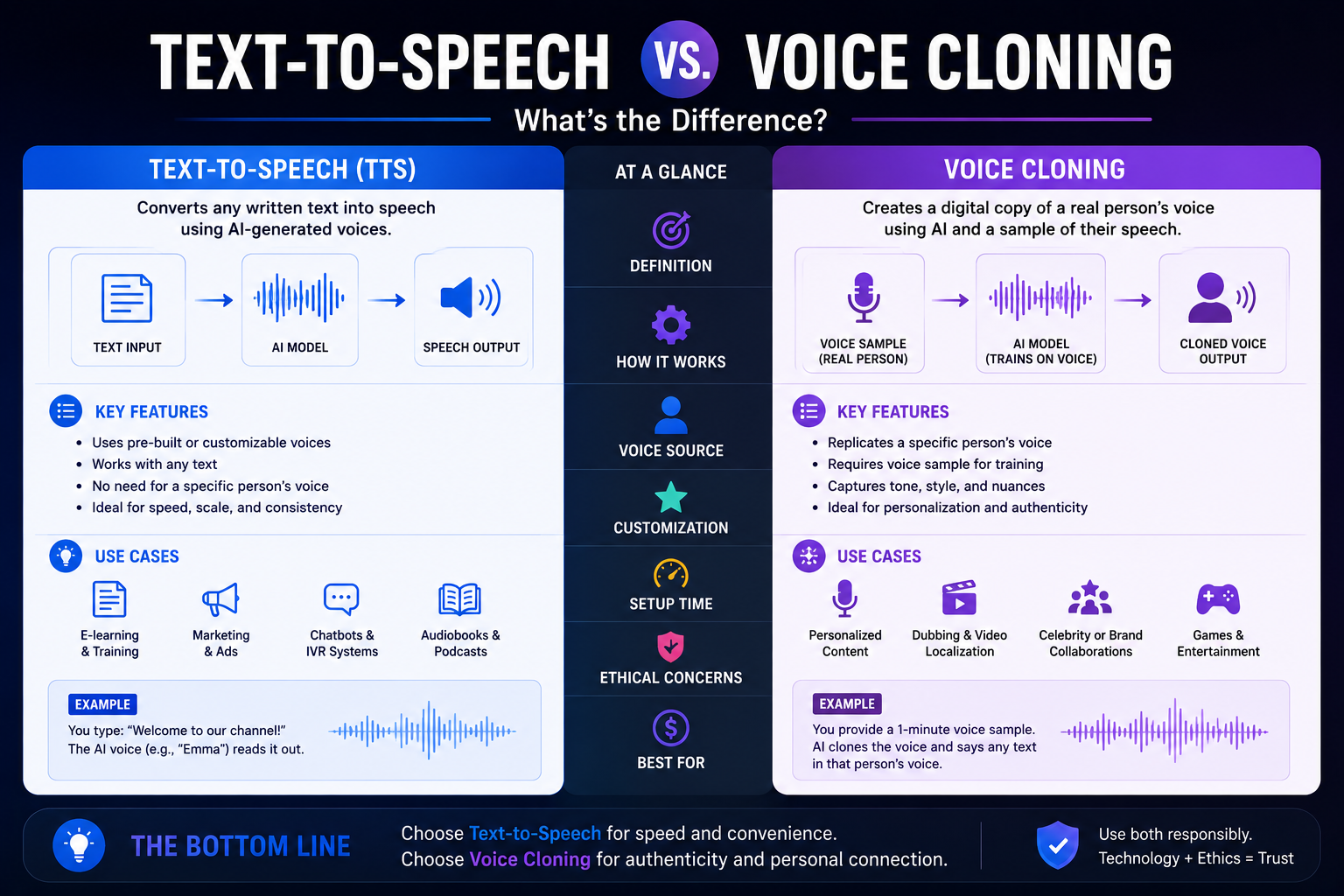
Text-to-speech, or TTS, converts written text into spoken audio. You provide a sentence, paragraph or larger document, and a speech model produces an audio output using a selected synthetic voice.
Modern TTS is far beyond the monotone computer voices associated with older screen readers. Systems from Google Cloud, Microsoft Azure, Amazon Polly, OpenAI, ElevenLabs and other providers can produce speech with natural pacing, pronunciation and expressive characteristics.
What voice cloning adds
Voice cloning adds a specific identity to the process. Instead of selecting only from a preset voice library, you provide an authorized speaker's reference audio and the system generates new speech intended to resemble that speaker.
The text is still converted into speech, but the voice itself is the key difference. You are asking the system not just to say something, but to say it in the characteristics of a particular voice.
An easy analogy
Think of standard TTS as choosing a narrator from a casting list. Voice cloning is closer to creating a reusable digital version of a specific narrator's vocal characteristics.
TTS answers “How can this text be spoken?” Voice cloning adds “Which authorized voice should speak it?”
| Feature | Text-to-Speech | Voice Cloning |
|---|---|---|
| Input | Text | Text plus authorized voice reference |
| Voice selection | Preset or platform-provided voices | A specific authorized speaker |
| Main goal | Generate speech | Generate speech with a recognizable voice identity |
| Typical use | Accessibility, apps, narration | Personal narration, branded voices, content production |
Voice cloning is not a replacement for TTS. It is a way of making generated speech more closely tied to a particular voice.
2. How Text-to-Speech Works
From characters to sound
A modern TTS system takes written language and predicts how it should be spoken. Behind the scenes, the system has to handle words, punctuation, pronunciation, timing and acoustic characteristics before producing an audio waveform.
The technical architecture differs by provider, but the basic user experience remains simple: text goes in, speech comes out.
Why modern TTS sounds more natural
Newer speech models can represent much more than individual words. They can learn patterns associated with pauses, emphasis, rhythm and conversational delivery. That is why modern synthetic voices can sound dramatically different from early computer-generated speech.
For example, a question should not necessarily be delivered with the same rhythm as a statement. A well-designed speech system can account for punctuation and linguistic context when producing the audio.
Where standard TTS is especially useful
- Reading websites and documents aloud.
- Creating narration for videos.
- Generating audio notifications.
- Building conversational applications.
- Producing educational material.
- Supporting accessibility features.
- Generating spoken content at scale.
Real numbers help explain the scale
Suppose an application needs to generate 10,000 short spoken notifications. Recording each message manually would be impractical. A TTS system can generate them programmatically from text.
If each notification averages 20 words, the total is 200,000 words. This illustrates one of TTS's biggest advantages: speech can be generated from structured text without recording every variation.
3. How Voice Cloning Works Differently
The reference voice is the important ingredient
Voice cloning begins with audio from an authorized speaker. The system analyzes the recording and learns a representation of characteristics that make the voice recognizable.
The exact process varies by model, but the resulting system can use the voice representation alongside new text to synthesize speech that aims to preserve the speaker's vocal identity.
Why reference quality matters
A voice model can only work with the information present in its reference material. If the recording contains heavy echo, background conversation or inconsistent microphone distance, the result may be less convincing.
You do not necessarily need a professional studio. A quiet room and clean speech can be more valuable than an expensive microphone used in a noisy environment.
Cloning does not mean copying an old recording
This distinction is important. If you have a recording of someone saying “Welcome to the channel,” voice cloning is not simply cutting that sentence and rearranging it. The purpose is to generate new speech that was not present in the original recording.
Consent is part of the technology
Voice cloning should only be used with an authorized speaker. Your own voice is the clearest example. If another person is involved, obtain explicit permission and understand the applicable terms before generating or publishing cloned speech.
A realistic voice is powerful precisely because listeners can associate it with a real person. That makes consent and transparency essential.
4. Text-to-Speech vs. Voice Cloning: A Practical Comparison
Which technology should you choose?
The answer depends on what you are trying to accomplish. If you simply need a clear, natural narrator, standard TTS may be all you need. If you need the same recognizable speaker across dozens or hundreds of pieces of content, voice cloning may make more sense.
| Requirement | Better starting point | Reason |
|---|---|---|
| Generic narration | TTS | Preset voices are sufficient |
| Personal brand voice | Voice cloning | A consistent speaker identity matters |
| Accessibility reader | TTS | Fast, scalable speech generation |
| Creator's recurring narration | Voice cloning | Reusable voice identity |
| Large automated notification system | TTS | Many text variations can be generated automatically |
Speed, control and consistency
Both approaches can be fast. The difference is what you want to control. TTS gives you control over which synthetic voice speaks. Voice cloning gives you an additional layer of control over voice identity.
A useful decision rule
Ask one question: Does the identity of the speaker matter? If the answer is no, start with standard TTS. If the answer is yes and you have permission to reproduce that voice, investigate voice cloning.
5. Real-World Applications and Numbers
YouTube channels
Consider a creator publishing three videos each week. That is approximately 156 videos per year. With standard TTS, the creator can select a consistent synthetic narrator. With voice cloning, the creator can potentially maintain a voice based on their own authorized recording.
Online education
A course with 40 lessons at 15 minutes each contains 600 minutes, or 10 hours, of finished narration. If only 5% of the course needs updating later, that still represents 30 minutes of speech that may need to be recreated.
For a cloned voice workflow, updating individual sections can be easier than coordinating a new recording session and trying to match the original voice, room and microphone setup.
Customer and product applications
Suppose an application generates 50,000 short audio responses per month. If each response averages 12 words, the system produces approximately 600,000 words of speech per month.
At that scale, automated TTS is much more practical than human recording. Voice cloning can become relevant when the application requires a recognizable branded or authorized personal voice.
Audiobooks and articles
A 60,000-word manuscript is a significant recording project. Synthetic speech can reduce the amount of manual studio time required to create an audio version. The final quality still depends on pronunciation, pacing, editing and the selected voice.
Multilingual content
Google, Microsoft, Amazon and specialist providers offer multilingual speech capabilities. If a company produces the same 10-minute training video in 8 languages, that is 80 minutes of final narration for a single lesson.
At 20 lessons, the total becomes 1,600 minutes, or 26.7 hours of localized audio. Automated speech can make that kind of expansion more manageable, although human language review remains valuable.
6. Comparing Major AI Voice Approaches
Cloud TTS platforms
Google Cloud Text-to-Speech, Microsoft Azure Speech and Amazon Polly are examples of large cloud speech platforms. They are especially useful when developers need APIs, application integration, language options and scalable infrastructure.
Creator-focused voice platforms
ElevenLabs and Murf are examples of platforms commonly associated with creator and production workflows. Their feature sets can include expressive voices, voice creation, editing and multilingual capabilities.
Voice cloning platforms
Platforms focused on voice cloning place more emphasis on creating or reproducing a specific authorized voice. VoxClone AI is positioned around AI voice cloning and text-to-speech workflows for creators and other users who want reusable generated voices.
| Option | Primary strength | Best question to ask |
|---|---|---|
| Google Cloud TTS | Cloud speech infrastructure | How well does it fit my application architecture? |
| Microsoft Azure Speech | Enterprise speech services | What enterprise controls do I need? |
| Amazon Polly | AWS integration | Does it fit my AWS workflow? |
| ElevenLabs | Expressive creator-oriented voices | How natural and controllable is the voice? |
| Murf | Voice production workflow | How quickly can I edit and produce content? |
| VoxClone AI | Voice cloning and TTS | Can I create a reusable voice for my workflow? |
7. Common Mistakes, Challenges and Practical Solutions
Mistake: assuming every TTS voice is a voice clone
A preset synthetic voice is not automatically a clone of a real person. If you need a specific speaker identity, check whether the platform actually supports voice cloning and what authorization requirements apply.
Mistake: using poor reference audio
For cloning, noisy reference material can make the job harder. Record clearly, reduce environmental noise and maintain consistent microphone distance.
Mistake: ignoring pronunciation
Test the words that matter most to your audience. A technology channel should test product names and acronyms. A medical channel should test specialist terminology. A local business should test street names and regional terms.
Mistake: choosing technology before defining the job
Do not start by asking which platform has the longest feature list. Start with the content problem. Do you need 100,000 automated messages? A consistent YouTube narrator? An accessibility reader? A branded voice for a virtual assistant?
Choose the voice technology around the job you need done, not the other way around.
Privacy, consent and disclosure
Voice data can be sensitive. Before uploading a recording, review how the provider stores, processes and deletes voice data. When using another person's voice, obtain clear permission. For public-facing synthetic media, consider whether disclosure is appropriate or required by the platform or applicable rules.
8. What Happens Next: The Two-to-Three-Year Outlook
TTS will become more conversational
The next generation of speech systems is likely to focus increasingly on context. Instead of simply producing correctly pronounced words, systems will need to choose appropriate pauses, emphasis and delivery based on the meaning of the conversation.
Voice identity will become more controllable
Voice cloning is likely to move toward finer control over characteristics such as speaking style, pace and emotional intensity, while maintaining a stable underlying voice identity.
Real-time voice interaction will grow
Speech systems are increasingly being used in assistants, customer support and interactive applications. Lower latency will make it easier for users to interrupt, respond and continue a conversation naturally.
The boundary between TTS and voice cloning will become less obvious
Future systems may combine preset voices, custom voice identities, style controls and real-time generation in one workflow. For users, the distinction may become less about separate products and more about which controls are available for the voice they choose.
The future is likely to give users both sides of the equation: control over what is said and much finer control over who it sounds like.
9. Practical Takeaways: Which One Should You Use?
Choose TTS when
- You need a clear synthetic narrator.
- You are generating large amounts of automated speech.
- You are building an accessibility feature.
- You need speech inside an application.
- The identity of the speaker is not central to the experience.
Choose voice cloning when
- You want a reusable version of your own voice.
- Your brand depends on a recognizable narrator.
- You publish frequent videos or courses.
- You need to revise narration without rerecording everything.
- You have clear authorization to reproduce the target voice.
Use both when necessary
You do not have to pick one technology for every project. A company might use standard TTS for automated notifications and a cloned brand voice for marketing videos. A creator might use a preset voice for experiments and a personal clone for their main channel.
10. Conclusion: TTS Generates Speech, Voice Cloning Adds Identity
The difference between text-to-speech and voice cloning becomes straightforward once you separate speech generation from voice identity.
TTS turns text into spoken audio using a selected synthetic voice. Voice cloning takes that same basic speech-generation idea and adds a reference voice, allowing new speech to be generated with characteristics associated with an authorized speaker.
Neither approach is automatically better. TTS is ideal for scalable narration, accessibility, applications and situations where the narrator's identity is not important. Voice cloning is valuable when consistency and a recognizable personal or branded voice matter.
The right choice depends on your actual workflow. Start with the job, test a few representative sentences, check pronunciation and quality, and pay attention to privacy and consent. Once you know whether you need a narrator or a recognizable voice identity, the decision becomes much easier.
Hashtags
#TextToSpeech #VoiceCloning #AIVoice #VoiceAI #TTS #GenerativeAI #SpeechAI #AIAudio #ContentCreation #YouTubeCreators #VoiceTechnology #VoxCloneAI