
Named Entity Recognition for Voice: Turning Speech Transcripts Into Structured Data
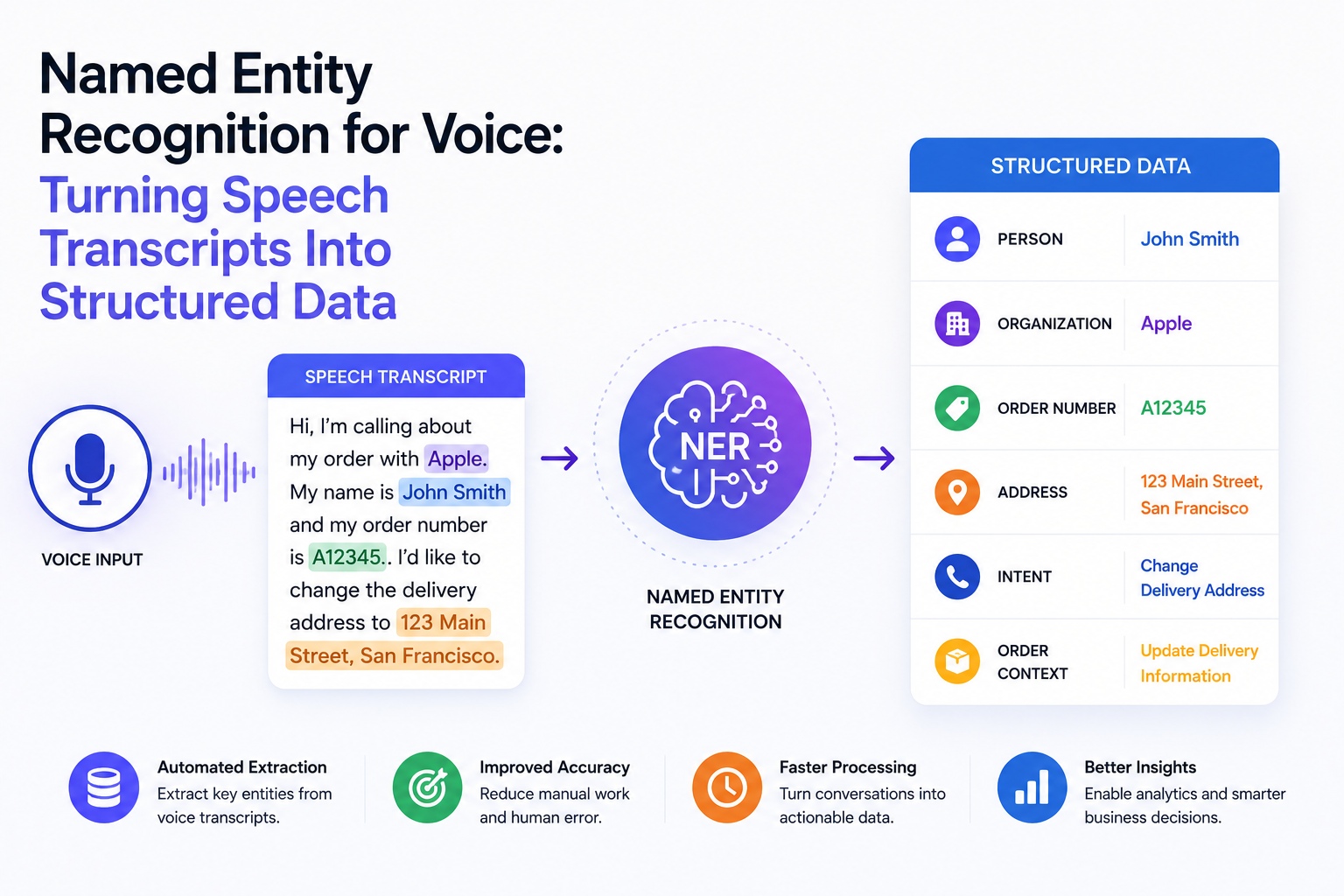
A customer calls a logistics company and says: "Hi, this is Maria Chen calling about shipment 884271, it was supposed to arrive in Austin on the 14th but it's still showing as in transit from the Memphis facility." To a human listener, that sentence is immediately useful. To a computer that has only transcribed the audio into text, it is just a string of characters. The gap between "we have a transcript" and "we have data we can act on" is exactly what Named Entity Recognition closes.
Every voice AI system that does something useful with a conversation, beyond simply playing it back, depends on extracting structured information from unstructured speech. Names, dates, locations, account numbers, product names, monetary amounts, all of these need to be identified and pulled out of the raw transcript before any downstream system can use them. This process, Named Entity Recognition (NER), is one of the least visible but most consequential components of the modern voice AI stack.
This article explains what NER actually does, how it works for voice specifically (which is different from NER for written text in important ways), where it delivers the clearest business value, and what the current limitations and future directions look like for anyone building or evaluating voice AI systems that need to turn conversations into data.
What Named Entity Recognition Actually Does
Before getting into voice-specific considerations, it is worth being precise about what NER is and what it is not, because the term gets used loosely in marketing materials.
Defining Entities and Entity Types
Named Entity Recognition is the task of identifying spans of text that refer to specific real-world objects and classifying them into predefined categories. The standard entity types used across most NER systems include PERSON (names of individuals), ORG (organizations and companies), GPE (geopolitical entities like cities and countries), DATE, TIME, MONEY, and PRODUCT. Domain-specific NER systems extend this with custom entity types: a healthcare NER system might add MEDICATION, DOSAGE, and SYMPTOM. A logistics system might add TRACKING_NUMBER and FACILITY.
In the customer service example from the introduction, a well-tuned NER system applied to that transcript would identify: "Maria Chen" as PERSON, "884271" as TRACKING_NUMBER, "Austin" as GPE (destination), "the 14th" as DATE, and "Memphis" as GPE (origin facility). That extraction transforms an unstructured sentence into a structured record that a logistics system can query, route, and act on automatically.
NER vs. Intent Classification vs. Sentiment Analysis
NER is often discussed alongside other NLP tasks, and the distinctions matter for understanding what each component contributes. Intent classification determines what the speaker wants ("check order status", "file a complaint"). Sentiment analysis determines the emotional tone of the speech. NER extracts the specific factual details, the who, what, where, and when, regardless of intent or sentiment. A complete voice AI system typically runs all three in parallel: intent tells the system what to do, sentiment tells it how urgently or carefully to do it, and NER provides the specific data needed to actually do it.
Why This Matters More Than It Might Seem
A voice AI system that transcribes a call accurately but fails to extract the tracking number, the date, or the customer's name has produced a transcript that still requires human reading to be useful. NER is what makes the difference between "we recorded the call" and "the call automatically updated the customer's record, created a follow-up task, and flagged the shipment for expedited handling". McKinsey's 2024 analysis of AI-driven process automation found that structured data extraction from unstructured sources accounts for over 60% of the value in voice AI automation projects, more than the conversational AI components themselves.
"A transcript is a record of what was said. Structured data extracted through NER is something a computer can act on. That distinction is the difference between voice AI that documents and voice AI that automates."
Why NER for Voice Is Different From NER for Text
NER has existed as an NLP research area for decades, originally developed and refined on written text: news articles, documents, web pages. Applying it to voice transcripts introduces challenges that text-trained NER systems do not encounter.
Speech Recognition Errors Cascade Into NER Errors
NER for voice operates on the output of an ASR system, and any errors in that transcription propagate directly into entity extraction errors. If an ASR system transcribes "884271" as "884 to 71" or mishears "Memphis" as "Memphys", the NER system either fails to recognize these as entities at all, or extracts them incorrectly. This is fundamentally different from text-based NER, which operates on input that, while it might contain typos, does not have the systematic acoustic confusion errors that speech recognition introduces (numbers and similar-sounding words being the most common culprits).
Research from Amazon Science published in 2023 found that NER accuracy on ASR transcripts was 12 to 18 percentage points lower than NER accuracy on the same content when transcribed by a human, even when overall ASR word error rate was below 5%. The errors are not evenly distributed: they concentrate heavily on exactly the kinds of entities that matter most, names, numbers, and addresses, because these are the words ASR systems are most likely to get wrong.
Lack of Punctuation and Capitalization Cues
Written text NER systems rely heavily on capitalization ("Maria Chen" vs. "maria chen") and punctuation (commas, periods marking sentence and phrase boundaries) as signals for entity boundaries. Raw ASR output often lacks both, or includes them inconsistently based on the ASR system's punctuation prediction model, which is itself imperfect. NER systems designed for voice transcripts need to be either trained on data that reflects this lack of formatting, or paired with a punctuation restoration step before NER runs, adding another stage to the pipeline where errors can be introduced.
Disfluencies and Natural Speech Patterns
People do not speak the way they write. Real speech is full of disfluencies: "um", "uh", false starts, repetitions, and self-corrections ("it was, uh, shipment, sorry, order 884271, not 884272"). A text-based NER system trained on clean written sentences has never seen this pattern and may extract "884272" as the entity when the speaker actually corrected themselves to "884271". Voice-specific NER systems need training data that includes these natural speech patterns and need to handle self-correction as a specific linguistic phenomenon, recognizing that the corrected value, not the first-mentioned value, is the one that matters.
| Challenge | Text NER | Voice NER |
|---|---|---|
| Input errors | Typos, rare | ASR errors, systematic on names/numbers |
| Capitalization cues | Reliable | Often absent or predicted (unreliable) |
| Disfluencies | Rare, mostly absent | Common: repetitions, self-corrections |
| Number formatting | Digits as written | Spoken forms ("eight eight four") |
| Real-time requirement | Usually batch | Often streaming, low latency |
How Modern Voice NER Systems Work
The technical approaches to NER have evolved substantially, and the current generation of systems looks quite different from the rule-based and statistical approaches that dominated a decade ago.
From Rule-Based Systems to Transformer Models
Early NER systems relied heavily on hand-crafted rules and gazetteers: lists of known names, places, and organizations that the system would match against. These approaches were brittle, they could not recognize entities not in their lists, and they required constant manual maintenance. Statistical models using Conditional Random Fields (CRFs) improved on this by learning patterns from labeled training data, but still required substantial feature engineering.
The current generation of NER systems is built on transformer-based language models. Models like BERT and its successors, fine-tuned on entity-labeled data, achieve dramatically higher accuracy than previous approaches because they understand context: the same word can be recognized as different entity types depending on surrounding words, something rule-based systems could never handle. spaCy, an open-source NLP library widely used for production NER, reports F1 scores above 90% on standard English NER benchmarks using transformer-based models, compared to F1 scores in the 70s for older statistical approaches on the same benchmarks.
LLM-Based Entity Extraction
Large Language Models have introduced a different approach entirely: rather than training a dedicated NER model, you prompt an LLM to extract entities directly, often specifying a custom schema in the prompt itself. This approach, sometimes called zero-shot or few-shot entity extraction, allows extraction of custom entity types without training a dedicated model for each new type. OpenAI's GPT-4 and similar models can extract entities like "insurance policy number" or "preferred delivery window" from a transcript simply by being asked to, without any task-specific training data.
The tradeoff is computational cost and latency. Dedicated NER models are small, fast, and cheap to run at scale. LLM-based extraction is more flexible but more expensive per call and typically higher latency. Production systems handling high call volumes often use dedicated NER models for common, well-defined entity types (names, dates, standard identifiers) and reserve LLM-based extraction for less common or highly variable entity types where the flexibility justifies the cost.
Voice-Specific Normalization
A critical step specific to voice NER is entity normalization: converting spoken forms into canonical structured forms. "Eight eight four two seven one" needs to become "884271". "The fourteenth of next month" needs to become a specific calendar date. "Five hundred dollars" needs to become "500.00" in a currency field. This normalization step is often more error-prone than the entity recognition itself, because spoken number and date formats are highly variable, and getting normalization wrong produces an entity that was correctly identified but incorrectly represented, which can be just as useless as not extracting it at all.
Real-World Applications: Where Voice NER Drives Measurable Value
NER for voice is not an academic exercise. Across industries, it is the technology that turns call recordings into operational data that drives real decisions.
Contact Center Analytics and Compliance
Contact centers process enormous volumes of calls, and NER applied at scale to call transcripts enables analytics that would be impossible through manual review. Extracting product names, competitor mentions, pricing discussions, and complaint categories across millions of calls allows organizations to identify trends, compliance issues, and emerging customer concerns in near real time. NICE and Verint, two leading contact center analytics platforms, both build their compliance monitoring and customer experience analytics on NER pipelines applied to call transcripts. A retail bank using this kind of analytics can detect, within days rather than months, that a specific product is generating an unusual volume of complaints mentioning a particular feature, information that would take much longer to surface through traditional reporting.
CRM Automation in Sales Calls
As covered in the broader context of voice AI and CRM integration, NER is the specific technology that extracts the structured fields, company names, deal sizes, decision timelines, competitor names, that populate CRM records automatically after a sales call. A 2024 analysis of sales conversation intelligence platforms found that automated entity extraction reduced manual CRM data entry time by 68% for sales teams using these tools, with the largest time savings coming from extraction of deal-specific numbers and dates that previously required reps to manually transcribe from memory or notes.
Healthcare Documentation
Clinical NER, applied to transcripts of patient encounters, extracts medications, dosages, symptoms, diagnoses, and follow-up instructions into structured fields that populate electronic health records. This is a higher-stakes application of the same underlying technology, where extraction accuracy directly affects clinical documentation quality. Specialized clinical NER systems, including those used by Nuance Dragon Medical and ambient documentation vendors like Abridge, are trained on medical vocabulary specifically because general-purpose NER systems significantly underperform on drug names, dosage units, and anatomical terminology that rarely appear in general training data.
Logistics, Insurance, and Field Service
Industries with heavy phone-based operations, logistics dispatch, insurance claims intake, field service scheduling, all benefit from NER that extracts the domain-specific identifiers central to their operations: tracking numbers, policy numbers, claim numbers, addresses, and appointment times. The example at the start of this article, a shipment tracking inquiry, represents exactly this category. Insurance companies processing claims via phone use NER to extract policy numbers, incident dates, and damage descriptions directly into claims management systems, reducing the time from initial call to claims processing initiation. A 2024 insurtech industry report found that automated entity extraction from claims calls reduced average claims intake processing time from 12 minutes to under 3 minutes for straightforward claims.
Building or Buying: Platform Comparison
Organizations building voice AI systems that need NER capability face a choice between building custom extraction pipelines and using platform-provided NER services. Here is how the major options compare.
Cloud Provider NER Services
Google Cloud Natural Language API, Amazon Comprehend, and Microsoft Azure AI Language all offer pre-built NER services that recognize standard entity types out of the box and support custom entity training for domain-specific needs. These services integrate naturally with the same providers' speech-to-text offerings, simplifying the pipeline architecture. Amazon Comprehend Medical, a specialized variant, is specifically tuned for clinical entity extraction, recognizing medications, dosages, and medical conditions with accuracy substantially higher than general-purpose NER on this content.
Open-Source NLP Libraries
spaCy and Hugging Face Transformers provide open-source NER models that can be self-hosted, fine-tuned on custom data, and run without per-call API costs. This approach requires more engineering investment, including infrastructure for model serving and ongoing maintenance, but eliminates the variable per-call costs of cloud APIs and keeps all processing within an organization's own infrastructure, which can be a meaningful consideration for organizations with data residency requirements.
LLM-Based Custom Extraction
For organizations needing highly customized entity types that change frequently, LLM-based extraction through APIs from OpenAI, Anthropic, or Google offers the fastest path to a working extraction pipeline without training data collection or model training cycles. The custom entity schema is defined in the prompt and can be modified instantly, compared to weeks for retraining a dedicated model. The cost and latency tradeoffs discussed earlier apply, making this approach best suited for lower-volume, high-variability use cases rather than high-volume, well-defined extraction tasks.
| Approach | Setup Speed | Per-Call Cost | Custom Entity Flexibility | Best For |
|---|---|---|---|---|
| Cloud provider NER (Comprehend, Azure AI Language) | Fast | Low to medium | Medium (custom training supported) | High-volume, standard entity types |
| Open-source (spaCy, Hugging Face) | Slow (build and tune) | None (infrastructure cost only) | High (full control) | Data residency, very high volume |
| LLM-based extraction (GPT-4, Claude) | Very fast | High | Very high (prompt-defined) | Low to medium volume, high variability |
Challenges and How Organizations Address Them
NER for voice has matured significantly, but real implementations still encounter consistent challenges that are worth understanding before deployment.
Domain Vocabulary Gaps
General-purpose NER models are trained on broad text corpora that may underrepresent industry-specific terminology: product names, internal codes, regional place names, and jargon specific to an organization. A NER system that has never seen your product catalog will not reliably extract product names from customer calls about those products. The solution is custom entity training, providing labeled examples of domain-specific entities so the model learns to recognize them. Amazon Comprehend and Azure AI Language both support custom entity recognition training with as few as a few hundred labeled examples per entity type, though accuracy improves substantially with larger labeled datasets.
Ambiguity and Context-Dependent Entities
The same word can be different entity types depending on context. "Washington" could be a person's surname, a state, or a city. "Apple" could be the company or the fruit. NER systems use surrounding context to disambiguate, but this is exactly where the systematic ASR errors discussed earlier compound the problem: if the surrounding context words are also misrecognized, the disambiguation signal that NER relies on is degraded along with the target entity itself.
Multilingual and Code-Switching Speech
NER for languages beyond English has historically lagged significantly, and the gap widens further for voice transcripts. Code-switching, where speakers mix languages within a single conversation, common in multilingual markets like India, is a particularly difficult case: a speaker might say a sentence primarily in Hindi but use English for a product name or a number, and NER systems need to handle this mixed-language input correctly. Organizations operating in multilingual markets should specifically test NER accuracy on code-switched speech samples representative of their actual call patterns, since general benchmark numbers for individual languages do not reflect this real-world complexity.
Privacy Considerations in Entity Extraction
NER systems that extract names, account numbers, and other identifying information are, by definition, working with personal data. For organizations subject to privacy regulations, the NER pipeline itself becomes part of the compliance scope: where does extracted entity data get stored, who can access it, and how does it get incorporated into retention and deletion policies. Redaction-focused NER, a specific application where the goal is to identify and remove or mask PII rather than extract it for use, is increasingly common as a privacy safeguard layered on top of standard NER pipelines, particularly for call recordings that need to be retained for quality assurance but should not expose customer PII to every reviewer.
Future Trends: Voice NER Through 2028
The trajectory for voice NER follows the broader trends in voice AI: tighter integration with end-to-end models, improved multilingual capability, and expansion into more specialized domains.
End-to-End Models That Skip the Separate NER Step
The traditional pipeline (audio to transcript to NER to structured data) involves multiple stages, each with its own error rate. Emerging end-to-end models aim to go directly from audio to structured output, potentially avoiding the error compounding that occurs when ASR errors propagate into a separate NER stage. OpenAI's GPT-4o demonstrated audio-native processing that can, in principle, extract structured information directly from audio without an intermediate text transcript. Whether this approach ultimately outperforms the pipeline approach for entity extraction specifically is still an open research question, but the architectural trend toward unified audio-to-output models is clear.
Real-Time Entity Extraction at Conversation Speed
Current production systems often run NER as a post-call batch process. The next development is real-time entity extraction during live conversations, enabling use cases like real-time agent assist (surfacing a customer's account information the moment they state their account number) and live compliance monitoring (flagging when a prohibited term or a required disclosure trigger is mentioned, in real time during the call). This requires NER models fast enough to run on streaming partial transcripts with acceptable latency, an area of active development as streaming ASR and streaming NLP architectures mature together.
Self-Improving Extraction Through Feedback Loops
As organizations deploy NER pipelines and review their outputs (correcting misextracted entities, confirming correct ones), this feedback represents valuable training data for improving the models over time. Expect more voice AI platforms to build explicit feedback loops where human corrections to extracted entities automatically feed back into model fine-tuning, creating systems that improve specifically on the entity types and speech patterns most relevant to each organization's actual call volume, without requiring a separate, manually managed retraining project. For organizations and content creators working with voice technology more broadly, including voice cloning and TTS for content production, platforms like VoxClone AI represent the accessible end of the voice AI spectrum, where the underlying advances in voice technology become available without enterprise infrastructure. The app is available on the Google Play Store.
Practical Takeaways: Implementing Voice NER Well
If you are building or evaluating a voice AI system that needs to extract structured data from conversations, here is the practical guidance that consistently separates implementations that work from ones that disappoint.
Implementation Priorities
- Test on your actual transcripts, not clean text. NER accuracy benchmarks on written text tell you very little about performance on your ASR output. Build a test set from real call transcripts in your domain before committing to a platform.
- Prioritize the entity types that drive your highest-value use cases. Not all entities matter equally. If automated CRM updates are your goal, focus extraction quality on the specific fields your CRM workflow needs, rather than trying to extract everything reasonably well.
- Build in normalization validation. Test that spoken numbers, dates, and identifiers are correctly normalized into the formats your downstream systems expect. This step is where many implementations silently fail.
- Plan for domain-specific training from the start. If your industry has specialized vocabulary, product names, or identifiers, budget for custom entity training rather than assuming general-purpose models will be sufficient.
- Design human review workflows for low-confidence extractions. Rather than treating NER output as fully automated or fully manual, route low-confidence extractions to human review, capturing corrections as future training data.
Measuring Success
The right metric for voice NER is not abstract accuracy on a benchmark. It is the rate at which extracted entities require correction before they can be used downstream, measured on your actual call data, for the specific entity types your workflows depend on. An NER system with 95% accuracy on a general benchmark but 70% accuracy on your specific tracking number format is, for your purposes, a 70% accurate system. Always validate against your own data before drawing conclusions from vendor-provided benchmarks.
Conclusion
Named Entity Recognition is the unglamorous but essential bridge between voice AI's most visible capabilities, transcription and conversation, and its most valuable outcomes, automated workflows, structured analytics, and actionable data. Every voice AI system that does something useful with the content of a conversation, rather than just recording it, depends on NER working well.
The technology has matured substantially, moving from brittle rule-based systems to transformer models and now to flexible LLM-based extraction, but voice-specific challenges, ASR error propagation, disfluencies, normalization of spoken numbers and dates, remain real engineering problems that require deliberate attention. Organizations that test extraction accuracy on their own real-world transcripts, invest in domain-specific training where needed, and build appropriate human review loops for low-confidence cases get NER systems that actually deliver the automation value the technology promises.
The next time you interact with a voice AI system that seems to "understand" what you said, well beyond just transcribing it, remember that a substantial part of that understanding is happening in the NER layer, quietly turning your words into the data that makes the system actually useful.
#NamedEntityRecognition #VoiceAI #NLP #SpeechRecognition #DataExtraction #VoxCloneAI #ConversationalAI #ContactCenterAI #TextToSpeech #MachineLearning #GooglePlayStore #AIAutomation