How VoxClone AI Is Redefining the Future of Digital Audio and Voice Automation
By VoxClone AI Team · 2026-05-20
How VoxClone AI Is Redefining the Future of Digital Audio and Voice Automation
Think about the last time you heard a truly captivating voice. Was it a podcast host, a character in a documentary, or perhaps a voice assistant giving you directions? Now, imagine if you could replicate that voice, or any voice, with stunning accuracy, and use it to create endless hours of new, compelling audio content. This isn't science fiction anymore; it's the reality unfolding right before us, driven by breakthroughs in AI voice technology.
For years, digital audio felt a bit… stiff. Text-to-speech (TTS) engines were functional, sure, but they often sounded robotic, lacking the warmth, inflection, and natural rhythm that makes human speech so engaging. This limitation meant that scaling audio content, personalizing user experiences, or even simply narrating a long document required significant human effort, time, and budget. But what if we could automate this process while simultaneously enhancing the quality to be virtually indistinguishable from a human speaker? That's the question platforms like VoxClone AI are answering, fundamentally changing how we approach digital audio and voice automation.
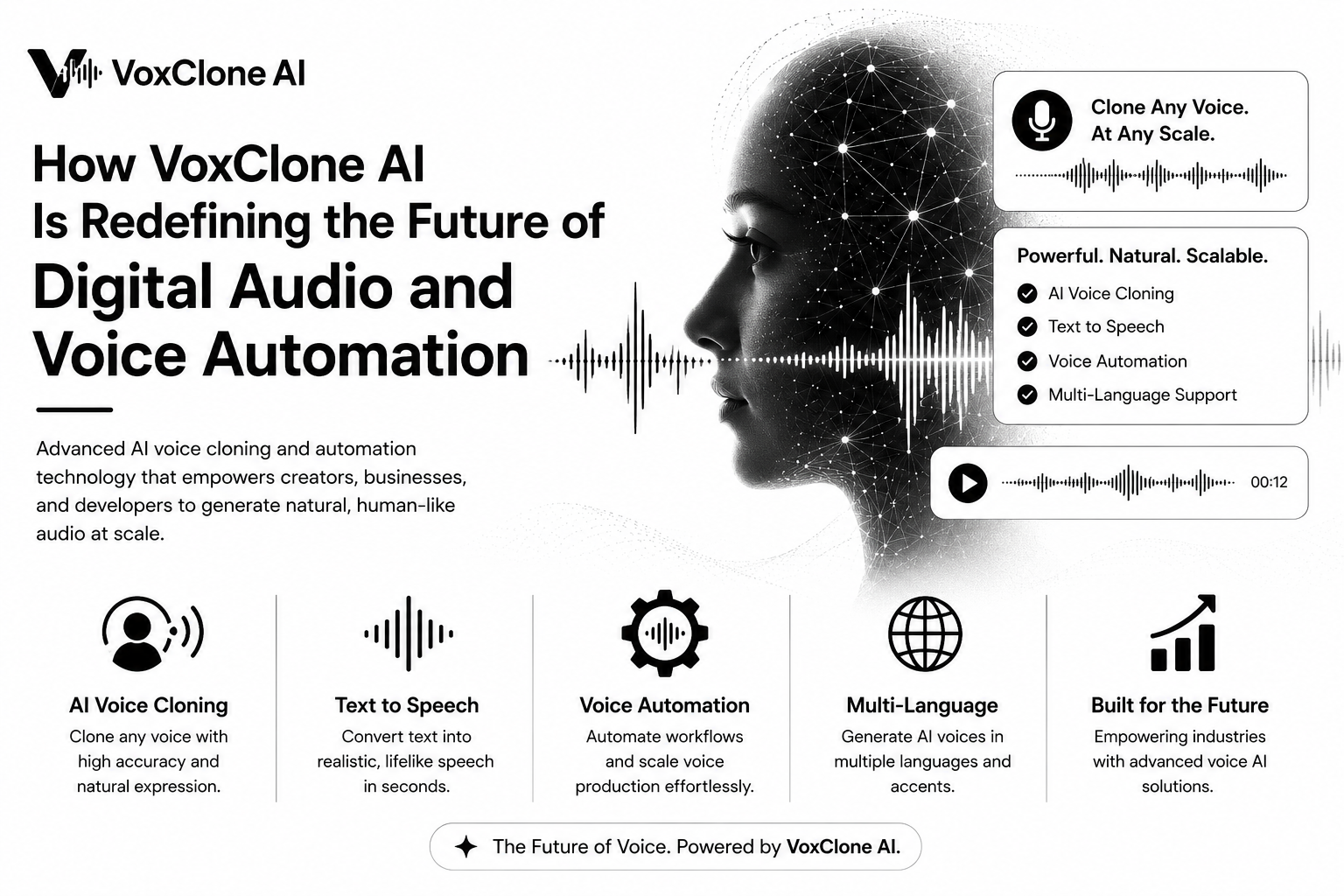
VoxClone AI is transforming digital audio with advanced voice cloning and automation technology that enables realistic, scalable, and personalized voice experiences. Its AI-driven platform is helping creators, businesses, and brands produce high-quality audio content faster and more efficiently than ever before.
The Dawn of a New Audio Era: Beyond Traditional Voice Synthesis
For a long time, if you wanted a computer to speak, you were stuck with what we call traditional text-to-speech. These systems, while groundbreaking in their time, worked by concatenating pre-recorded phonetic units or using rule-based algorithms. The result was often functional, but rarely natural. Think about the early days of GPS navigation or automated phone menus – distinct, but undeniably artificial. However, recent advancements have pushed us far beyond those limitations, into an era where synthetic voices are not just intelligible, but genuinely expressive and indistinguishable from human speech.
Understanding the Shift from TTS to AI Voice Cloning
The leap we've seen isn't just an incremental improvement; it's a paradigm shift. Traditional TTS, exemplified by early versions of Amazon Polly or Google's standard voices, focused on clear articulation. The goal was to convert text into understandable speech. The problem was, "understandable" didn't always mean "engaging." These systems often struggled with natural pauses, intonation, and the subtle emotional cues that make human conversation so rich. The global text-to-speech market, while projected to reach $8.3 billion by 2027, is seeing its growth propelled by these newer, more advanced capabilities.
Enter AI voice cloning. This technology doesn't just read text; it learns the unique characteristics of a specific voice – its timbre, pitch, speech patterns, and even emotional inflections – from a small audio sample. Then, it can generate entirely new speech in that cloned voice. This means you can take a voice, say, of a beloved author, and have it narrate their latest unpublished work, or even localize content into multiple languages while retaining the original speaker's distinctive vocal identity. This level of realism and personalization was simply unattainable a few years ago. Platforms like ElevenLabs have shown what's possible, and now others are pushing the boundaries even further.
The Core Technologies Powering Realistic AI Voices
What makes this possible? It's a combination of sophisticated machine learning models, primarily deep learning neural networks. Specifically, advancements in generative adversarial networks (GANs) and transformer models, similar to those behind large language models (LLMs), have been crucial. These networks are trained on vast datasets of human speech, learning to predict not just the next word, but the next phoneme, the next waveform, and how it should sound based on context, emotion, and speaker identity. Think of it like a highly skilled impressionist who has studied every nuance of a person's voice and can now improvise new lines in character.
These models can analyze everything from subtle breath sounds to the minute changes in pitch that convey excitement or sadness. The result is a synthetic voice that doesn't just sound like a human, but *feels* human. This has led to a dramatic improvement in listener perception; studies show that over 60% of listeners now struggle to differentiate between advanced AI-generated speech and human speech in short segments. This wasn't the case even five years ago.
Comparison: Traditional TTS vs. AI Voice Cloning | ||
Feature | Traditional Text-to-Speech (TTS) | AI Voice Cloning |
|---|---|---|
Realism & Naturalness | Often robotic, limited emotional range, unnatural pauses. | Highly realistic, rich emotional expression, human-like rhythm and intonation. |
Voice Customization | Limited choice from pre-set voices (e.g., male/female, regional accents). | Can clone *any* voice from a short audio sample, creating a unique digital persona. |
Scalability | Good for basic content generation. | Exceptional for mass production of personalized, high-quality audio. |
Applications | Basic screen readers, simple voice prompts, early audiobooks. | Advanced podcasts, celebrity narrations, dynamic game characters, personalized customer service. |
How VoxClone AI Is Leading the Charge in Voice Automation
In this rapidly evolving landscape, many players are making significant strides. Google's WaveNet, Microsoft's Custom Neural Voice, and startups like Murf and ElevenLabs have all contributed to pushing the boundaries. But VoxClone AI is carving out its own space by focusing on an unparalleled blend of hyper-realistic voice reproduction, robust scalability, and a strong commitment to ethical AI. It's not just about making a voice sound good; it's about making it sound right, at scale, and with integrity.
Precision and Nuance: Capturing the Human Element
What truly sets platforms like VoxClone AI apart is their ability to capture the subtle nuances that define a human voice. It’s not just about pitch and tone; it’s about the slight hesitations, the emphasis on certain words, the emotional undertones that convey meaning beyond the literal text. Imagine trying to replicate the distinct warmth of Morgan Freeman's narration or the energetic cadence of a specific YouTube creator. VoxClone AI's advanced models are trained to pick up on these intricate details from surprisingly short audio samples – often just a few minutes of speech. This allows for the creation of digital voice clones that are not just functional but genuinely expressive, making them virtually indistinguishable from the original speaker in many contexts.
"The real magic of AI voice isn't just generating sound; it's generating personality. That's where the future of digital audio truly lies."
Scalability and Efficiency: Doing More with Less
Beyond realism, the practical advantages of AI voice automation are immense. Consider the traditional process of recording audio for an audiobook or a large e-learning course. It involves booking studios, hiring voice actors, countless hours of recording, editing, and re-recording for script changes. This is time-consuming and expensive. AI voice cloning drastically cuts down on these overheads. For instance, a project that might take a professional voice actor 20 hours to record could be generated in minutes with an AI clone, once the initial voice model is created. This represents a potential cost saving of up to 80% on audio production for certain types of content.
This efficiency means creators, businesses, and educators can produce more audio content, faster, and across more platforms and languages than ever before. Imagine localizing a video into 10 languages without needing 10 different voice actors, all while maintaining a consistent brand voice. This level of scalability opens up entirely new markets and possibilities for content distribution.
Ethical Considerations and Responsible AI Development
With great power comes great responsibility, and AI voice technology is no exception. The ability to clone voices raises important ethical questions about consent, deepfakes, and potential misuse. Platforms like VoxClone AI are acutely aware of these challenges and are building safeguards into their systems. This includes strict consent mechanisms, where explicit permission from the original speaker is required before their voice can be cloned. Many platforms are also exploring voice watermarking technologies to help identify AI-generated audio, a crucial step in combating misinformation.
Furthermore, responsible development means ensuring transparency about when a voice is synthetic and educating users on best practices. The goal is to empower creators while protecting individuals and maintaining trust in digital media. The industry as a whole is seeing a push for standardized ethical guidelines, with major players like OpenAI and Google actively contributing to public discourse and policy recommendations.
Transforming Industries: Real-World Applications of Advanced Voice AI
The impact of advanced AI voice technology isn't theoretical; it's already reshaping numerous sectors. From how we consume media to how businesses interact with their customers, the applications are vast and growing. Let's look at some key areas where this technology is making a tangible difference.
Content Creation and Media Production
This is perhaps the most obvious and immediate impact. Podcasters can now create localized versions of their shows in multiple languages, expanding their reach exponentially. Imagine a popular podcast host whose voice can seamlessly narrate their content in Spanish, French, or Mandarin, without needing to learn those languages or hire new talent. This could increase a podcast's global listenership by over 300% in non-English speaking markets.
For audiobook publishers, AI voice cloning means bringing more books to audio faster and more affordably. Indie authors, in particular, can now produce high-quality audiobooks without the prohibitive costs of traditional narration. Video creators can generate voiceovers for documentaries, explainer videos, or marketing materials in their own cloned voice, saving hours in the recording studio. News organizations are even exploring AI voices to deliver personalized news summaries, with over 15% of digital news outlets experimenting with synthetic media for content delivery.
Customer Service and Interactive Experiences
Gone are the days of frustrating, robotic interactive voice response (IVR) systems. Modern AI voice allows companies to create highly natural and empathetic automated customer service experiences. Brands can clone a specific voice that aligns with their identity, ensuring consistency across all automated interactions. This leads to improved customer satisfaction, with some companies reporting a 25% increase in positive customer feedback when using natural AI voices compared to traditional TTS.
Beyond basic call centers, think about personalized virtual assistants or interactive kiosks that speak with a familiar, friendly voice. This creates a much more engaging and less sterile experience for users, whether they're navigating a smart home device or getting assistance at an airport. The global AI in customer service market is projected to reach $3.5 billion by 2026, largely driven by advancements in natural voice interaction.
Education and Accessibility
In education, AI voice offers incredible potential for personalized learning. Imagine e-learning modules where the content is narrated by a cloned voice of a particular professor, making remote learning feel more personal and engaging. For language learners, AI can provide dynamic, interactive lessons where they can practice speaking and receive feedback from an AI tutor that speaks like a native speaker. This can significantly improve pronunciation and fluency.
For accessibility, AI voice is a game-changer. It can convert any text-based material into high-quality audio for individuals with visual impairments or reading difficulties. This goes beyond simple screen readers by offering voices that are naturally expressive and pleasant to listen to, making information more accessible and enjoyable for everyone. The market for assistive technology, including advanced text-to-speech, is expected to grow by 10% annually over the next five years.
Gaming and Entertainment
The gaming industry is constantly seeking ways to create more immersive experiences. AI voice cloning allows game developers to generate vast amounts of dialogue for non-player characters (NPCs) or dynamic story paths without needing to record thousands of lines from scratch. This means more diverse character voices, more expansive narratives, and the ability to update game content with new dialogue much faster. Some studios are already reporting a 60% reduction in voice acting costs for minor characters by using AI voice generation.
In other entertainment forms, AI can help create personalized storytelling experiences or even generate voiceovers for animated content. Imagine a choose-your-own-adventure story where every character's voice is dynamically generated based on their personality, or a fan-made animation where you can hear your favorite character speak lines never before recorded by their original actor (with proper ethical consent, of course). The possibilities for dynamic, responsive audio are truly exciting.
The Technical Underpinnings: What Makes AI Voices So Convincing?
Behind every incredibly realistic AI voice is a sophisticated stack of technology. It's not magic; it's advanced computational linguistics, deep learning, and clever engineering. Understanding these components helps us appreciate the complexity and potential of platforms like VoxClone AI.
Deep Learning and Neural Networks in Voice Generation
The core of modern AI voice generation lies in deep neural networks. These are complex algorithms inspired by the human brain, capable of learning intricate patterns from vast amounts of data. For voice, this means training on hundreds of thousands, sometimes millions, of hours of human speech. Models like Google's WaveNet, and later transformer-based architectures similar to those powering OpenAI's GPT series, have revolutionized the field. These networks don't just store snippets of sound; they learn the underlying rules of human speech – how phonemes connect, how stress changes meaning, and how emotions color articulation.
Specifically, a common approach involves two main components: a text-to-mel spectrogram model and a vocoder. The first takes text and converts it into a visual representation of sound frequencies over time (a spectrogram), essentially an acoustic blueprint. The second then takes that blueprint and synthesizes the actual audio waveform. This two-stage process allows for incredible control and fidelity, producing speech that captures the subtle intricacies of human vocal production.
Data Quality and Model Training
The old adage "garbage in, garbage out" is particularly true for AI voice. The quality and diversity of the training data are paramount. To create a highly natural and versatile voice model, developers need access to clean, high-fidelity recordings of human speech covering a wide range of emotions, speaking styles, and linguistic contexts. This data is painstakingly curated and annotated. For example, large companies like Microsoft and Google invest heavily in collecting and cleaning massive datasets, often comprising over 100,000 hours of speech from diverse speakers.
When you want to clone a specific voice, the AI model needs to learn the unique characteristics of that voice from a relatively small sample. This "few-shot learning" or "zero-shot learning" capability is a major breakthrough. It means the model has already learned so much about the general properties of human speech that it only needs a brief exposure to a new voice (sometimes as little as 30 seconds of audio) to adapt and reproduce its unique qualities. This efficiency is what makes personalized voice cloning practical for everyday use.
Real-time Processing and API Integration
Beyond the underlying models, practical application requires efficient processing. For many interactive applications, such as customer service chatbots or virtual assistants, speech needs to be generated in real-time. This means the AI must convert text to speech with minimal latency, often within milliseconds. This requires optimized algorithms and powerful computational infrastructure, often running on cloud-based GPUs.
Furthermore, for developers and businesses to easily incorporate AI voice into their existing products and workflows, platforms offer robust Application Programming Interfaces (APIs). These APIs allow for seamless integration, letting you send text to the service and receive audio back, all programmatically. This ease of integration is crucial for widespread adoption, enabling everything from dynamic website narration to bespoke in-app voice experiences. Platforms like VoxClone AI are built with these developer-friendly interfaces in mind, ensuring that powerful voice automation is accessible to a broad range of applications.
Navigating the Challenges and Crafting Solutions in AI Voice
While the capabilities of AI voice are undeniably exciting, it's important to approach this technology with a clear understanding of its potential pitfalls. As with any powerful tool, responsible development and deployment are crucial. The industry is actively working to address these challenges head-on.
Addressing Misinformation and Deepfakes
The ability to clone a voice with high fidelity naturally raises concerns about deepfakes and the spread of misinformation. Imagine a scenario where a politician's voice is cloned to generate a fabricated statement, potentially causing widespread confusion or harm. This is a serious threat that the AI community is taking very seriously. Public concern about AI-generated misinformation is significant, with over 70% of internet users expressing worry about its impact on society.
Solutions are emerging. One promising area is audio watermarking, embedding imperceptible signals into AI-generated speech that can be detected by specialized tools, indicating its synthetic origin. Another approach is developing robust AI detection models that can identify anomalies in synthetic speech, although this is an ongoing cat-and-mouse game as generation models become more sophisticated. Platforms are also implementing strict usage policies and content moderation to prevent malicious use.
Ensuring Voice Authenticity and Consent
The ethical cornerstone of voice cloning is consent. It's paramount that individuals have full control over whether their voice can be cloned and how it is used. Responsible platforms implement stringent consent processes, often requiring explicit verbal agreement from the speaker before their voice can be digitized and cloned. This might involve a verification phrase spoken by the individual, affirming their permission. This is not just a best practice; it's becoming a legal necessity in many jurisdictions. The average cost of a data privacy breach, which could include misuse of biometric data like voice, is estimated at $4.35 million, emphasizing the need for strong consent protocols.
Beyond initial consent, ongoing transparency about the use of cloned voices is vital. Audiences should generally be aware when they are listening to an AI-generated voice, especially in contexts where authenticity is important, such as news or personal communications. This builds trust and helps mitigate potential ethical dilemmas.
Overcoming Technical Hurdles in Voice Production
Even with advanced AI, technical challenges remain. Maintaining consistent emotional tone across very long pieces of text can be tricky. Dealing with complex linguistic nuances, like sarcasm or subtle humor, still requires sophisticated models. Background noise in original audio samples can also affect the quality of a cloned voice. Researchers are constantly working on improving these aspects. Techniques like emotion conditioning and noise reduction algorithms are continually being refined to produce even more robust and versatile voice models.
Another challenge is the computational cost. Training these highly complex models requires significant processing power, which translates to energy consumption and infrastructure costs. However, ongoing research into more efficient model architectures and hardware optimization is steadily reducing these barriers, making advanced AI voice technology more accessible and sustainable. The efficiency of AI models has improved dramatically, with some models now requiring 10x less computational power for inference than their predecessors did just two years ago.
The Road Ahead: Future Trends in Digital Audio and Voice Automation
The current state of AI voice technology is impressive, but it's just the beginning. Looking ahead two to five years, we can anticipate even more transformative developments that will further blur the lines between human and synthetic speech and open up entirely new paradigms for interaction and content creation.
Hyper-Personalization and Adaptive Voices
Imagine a future where your digital assistant not only understands your commands but also adapts its voice and speaking style to match your mood or the context of the conversation. If you're stressed, it might speak in a calmer, more reassuring tone. If you're excited, it might match your enthusiasm. This hyper-personalization will extend beyond tone to include vocabulary and even subtle linguistic habits, creating an interaction that feels truly tailored to you.
We'll also see more adaptive voices in media. For instance, an AI narrator might adjust its pace and emphasis dynamically based on listener feedback or even biometric data (like heart rate) to maximize engagement. This level of dynamic, real-time adaptation will make digital audio experiences incredibly immersive. The market for personalized audio experiences, driven by AI, is expected to grow from $1.2 billion to $4.5 billion by 2028.
Multilingual Capabilities and Global Reach
Cross-language voice cloning is a rapidly advancing frontier. Soon, you won't just be able to clone your voice; you'll be able to have your cloned voice speak fluently in dozens of different languages, maintaining your unique vocal identity. This means a single piece of audio content can be instantly localized for a global audience, breaking down language barriers in a way never before possible. This will be transformative for global businesses, international education, and cross-cultural communication.
Consider a CEO delivering a keynote speech. With advanced AI voice, that speech could be simultaneously translated and delivered in the CEO's own cloned voice, in real-time, to audiences speaking 20 different languages. This capability alone could expand a company's global market reach by an estimated 20% to 30% by making content universally accessible and relatable. The demand for AI-powered real-time translation and voice localization is projected to increase by over 40% annually.
The Blurring Lines Between Real and Synthetic
As AI voice technology continues to improve, the distinction between human and synthetic speech will become increasingly difficult to discern. This isn't just about realism; it's about the emotional depth and contextual awareness of AI-generated voices. We'll see AI voices that can convincingly convey complex emotions, tell nuanced stories, and even improvise in conversations with remarkable authenticity. This will lead to a future where AI voices are not merely tools but integral parts of our digital interactions, indistinguishable from human counterparts in many scenarios.
This convergence will open new avenues for creativity, allowing artists and creators to experiment with voice in ways previously unimaginable. It also underscores the importance of the ethical frameworks and transparency measures we discussed earlier. As the technology matures, these safeguards will be more critical than ever to ensure a positive and trustworthy digital audio environment.
Future Trends: Impact & Potential | ||
Trend | Key Characteristic | Potential Impact |
|---|---|---|
Hyper-Personalization | AI voices adapt to user mood, context, and preferences. | More engaging digital assistants, personalized learning, tailored entertainment. |
Multilingual Voice Cloning | Cloned voice speaks fluently in many languages, retaining identity. | Global content reach, breaking language barriers in business and media. |
Emotional Intelligence | AI voices convincingly convey complex human emotions. | Deeper immersive experiences in gaming, more empathetic customer service. |
Real-time Interaction | Instantaneous text-to-speech conversion for dynamic conversations. | Seamless human-AI dialogue, advanced virtual assistants, interactive storytelling. |
Practical Steps for Embracing AI Voice in Your Projects
Feeling inspired to explore AI voice for your own work? Here are some practical steps to get you started and ensure you get the most out of this powerful technology.
1. Identifying Your Needs and Goals
Before jumping in, clearly define what you want to achieve. Are you looking to:
Scale content production? (e.g., more audiobooks, localized podcasts)
Enhance user experience? (e.g., more natural voice assistants, interactive learning)
Personalize interactions? (e.g., custom brand voice for customer service)
Reduce costs and time? (e.g., replacing traditional voice acting for specific projects)
Understanding your primary objective will help you choose the right platform and approach. For example, if you need hyper-realistic cloning and broad language support, platforms like VoxClone AI would be a strong contender.
2. Starting Small and Iterating
You don't need to overhaul your entire audio strategy overnight. Begin with a pilot project. Try generating a short narration for a blog post, a few lines of dialogue for a demo, or a small section of an e-learning module. Experiment with different voices, speaking styles, and emotional inflections. Collect feedback from your target audience. This iterative approach allows you to learn, refine your process, and gradually expand your use of AI voice as you gain confidence and see tangible results. Many platforms offer free trials or starter tiers, making it easy to experiment without a significant initial investment.
3. Integrating AI Voice Responsibly
Always prioritize ethical considerations. If you're cloning a voice, ensure you have explicit consent from the original speaker. Be transparent with your audience about when AI-generated voices are being used, especially in sensitive contexts. Consider adding a small disclaimer or visual cue if appropriate. By integrating AI voice responsibly, you not only build trust but also contribute to a healthier digital ecosystem. Remember, the goal is to augment human creativity and efficiency, not to mislead or replace human connection without consent.
Conclusion: The Humanity in AI Voice
We've journeyed from the stiff, mechanical tones of early text-to-speech to the hyper-realistic, emotionally nuanced voices generated by today's advanced AI. This isn't just a technological leap; it's a profound shift in how we create, consume, and interact with digital audio. AI voice cloning and automation are democratizing audio production, enabling unprecedented scalability, and opening doors to personalized experiences that were once confined to our imaginations.
Platforms like VoxClone AI are at the forefront of this revolution, pushing the boundaries of what's possible while also championing responsible development. They remind us that the future of digital audio isn't about replacing human voices entirely, but about amplifying them, extending their reach, and empowering creators to tell stories, educate, and connect in richer, more impactful ways. The human element, with all its unique inflections and emotions, remains central, even as AI provides the tools to replicate and scale it. The future of digital audio is here, and it sounds more human than ever before.
Related Topics
#AIVoice #VoiceCloning #TextToSpeech #DigitalAudio #VoiceAutomation #SyntheticVoice #AIInnovation #ContentCreation #CustomerExperience #FutureOfSound #VoxCloneAI #MachineLearning