
Imagine spending six months building an automated voice agent for a healthcare network. The user interface looks sleek, the API integrations run smoothly, and the conversational logic handles patient scheduling effortlessly. Then, during a live demo with hospital executives, your AI assistant reads out a prescription notification: "Please take 50 M-G of doctor Read's medication." Instead of saying "milligrams" and pronouncing "Reed," the system spells out the letters M-G and pronounces "Read" like the past tense verb. In three seconds, a technical glitch turns a promising enterprise software deployment into an embarrassing viral joke.
Pronunciation errors remain the single fastest way to shatter user trust in Text-to-Speech (TTS) applications. Whether you build interactive voice response systems, e-learning modules, audiobooks, or AI-powered accessibility tools, getting the spoken word right is critical. Neural voice models have made incredible strides in emotional expressiveness, but speech synthesis engines still stumble over heteronyms, acronyms, regional proper nouns, and technical jargon. Understanding how to diagnose and systematically repair these audio flaws is an essential skill for modern software engineers.
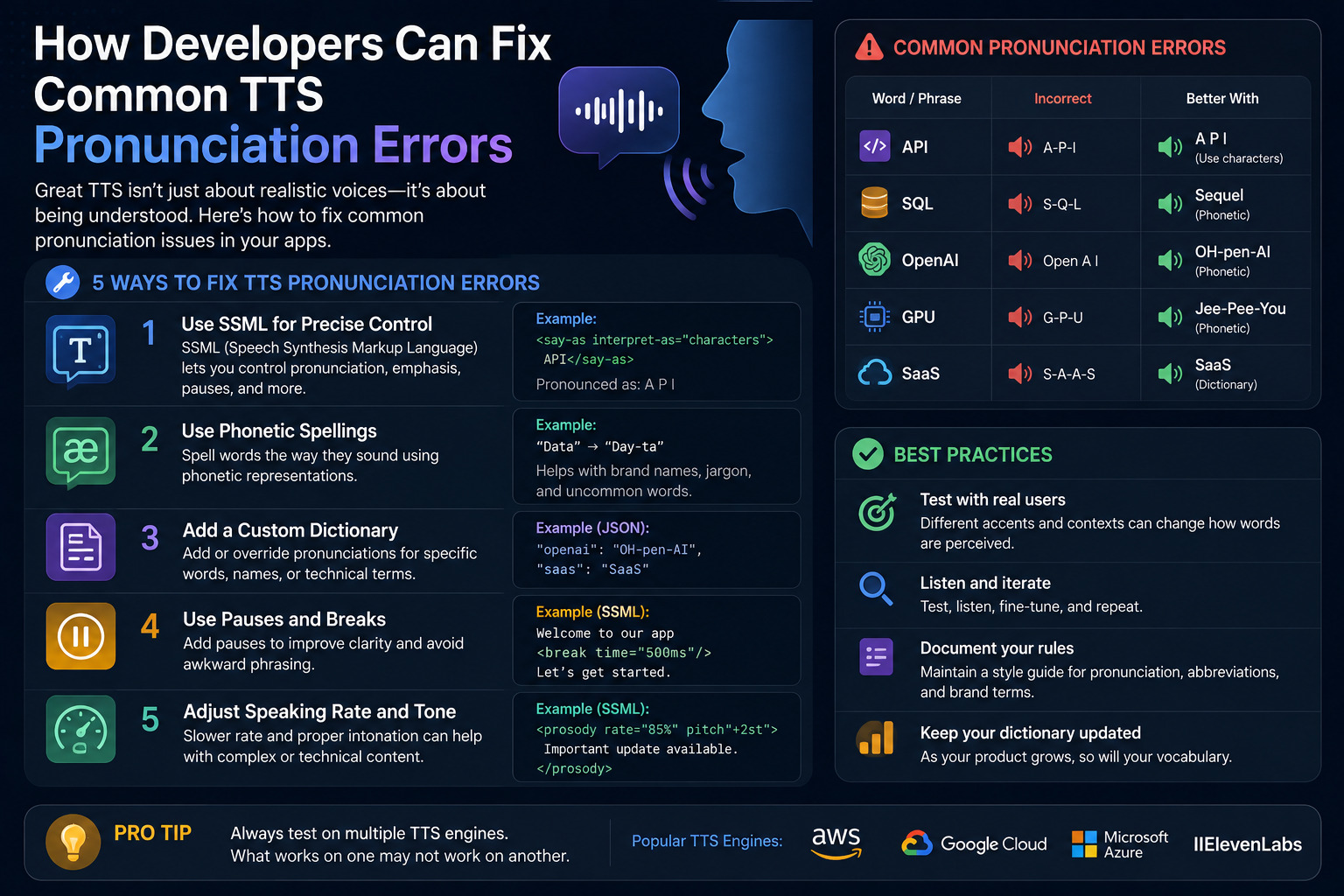
1. Background and Context: Why Neural Models Still Struggle with Text
Modern TTS systems look very different from the concatenative engines of fifteen years ago. Legacy software pieced together pre-recorded snippets of human speech, creating choppy, robotic audio that struggled with natural pacing. Today's neural architectures rely on deep learning pipelines—often pairing grapheme-to-phoneme (G2P) frontends with neural vocoders to transform raw text directly into fluid waveform audio.
The Root Cause of Phonetic Failures
Despite these massive advancements, speech synthesis engines process written text through probabilistic statistical inference rather than true semantic comprehension. When a neural network processes the grapheme string read, it evaluates nearby tokens to guess whether the output should be the phoneme sequence /riːd/ or /rɛd/. If your context window contains ambiguous phrasing, the probability distribution fails, resulting in a mispronunciation.
According to industry benchmarks from speech evaluation studies, unassisted commercial TTS engines suffer from a 3.2% to 6.8% error rate when handling specialized domain terminology, uncommon surnames, and homographs without custom phonetic overrides. In customer service applications handling over 100,000 daily calls, that error rate translates to thousands of jarring conversational mistakes every single day.
| TTS Architecture Generation | Primary Synthesis Method | Typical Word Error Rate (WER) | Pronunciation Override Complexity |
|---|---|---|---|
| First Gen (Concatenative) | Stitching sliced audio clips | 12.5% – 18.0% | High (Required manually recording new audio) |
| Second Gen (Parametric/HMM) | Statistical acoustic modeling | 7.0% – 11.2% | Moderate (Basic dictionary lookups) |
| Third Gen (Neural Autoregressive) | Tacotron/FastSpeech + WaveNet | 2.5% – 4.5% | Flexible (SSML & IPA support) |
| Fourth Gen (Zero-Shot Multimodal) | Direct Audio Token Transformers | 1.2% – 3.0% | Advanced (Context-aware prompt guidance) |
2. Anatomy of Pronunciation Errors: The Four Major Pitfalls
Before implementing technical fixes, you need to categorize the types of pronunciation failures occurring in your audio pipeline. Mispronunciations fall into four distinct linguistic buckets, each requiring a specific remediation strategy.
Heteronyms and Homographs
Heteronyms are words spelled identically that have different meanings and pronunciations depending on context. Consider these common examples:
- Bass: The fish (/bæs/) versus the low-frequency musical tone (/beɪs/).
- Lead: To guide someone (/liːd/) versus the heavy metallic element (/lɛd/).
- Wind: Moving air (/wɪnd/) versus turning a clockwork key (/waɪnd/).
- Resume: To start again (/rɪˈzjuːm/) versus a professional curriculum vitae (/ˈrɛzjʊmeɪ/).
When an API receives raw text without grammatical markup, G2P algorithms rely strictly on local n-gram probabilities. If the input sentence reads "I need to resume my work on the resume," simple neural engines frequently select the same vocalization for both instances.
Acronyms, Initialisms, and Abbreviations
Text-to-speech engines struggle to determine whether a string of capital letters should be spoken as a single word (an acronym like NASA or NATO) or spelled out letter-by-letter (an initialism like API, SQL, or FBI).
The problem deepens with domain-specific shorthand. In medical software, q.i.d. means "four times a day," while in real estate listings, 3 bdr 2 ba means "three bedrooms, two bathrooms." If your ingestion pipeline feeds raw shorthand into a speech model without text normalization, the resulting voice output confuses listeners.
Proper Nouns and Geographic Names
Names of people, brands, and places ignore standard English phonetic rules. A neural model trained on general web text will mispronounce regional locations like Worcester (/ˈwʊstər/), Schenectady (/skəˈnɛktədi/), or La Jolla (/lə ˈhɔɪ.ə/). Similarly, corporate brand names like Nguyen (/wɪn/) or Swarovski (/swɑːrˈɒfski/) consistently fail without explicit phonetic dictionary overrides.
Numerical Formats, Units, and Currency
Reading numbers correctly requires understanding sentence context. The string 10/12/2026 should be rendered as "October twelfth, twenty twenty-six" in North America, but as "the tenth of December, twenty twenty-six" in Europe. Similarly, $1.5M should read "one point five million dollars," whereas 1.5m in a construction app might mean "one point five meters."
3. Mastering Speech Synthesis Markup Language (SSML)
The primary tool for controlling TTS output across major cloud platforms is Speech Synthesis Markup Language (SSML). SSML provides an XML-based standard for annotating text with structural pronunciation cues.
Enforcing Context with the sub Tag
The simplest way to fix acronyms, initialisms, and domain abbreviations is the <sub> element. This tag substitutes a human-readable text string for the written grapheme during the acoustic rendering pass.
<speak>
  The patient was prescribed 50
  <sub alias="milligrams">mg</sub> of
  <sub alias="prednisone">prednisone</sub>.
</speak>
Guiding Interpretation with the say-as Tag
To fix dates, cardinal numbers, ordinal sequences, and telephone numbers, use the <say-as> tag. This instructs the text-normalization engine exactly how to expand the character sequence before generating speech.
<speak>
  Your appointment is scheduled for
  <say-as interpret-as="date" format="mdy">10/12/2026</say-as>.
  Please call us at
  <say-as interpret-as="telephone">800-555-0199</say-as>.
</speak>
Precision Control with the phoneme Tag
When dealing with unusual proper nouns that alias tags cannot solve, use the <phoneme> element. This tag allows you to specify exact phonetic representations using either the International Phonetic Alphabet (IPA) or the Extended Speech Assessment Methods Phonetic Alphabet (X-SAMPA).
<speak>
  Welcome to the historic city of
  <phoneme alphabet="ipa" ph="ˈwʊstər">Worcester</phoneme>.
  Our lead engineer is
  <phoneme alphabet="ipa" ph="wɪn">Nguyen</phoneme>.
</speak>
"SSML acts as an explicit contract between your application code and the neural acoustic model. Relying on an AI to guess proper nouns is a gamble; using explicit phoneme tags is engineering."
4. Custom Lexicons and Global Pronunciation Dictionaries
While inline SSML tags work well for static templates, manually tagging thousands of dynamic text strings in a database quickly becomes unmaintainable. The scalable solution is implementing global pronunciation lexicons.
Understanding W3C PLS (Pronunciation Lexicon Specification)
The W3C Pronunciation Lexicon Specification (PLS) is an XML format supported by cloud voice providers like Amazon Polly, Microsoft Azure Speech, and Google Cloud Text-to-Speech. A PLS document defines global substitution rules that automatically apply whenever a specific grapheme appears in your text stream.
<?xml version="1.0" encoding="UTF-8"?>
<lexicon version="1.0"
         xmlns="http://www.w3.org/2005/01/pronunciation-lexicon"
         alphabet="ipa"
         xml:lang="en-US">
  <lexeme>
    <grapheme>VoxClone</grapheme>
    <phoneme>ˈvɒks.kloʊn</phoneme>
  </lexeme>
  <lexeme>
    <grapheme>SQL</grapheme>
    <alias>Sequel</alias>
  </lexeme>
</lexicon>
Custom Lexicons Across Major Voice Providers
Enterprise voice platforms implement lexicon management in slightly different ways. Understanding these differences helps when building cross-cloud or multi-vendor voice applications.
- Microsoft Azure Speech: Supports W3C PLS files alongside Custom Neural Voice dictionary models uploaded through the Speech Studio portal.
- Amazon Polly: Allows developers to register up to 100 PLS lexicons per AWS region, applying them dynamically during synthesis API calls using the
LexiconNamesparameter. - ElevenLabs & Murf AI: Provide web-based workspace dictionaries and API key-value overrides that automatically convert problematic terms into phonetic respellings before synthesis.
- Specialized Platforms: Modern platforms like VoxClone AI streamline pronunciation tuning by providing developer-friendly API endpoints for custom voice cloning and automated phonetic dictionary mapping, ensuring high consistency across custom branded voices.
5. Building an Automated Text Normalization Pipeline
Relying solely on cloud-side TTS engines to clean your text is risky. The most reliable voice architectures run a dedicated Text Normalization Pipeline on the server before making any external synthesis API requests.
Architecture of a Server-Side Normalization Pipeline
A well-architected text preprocessing service sanitizes input text through five sequential filtering layers before passing the structured payload to your TTS provider:
- Regex Pattern Extraction: Identifies and formats structured data types such as URLs, email addresses, phone numbers, tracking numbers, and financial currencies.
- Domain Shorthand Expansion: Replaces specialized industry jargon (such as medical doses, legal citations, or real estate shorthand) with spelled-out equivalents.
- Part-of-Speech (POS) Disambiguation: Uses lightweight Natural Language Processing (NLP) models (like spaCy or NLTK) to identify parts of speech, helping distinguish whether "read" is a present-tense verb or a past-tense verb.
- Global Lexicon Injection: Queries your organization's central database to wrap internal brand names and employee surnames in
<phoneme>or<sub>SSML tags. - Unicode and Character Sanitization: Strips invisible control characters, unsupported emojis, and non-standard typography that can cause neural vocoders to fail or emit odd static noises.
| Pipeline Stage | Raw Input Example | Normalized Output Example | Latency Impact |
|---|---|---|---|
| 1. Currency & Numbers | Total due: $4,500.50 | Total due: four thousand five hundred dollars and fifty cents | < 1 ms |
| 2. Technical Acronyms | Connect to the REST API via HTTPS | Connect to the REST <sub alias="A P I">API</sub> via <sub alias="H T T P S">HTTPS</sub> | < 1 ms |
| 3. POS Homograph Tagging | I read the report yesterday | I <phoneme ph="rɛd">read</phoneme> the report yesterday | 3 ms – 8 ms |
| 4. Brand Lexicon Injection | Generated with VoxClone AI | Generated with <phoneme ph="ˈvɒks.kloʊn">VoxClone</phoneme> <sub alias="A I">AI</sub> | < 1 ms |
6. Real-World Case Studies: Financial and Healthcare Deployments
To see how these techniques function in production, let us examine two enterprise implementations where fixing TTS pronunciation directly impacted business outcomes.
Case Study 1: Regional Banking Network Automated Phone Support
A regional bank with 180 branches deployed an AI voice assistant powered by OpenAI and Amazon Polly to handle account inquiries. During initial soft launch monitoring, auditors discovered a high customer frustration rate caused by two distinct pronunciation failures:
- The system read account balances like "$1,005.00" as "one thousand five dollars" instead of "one thousand and five dollars zero cents."
- The local branch location on "Paseo de Peralta" was rendered using rigid English phonetics, making the street name unrecognizable to local callers.
The Fix: The engineering team built a Node.js pre-processing middleware layer. The service uses regex rules to transform financial quantities into spelled-out English strings and injects W3C PLS lexicon entries for all 180 branch addresses. Within thirty days of deployment, caller containment rates increased by 18.4% and speech-related customer complaints dropped to near zero.
Case Study 2: E-Learning Platform Technical Courseware
An online education platform produced over 500 hours of automated video courseware covering cloud computing and software engineering. Their initial TTS rendering engine mispronounced key technical terms throughout the courses—pronouncing Kubernetes as /kuːbər-neets/ instead of /koo-ber-NET-ees/ and reading nginx verbatim as /n-gink-x/.
The Fix: The team built an automated validation tool using Python. The script scans course transcripts against a developer dictionary of 2,500 tech terms, automatically wrapping unmatched technical terms in explicit IPA <phoneme> tags. Integrating this step into their media generation pipeline saved an estimated $140,000 in manual audio editing costs while cutting production turnaround times by 75%.
7. Common Implementation Challenges and Solutions
Even with SSML and custom lexicons, developers encounter edge cases when tuning speech synthesis pipelines. Here is how to solve the three most frequent technical hurdles.
1. Handling Multi-Language Code-Switching
If your application serves multilingual regions (such as bilingual communities in Canada or the Southwestern United States), a single sentence may mix languages—such as "Please drive down Main Street toward El Camino Real." A voice engine assigned to US English will mangle the Spanish road name.
Solution: Use the SSML xml:lang attribute to temporarily shift the acoustic model's language rules for specific words without switching the overall primary voice.
<speak>
  Please turn right onto
  <lang xml:lang="es-MX">El Camino Real</lang>
  and continue for two miles.
</speak>
2. Neural Vocoder Artifacts from Extreme SSML Nesting
Over-tagging your text with deeply nested SSML elements can occasionally cause modern neural vocoders (like WaveNet or Tacotron derivatives) to produce strange audio glitches, awkward pauses, or unnatural pitch jumps near tag boundaries.
Solution: Keep SSML structures as flat as possible. Prefer server-side text normalization (respelling "mg" to "milligrams" in raw text) over heavy SSML nesting whenever simple text expansion achieves the same acoustic result.
3. Voice Consistency Across Cloned Voices
When using custom voice cloning services, generic cloud lexicons may not match the unique pitch contours or regional accent characteristics of your original voice actor.
Solution: Leverage platforms built specifically for custom voice workflows. Services like VoxClone AI allow developers to fine-tune custom voice models using targeted audio samples, ensuring that brand names and technical terms match the speaker's natural tone and cadence automatically.
8. Future Trends: What Voice AI Looks Like by 2028
Over the next two to three years, the way developers handle TTS pronunciation will shift dramatically as speech models move from modular pipelines to unified multimodal architectures.
Context-Aware Multimodal Transformers
Next-generation speech models are moving away from isolated G2P frontends. Integrated speech-to-speech and text-to-speech foundation models evaluate full paragraph semantics natively. These models will automatically infer whether "read" is past or present tense based on surrounding narrative context, dramatically reducing the need for manual homograph tagging.
Zero-Shot Prompt-Based Pronunciation Guidance
Instead of requiring complex XML schemas like SSML, future API calls will accept natural language context prompts. Developers will simply pass guidance parameters like { "pronunciation_style": "Medical Jargon", "accent_region": "Pacific Northwest" }, allowing the model to adapt its phonetic rendering dynamically on the fly.
Automated Real-Time Audio Feedback Loops
Upcoming developer tools will incorporate real-time acoustic feedback loops. As the system generates audio, an automated background speech recognition model will immediately transcribe the generated sound back into text. If the transcribed text deviates from the source grapheme, the system will flag the mispronunciation and automatically adjust its phonetic weights in milliseconds.
9. Practical Procurement and Implementation Checklist
Ready to eliminate pronunciation errors from your production app? Follow this actionable engineering roadmap:
- Build a domain-specific dictionary: Collect all brand names, executive names, technical jargon, and industry acronyms unique to your enterprise.
- Implement server-side normalization: Set up a lightweight text preprocessing script to handle currency, date formatting, and acronym expansion before calling your TTS provider.
- Standardize on W3C PLS: Maintain your custom pronunciations in a portable W3C PLS dictionary format to avoid vendor lock-in across cloud providers.
- Audit heteronyms in your dataset: Run part-of-speech taggers over dynamic user inputs to detect ambiguous words like *lead*, *read*, or *resume* before rendering.
- Establish automated audio regression testing: Run nightly build scripts that render key test phrases, converting output audio back to text via ASR to automatically flag audio regressions.
10. Conclusion
Speech synthesis has advanced far beyond the robotic monotone algorithms of the past, but achieving truly natural, human-grade voice output still requires thoughtful engineering. Neural models are exceptionally good at emotional tone, pacing, and vocal realism, yet they remain vulnerable to the quirks and ambiguities of written human language.
By combining server-side text normalization, structured SSML markup, and centralized pronunciation lexicons, developers can build voice applications that sound polished, authoritative, and reliable. Take control of your phonetic pipeline, protect your brand experience, and give your users the flawless voice interactions they expect.
#TTS #VoiceAI #SpeechSynthesis #SSML #DeveloperTools #VoxCloneAI #VoiceCloning #SoftwareEngineering #NLP #AudioEngineering