How AI Voice Generators Are Revolutionizing Content Creation
By VoxClone AI Team · 2026-05-20
What's Inside
How AI Voice Generators Are Revolutionizing Content Creation
Imagine this: you've just finished writing a brilliant new course, a captivating podcast script, or a series of engaging marketing videos. Now comes the challenge – bringing it all to life with a voice. Traditionally, this meant navigating auditions, booking studio time, and managing a team of voice actors, often leading to significant costs and delays. What if you could produce high-quality, natural-sounding voiceovers for all your content, in multiple languages, with unprecedented speed and efficiency?
That's no longer a futuristic dream. We're living in an era where AI voice generators are fundamentally reshaping how content is created and consumed. These sophisticated tools are not just for basic text-to-speech anymore; they're producing voices so realistic and nuanced that they're practically indistinguishable from human recordings. If you're a content creator, marketer, educator, or anyone looking to scale your audio output, understanding this technology isn't just an advantage – it's quickly becoming a necessity.
How AI Voice Generators Are Revolutionizing Content Creation
The Era of Auditory Innovation: Introduction
The journey of artificial intelligence has been marked by incredible milestones, from image recognition to natural language processing. Now, AI is making its most profound impact yet in the realm of sound. For years, "computer voices" were synonymous with robotic, monotone speech, often used for simple system prompts or accessibility features. They served a purpose, but they certainly didn't inspire or engage. Today, that perception is being completely rewritten. Advanced neural networks are capable of generating speech with human-like intonation, rhythm, and even emotion, opening up a universe of possibilities for content creators.
This isn't just about making machines talk; it's about giving them a voice – a personality, if you will. The ability to instantly transform text into compelling audio, or even clone an existing voice with uncanny accuracy, is democratizing audio content production. Whether you're a small business owner on a tight budget or a large enterprise needing to localize content for global audiences, AI voice generators are providing tools that were once exclusive to high-budget productions. They're removing barriers, accelerating workflows, and most importantly, helping you connect with your audience in powerful new ways. Let's dive into how this technology works and why it's becoming an indispensable part of the modern content creation toolkit.
The Dawn of Digital Voices: What Are AI Voice Generators?
At its core, an AI voice generator is a software that converts written text into spoken audio. You might know this as Text-to-Speech (TTS). But the modern iteration goes far beyond the flat, synthesized voices of the past. Today's AI voice generators, powered by deep learning and neural networks, analyze vast amounts of human speech data to learn the intricate patterns of language – not just words, but also pitch, tone, pace, and emphasis. This allows them to produce incredibly natural and expressive voices that can convey a wide range of emotions.
Think about the difference between a simple GPS instruction and a captivating audiobook narration. The technology behind the latter is what we're talking about now. Companies like Google with their WaveNet technology, Amazon with Polly, and Microsoft with Azure Cognitive Services have been at the forefront of this evolution, pushing the boundaries of what's possible. They've built models that can predict how a human would speak a given sentence, resulting in audio that feels organic and engaging, rather than artificial.
From Text to Talk: How It Works
The process typically involves several key steps:
Text Analysis: The AI first processes your written text, breaking it down into individual words and phonemes (the smallest units of sound). It also analyzes punctuation and sentence structure to understand the intended rhythm and pauses.
Linguistic Feature Extraction: It then extracts linguistic features like stress, intonation, and duration based on the context of the words. For example, the word "present" sounds different depending on whether it's a noun or a verb.
Acoustic Model: This is where the magic happens. A deep learning model, often a neural network, converts these linguistic features into acoustic features (like frequency, amplitude, and spectral characteristics). This model has been trained on massive datasets of human speech, learning how different sounds are produced and combined.
Vocoder (Voice Coder): Finally, a vocoder synthesizes these acoustic features into audible speech waveforms. Modern vocoders, like Google's WaveNet or even custom solutions, are incredibly sophisticated, generating high-fidelity audio that captures the nuances of the human voice.
The result is not just a sequence of sounds, but a coherent, natural-sounding spoken rendition of your text.
Beyond Basic TTS: The Rise of Emotional AI
The biggest leap has been in the ability of AI voices to convey emotion and different speaking styles. Early TTS systems were often described as "monotone" or "robotic" because they lacked the subtle variations in pitch and rhythm that humans naturally use to express feelings. Today, advanced AI models can be instructed to speak with happiness, sadness, excitement, or even a sense of urgency. This is achieved through training on emotionally tagged speech datasets and sophisticated algorithms that map emotional cues to specific vocal parameters.
Platforms like ElevenLabs have made significant strides in this area, offering a range of emotionally nuanced voices that can adapt to the context of the text. This capability is crucial for content that aims to truly connect with an audience, from marketing narration to character dialogue in games. It means your AI-generated voice isn't just speaking words; it's telling a story with feeling.
Why AI Voices Are a Game-Changer for Content Creators
For anyone producing content, the benefits of integrating AI voice generators into your workflow are immense. It's not just about novelty; it's about practical, tangible advantages that can redefine your production capabilities and reach. Let's look at the core reasons why this technology is so impactful.
Unlocking Efficiency and Speed
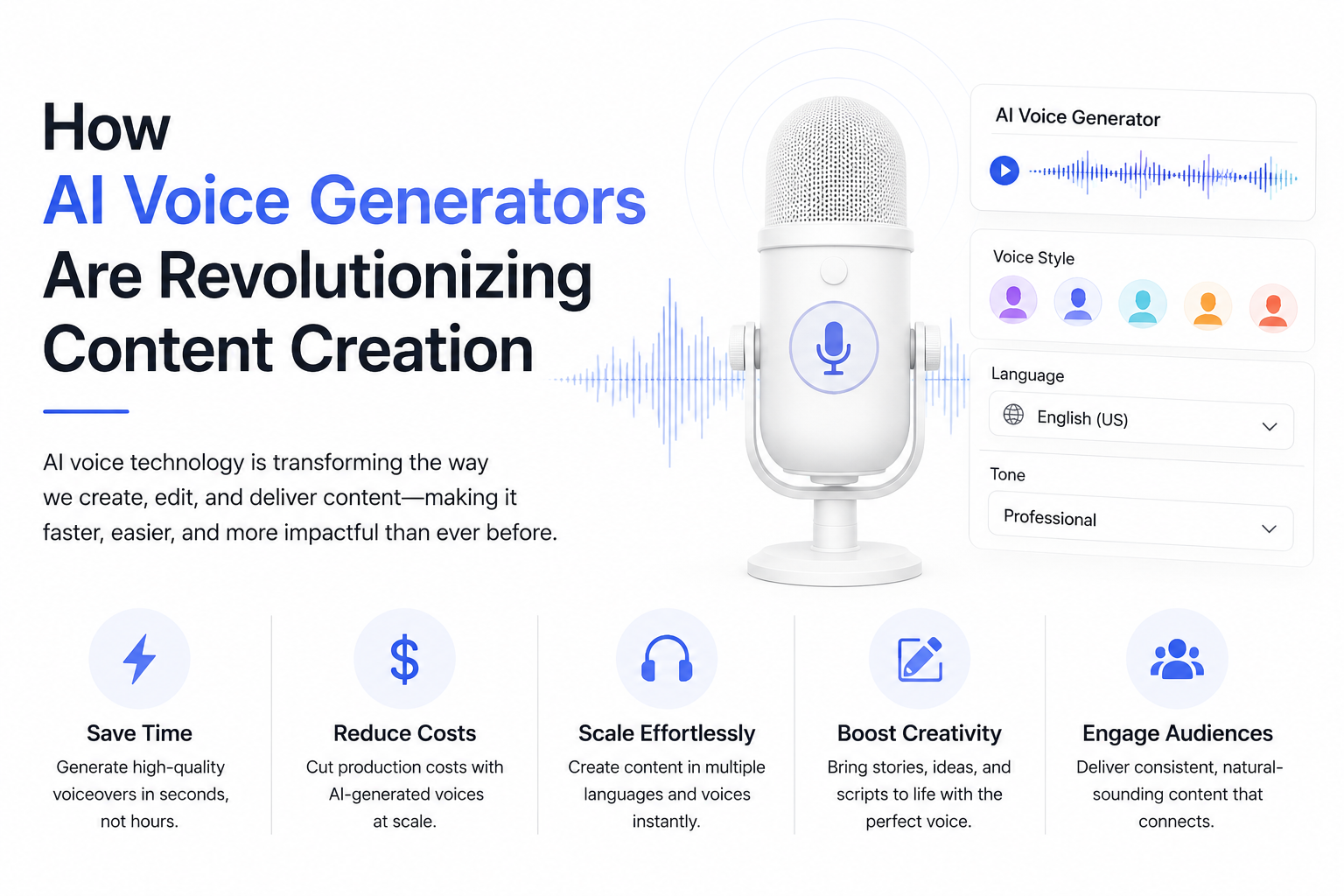
Think about the traditional voiceover process: script writing, casting, recording sessions, editing, re-recordings for mistakes, mixing, and mastering. This can take days, weeks, or even months for large projects. With AI voice generators, that timeline shrinks dramatically. You simply input your text, choose a voice, and generate the audio in minutes, not hours. Need a revision? Just edit the text and re-generate. There's no need to recall a voice actor or re-book studio time.
For example, producing a 10-minute explainer video might involve a full day of studio recording and another day of post-production. With AI, that same voiceover could be ready in under an hour. This speed means you can respond to market trends faster, publish more frequently, and iterate on your content without the usual bottlenecks. A study by Deloitte estimated that AI-powered content creation tools could reduce production times by up to 70% for certain tasks, a significant boost for any content team.
Cost-Effectiveness: A Budget-Friendly Revolution
Hiring professional voice actors is expensive. Rates can range from hundreds to thousands of dollars per project, depending on the actor's experience, project length, and usage rights. Add in studio fees, sound engineers, and potential re-recording costs, and your budget can quickly spiral. AI voice generators offer a dramatically more affordable alternative.
While premium AI platforms have subscription costs, they are typically a fraction of what you'd pay for human voice talent, especially for ongoing projects or high volumes of content. For small businesses, independent creators, or educational institutions, this means they can now afford professional-quality audio that was previously out of reach. Companies report cost savings of 80-90% on voiceover production by switching to AI-generated voices for internal training videos or localized marketing campaigns.
Scaling Production Without Compromise
One of the most powerful aspects of AI voice generation is its scalability. Need your video translated and voiced in 15 different languages? No problem. AI can generate consistent voiceovers across multiple languages with ease, often offering native-sounding accents and pronunciations. This capability is invaluable for global brands looking to connect with diverse audiences.
Consider a company producing a daily news podcast. Using AI, they can generate hundreds of minutes of audio content every week with a consistent voice, tone, and quality, without needing a full team of voice actors on standby. This allows for unprecedented consistency and volume, ensuring your brand voice is always present and uniform, regardless of the scale of your content output. This also extends to accessibility, as AI voices can quickly create audio versions of written content, making it available to a wider audience, including those with visual impairments.
Comparison: Traditional Voiceover vs. AI Voiceover | ||
Feature | Traditional Voiceover | AI Voiceover |
|---|---|---|
Cost | High (talent fees, studio, editing) | Low (subscription or per-character pricing) |
Production Time | Days to weeks/months | Minutes to hours |
Flexibility & Revisions |