
How AI Voice Agents Reduce Patient No-Shows With Automated Reminders
At 9:47am, a physician walks into an exam room that should have a patient in it. The room is empty. The front desk confirms: the 9:30 appointment did not show, did not call, did not cancel. That slot is gone. The patient who needed care did not get it. The practice absorbs the loss and scrambles to fill the gap with a same-day call list that takes 20 minutes of staff time to work through. Multiply this by five missed appointments per day, five days a week, across a 12-physician practice. The math is painful.
Patient no-shows are one of the most persistent and costly operational problems in healthcare. Research consistently puts the average no-show rate at 5% to 30% depending on specialty, patient population, and appointment type. Primary care, mental health, and community health settings often sit at the higher end of that range. The aggregate cost to the U.S. healthcare system is estimated at over $150 billion annually in lost revenue and wasted clinical capacity.
AI voice agents are changing that equation in a meaningful way. Not by replacing human staff, but by handling the appointment reminder and confirmation workflow at a scale and consistency that human-staffed calling simply cannot match. This article explains how these systems work, what the documented outcomes look like, and how healthcare organizations can deploy them effectively.
Why the No-Show Problem Is Harder to Solve Than It Looks
Patient no-shows happen for a complex mix of reasons, and understanding that mix is essential to designing interventions that actually work rather than adding operational noise.
The Root Causes Behind Missed Appointments
Research on no-show drivers consistently identifies several primary factors. Forgetting is the most commonly cited reason, particularly for appointments scheduled weeks or months in advance. Transportation barriers affect significant patient populations, especially in rural areas and among elderly patients without reliable access to vehicles. Work schedule conflicts that patients did not anticipate at booking time are common, as are childcare barriers and cost concerns about copays or procedures. Finally, a meaningful share of no-shows reflects patients who feel better and no longer think the appointment is necessary, particularly for follow-up visits.
The distribution of these reasons matters because different interventions address different causes. A voice reminder is very effective at preventing forgetting-related no-shows. It can surface transportation barriers by asking the patient if they have transportation arranged. It can capture schedule conflicts early enough to allow rebooking. It cannot address cost concerns or symptom improvement unless the reminder conversation is designed to handle those responses explicitly.
Why Manual Calling Falls Short
Most practices use some combination of staff-made reminder calls, text messages, and patient portal notifications. The staffing model has consistent limitations. Staff can realistically complete 8 to 12 reminder calls per hour, meaning a practice with 60 appointments the next day needs 5 to 8 hours of staff time dedicated solely to reminder calls if every patient is to receive a personal call. Most practices cannot commit that capacity, so reminder protocols get abbreviated or inconsistently applied.
Studies show that practices relying primarily on text or portal reminders have no-show rates averaging 3 to 5 percentage points higher than those using voice-based reminder protocols, because a significant portion of the patient population does not regularly engage with digital notifications but will answer a phone call.
The Window That Matters Most
Timing is a critical variable in reminder effectiveness. Research consistently shows that the optimal reminder window is 24 to 48 hours before the appointment for the primary reminder, with a shorter same-day confirmation for high-risk patients or specialties with historically high no-show rates. Reminders placed more than 72 hours in advance show lower effectiveness because patients cannot yet concretely plan around the appointment, and same-day reminders alone leave too little time to fill the slot if the patient cancels.
The no-show problem is fundamentally a communication timing and reach problem. AI voice agents address both simultaneously: they reach every scheduled patient at the right moment, without the staffing constraints that make consistent manual calling impractical.
How AI Voice Agent Reminder Systems Work
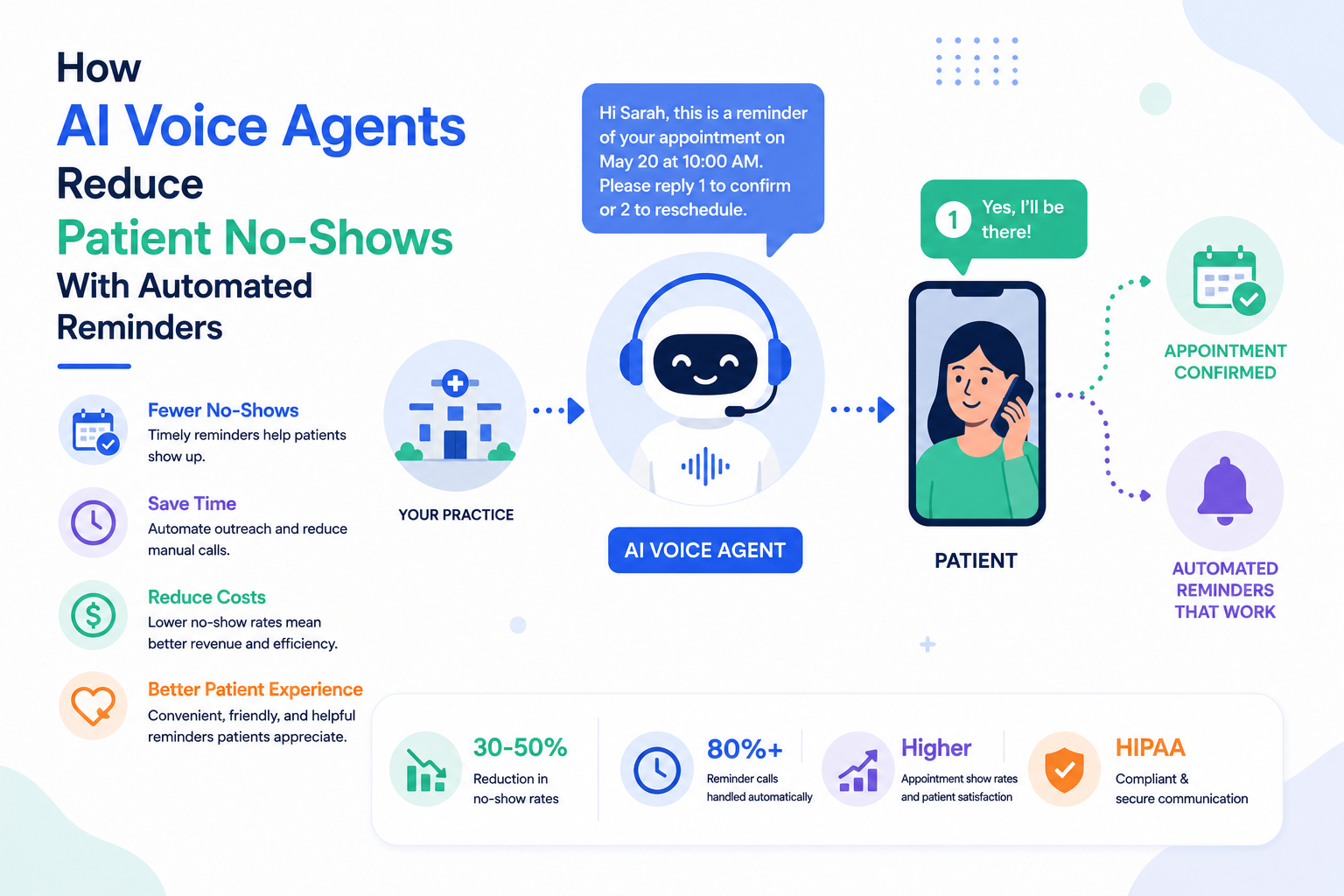
AI voice agents for appointment reminders are not simply automated robocalls with pre-recorded messages. The current generation of systems conducts genuine two-way conversations that handle patient responses, surface cancellations, offer rebooking, and integrate results back into the practice management system.
The Conversation Architecture
A well-designed AI voice reminder call begins by confirming it has reached the right patient, identifies the upcoming appointment with the provider name, date, time, and location, and asks for a confirmation response. From that confirmation request, the conversation branches based on the patient's response. A patient who confirms gets preparation instructions if applicable and a friendly close. A patient who needs to cancel is offered immediate rebooking within the call, which is far more effective at recovering the slot than directing the patient to call back later. A patient who raises a concern, like transportation or a question about what to bring, is handled by the AI or escalated to a human staff member depending on the complexity.
Natural Language Understanding for Patient Responses
Patients do not respond to appointment reminders in structured, predictable ways. They say things like "yeah, I'll be there," "I actually need to move that," "What time did you say again?" or "Hold on, let me check my calendar." The AI system needs to parse these natural responses correctly and route the conversation appropriately. Modern systems using speech recognition backed by OpenAI or Google Cloud speech models handle this conversational variability well in clean telephone audio conditions, though accent diversity and connection quality remain accuracy factors worth accounting for in deployment design.
Practice Management System Integration
The value of AI reminders multiplies when the system integrates directly with the practice's scheduling software. Confirmed appointments get flagged automatically. Cancellations trigger the waitlist workflow. Rebooking happens within the call and updates the schedule in real time. Without this integration, staff still need to manually process call outcomes, which eliminates a substantial share of the efficiency gains. Most modern AI reminder platforms integrate with common practice management systems including Epic, Cerner, Athena Health, eClinicalWorks, and Greenway Health through API connections.
Documented Outcomes: What the Numbers Actually Show
The business case for AI voice agent reminders rests on documented outcomes data, not projections. Here is what peer-reviewed research and health system deployment reports actually show.
No-Show Rate Reductions
Practices implementing AI voice reminder programs consistently document no-show rate reductions of 20% to 40% compared to their pre-implementation baseline. A community health center in California that implemented an AI voice reminder system across its 8 locations documented a no-show rate drop from 22% to 13% within 90 days of full deployment, representing a reduction of more than 400 missed appointments per month across the system.
A multispecialty group practice with 35 physicians documented a no-show rate reduction from 18% to 11% over six months, recovering an estimated $840,000 in annual revenue from previously lost appointment slots.
Cancellation Lead Time Improvement
An important secondary benefit of AI reminder calls is that when patients do cancel, they cancel earlier. With staff-only reminder protocols, a significant share of cancellations happen the morning of the appointment when filling the slot from the waitlist is difficult. AI reminder deployments consistently shift cancellations earlier, with 60 to 70% of cancellations occurring at least 24 hours in advance after implementation, compared to 35 to 45% before, giving practices much more time to backfill the slot.
Staff Time Reallocation
In practices where staff previously spent 3 to 5 hours daily on manual reminder calls, AI voice agents recover that time for higher-value activities: same-day scheduling, insurance verification, prior authorization work, and patient-facing administrative support. The financial value of this reallocation typically exceeds the direct no-show reduction revenue in mid-sized practices where staff capacity is a consistent bottleneck.
Patient Satisfaction Impact
Counter to what some practices initially expect, patient satisfaction scores for AI reminder calls tend to be positive. Patients appreciate being reminded. A well-designed AI voice interaction that is brief, clear, and easy to respond to is generally preferred over a robocall that plays a pre-recorded message with no interaction capability. The key design criterion is voice quality. A warm, natural-sounding AI voice achieves satisfaction scores significantly higher than a flat, synthetic-sounding system.
Voice Quality: Why It Matters More Than Most Practices Realize
The voice a patient hears when they pick up a reminder call shapes their entire perception of the interaction and, by extension, the practice. This is not a secondary concern. It directly affects response rates and patient satisfaction.
The Hangup Problem With Poor Voice Quality
When patients hear a robotic or obviously synthetic voice in the first two seconds of a call, a significant share hang up immediately. They recognize it as an automated call, associate it with spam or telemarketing, and disengage before the message is delivered. This hangup behavior effectively reduces the reach of the reminder program to only the patients who tolerate the voice long enough to hear the content, which tends to be a self-selected group that was already likely to attend.
The patients most likely to hang up on a robotic-sounding call are often the same patients at highest risk of no-showing: those with low digital engagement, lower health literacy, and less frequent healthcare utilization. Designing reminder calls with high-quality, natural-sounding voices is therefore not just an aesthetic choice. It is a patient equity issue.
Neural TTS and Voice Cloning for Healthcare
The generation of text-to-speech quality available from platforms like ElevenLabs, Google WaveNet, and Amazon Polly Neural has crossed a threshold where most patients cannot distinguish AI-generated voices from human voices in a brief telephone interaction. This quality level, combined with the conversational interaction design of modern AI reminder systems, produces engagement rates that approach those of human-staffed calling at a fraction of the cost.
VoxClone AI takes this a step further by allowing healthcare organizations to clone a specific voice persona for their reminder calls, maintaining a consistent, recognizable voice identity that patients associate with the practice rather than an anonymous AI system. This consistency builds familiarity over repeated interactions and measurably improves patient response rates compared to generic synthetic voices.
Multilingual Voice Support for Diverse Patient Populations
In markets with linguistically diverse patient populations, AI voice reminder systems that support multiple languages can significantly improve no-show rates among non-English-speaking patients. Practices in South Florida, the U.S. Southwest, and major urban centers often serve patient populations where 20% to 40% of patients prefer communication in Spanish, Haitian Creole, Vietnamese, or other languages. A reminder call in the patient's preferred language is dramatically more effective than one in English for patients with limited English proficiency.
Compliance, Privacy, and Consent in AI Patient Outreach
AI voice agents making outbound calls to patients operate in a heavily regulated environment. Getting the compliance architecture right is not optional and must be addressed before any system goes live.
HIPAA and the Minimum Necessary Standard
Appointment reminder calls are generally permitted under HIPAA as part of treatment-related communication. However, the minimum necessary standard applies: reminder calls should include only the information needed to remind the patient about the appointment, not additional PHI that the patient did not request. The patient's name, provider name, appointment date and time, and location are appropriate. Diagnosis information, medication details, or other clinical data should not appear in an outbound reminder call unless the patient has explicitly authorized more detailed communication.
TCPA Consent Requirements
The Telephone Consumer Protection Act governs automated calls and texts to patient phone numbers. Healthcare providers making appointment reminder calls generally have established business relationship exemptions under TCPA that permit outbound calling to existing patients without explicit prior written consent for each call. However, this exemption has specific requirements regarding the purpose of the call and does not extend to marketing communications. Confirm with your legal counsel that your AI reminder program falls squarely within treatment-related communication exemptions before deployment.
AI Disclosure Requirements
Several states have enacted or are considering requirements that AI-generated calls disclose their automated nature to recipients. California's CIPA and similar statutes in other states have provisions that may apply to AI outbound calling. The safest practice is to have the AI caller identify itself as an automated reminder system within the first few sentences of the call, which also tends to improve patient receptiveness by setting accurate expectations about the interaction type.
High-Risk Patient Populations and Targeted Reminder Strategies
Not all patients have the same no-show risk, and not all appointments have the same consequence if missed. Effective AI reminder programs recognize this and apply differentiated strategies based on patient and appointment risk profiles.
Identifying High-Risk Patients
Most practice management systems contain data that predicts no-show risk: prior no-show history, appointment lead time, appointment type, patient age, and insurance type all correlate with no-show probability. Patients who have missed two or more appointments in the prior 12 months have no-show rates 2 to 4 times higher than patients with perfect attendance. Appointments scheduled more than 30 days in advance show consistently higher no-show rates than those scheduled within the week.
AI reminder systems that integrate with practice analytics can apply risk scoring to customize the reminder protocol: high-risk patients receive earlier and more frequent contact, are offered easier rebooking pathways during the call, and may receive a secondary follow-up reminder if the initial call goes unanswered.
Appointment Type Differentiation
Mental health, substance use, and chronic disease management appointments have consistently higher no-show rates than acute care visits. For these appointment types, a more supportive reminder conversation that acknowledges the patient's context and gently reinforces the value of attendance can improve response rates. This requires more sophisticated dialogue design than a standard appointment confirmation, but the investment in that design pays disproportionate returns for the highest no-show-risk appointment categories.
Post-Cancellation Recovery Through AI
When a patient cancels during a reminder call, the AI agent can immediately offer the next available appointment rather than directing the patient to call back later. In-call rebooking converts a substantial share of cancellations into reschedules rather than lost care. Practices report in-call rebooking rates of 35 to 55% when the offer is made immediately at the point of cancellation, compared to 15 to 20% rebooking rates when patients are told to call the front desk to reschedule.
Deployment Best Practices for Healthcare Organizations
Getting an AI voice reminder program from concept to effective production requires careful attention to several operational design decisions that vendor demos rarely surface.
Define the Escalation Path Before Go-Live
Every AI reminder conversation will occasionally encounter a patient who wants to speak with a human, has an urgent concern, or presents a situation the AI is not equipped to handle. Design the escalation path before launch: at what point in the conversation does the AI offer a transfer? How is an urgent clinical concern flagged? What happens when the AI cannot understand the patient's response? These are not edge cases. They happen in every significant-volume deployment and the patient experience during these moments shapes perception of the entire program.
Test With Real Patient Demographics Before Full Rollout
Your patient population's age distribution, language preferences, and phone usage patterns should drive the pilot design. If 35% of your patients are over 70, your pilot needs to include a meaningful sample of elderly patients who may have different responses to AI callers than younger patients. If 25% prefer Spanish, test the Spanish-language version before rolling it out to that population. Assumptions based on general population data will not accurately predict how your specific patient base responds.
Measure the Right Metrics From Day One
Define your success metrics before launching: no-show rate, call completion rate, in-call cancellation and rebooking rate, patient satisfaction with the reminder interaction, and staff time recovered. Track these weekly for the first 90 days. The call completion rate and patient satisfaction data give you early signal on whether the voice quality and conversation design are performing, while the no-show rate gives you the financial outcome measure over a longer measurement window.
What the Next Two to Three Years Will Bring
AI patient outreach is moving rapidly from appointment reminders into a broader patient engagement role. Here is where the technology will be by 2028.
Predictive No-Show Intervention
Current AI reminder systems are primarily reactive: they remind every patient and handle responses. Next-generation systems will be predictive, using machine learning models trained on practice-specific historical data to identify which patients are most likely to no-show and deploying enhanced engagement protocols specifically for those patients, while using lighter-touch confirmation for low-risk patients. This personalization of intervention intensity will improve efficiency and patient experience simultaneously.
Longitudinal Patient Engagement Across the Care Journey
The same voice AI infrastructure handling appointment reminders will increasingly manage the full patient outreach calendar: post-discharge follow-up calls, chronic disease management check-ins, preventive care gap outreach, medication adherence support, and care plan education. Voice outreach platforms like VoxClone AI that provide consistent, natural-sounding voice synthesis are positioned to serve as the brand-consistent voice of a healthcare organization across all these touchpoints. Access the platform's voice capabilities through the VoxClone AI app on Google Play.
Integration With Patient Scheduling Self-Service
The natural extension of in-call rebooking is giving patients full self-service scheduling access within the AI voice interaction. By 2027, expect AI voice agents to handle not just reminders and rebooking, but new appointment scheduling for routine care, referral appointment booking, and real-time availability lookup across provider networks, all within a single voice call initiated by the patient or the practice.
Practical Implementation Checklist
Use this checklist to guide your AI voice reminder implementation from evaluation through deployment.
- Measure your current no-show rate by specialty and appointment type to establish a precise baseline
- Confirm HIPAA BAA coverage and TCPA compliance posture with your vendor before any pilot
- Verify AI disclosure approach meets applicable state requirements for your operating locations
- Audit the voice quality of candidate platforms by listening to sample calls, not just reviewing specifications
- Confirm EHR or practice management system integration is native, not requiring manual outcome processing
- Design the full conversation flow including escalation paths before beginning the pilot
- Select a pilot patient population that reflects your actual demographic and language mix
- Set a 24 to 48 hour reminder timing as the default and add same-day confirmation for high-risk patients
- Define success metrics before launch and report them weekly during the first 90 days
- Build in-call rebooking capability from day one rather than treating it as a future enhancement
Conclusion
Patient no-shows are costly, operationally disruptive, and detrimental to the patients who miss care they need. AI voice agents address the primary driver, which is patient forgetting and the logistical friction around cancelling or confirming, at a scale and consistency that human-staffed calling cannot match at reasonable cost.
The documented outcomes are meaningful: no-show rate reductions of 25% to 40%, earlier cancellations that allow better slot recovery, staff hours returned to higher-value work, and patient satisfaction that holds positive when the AI voice quality and conversation design meet reasonable expectations. The technology is no longer experimental. It is production-ready and increasingly standard in competitive healthcare markets.
What separates practices that see transformative results from those that see marginal improvements is almost entirely in the deployment decisions: voice quality, language support, EHR integration, escalation design, and the willingness to run a proper pilot with real measurement before going system-wide. The technology delivers on its promise when the implementation gives it a fair chance to do so.
Tags:
#PatientNoShows #AIVoiceAgents #HealthcareAI #AppointmentReminders #PatientEngagement #VoiceAI #VoxCloneAI #HealthTech #PatientCommunication #AutomatedReminders #PracticeManagement #HealthcareOperations