
How AI Voice Agents Automate Insurance Benefits Verification and Eligibility Calls
A billing coordinator at a busy orthopedic practice starts her day with a list of 40 patients scheduled for the next two days. Every one of them needs insurance eligibility verified before their appointment. She picks up the phone and dials the first payer. Hold time: 14 minutes. She gets through, reads out the member ID, navigates three menu prompts, and spends six minutes confirming benefits. She moves to the next call. By noon, she has cleared eight patients. There are 32 to go and the afternoon patient intake is already starting to queue up.
Insurance verification is the administrative tax on every healthcare appointment. It is non-negotiable, highly repetitive, and extraordinarily time-consuming when done manually. The American Medical Association estimates that the U.S. healthcare system spends over $80 billion annually on administrative tasks related to insurance verification and prior authorization alone, with a meaningful share of that cost absorbed by practices and health systems rather than insurers.
AI voice agents are changing the economics of this process in a concrete way. They make payer calls autonomously, navigate IVR systems, extract eligibility and benefit data, and return structured results to practice management systems in minutes rather than hours. This article explains how they work, where the genuine efficiency gains are, and what practices need to understand before deploying them.
The Scale of the Insurance Verification Problem
Before assessing solutions, it is worth being precise about the scope of the problem. Insurance verification is not one task. It is a cluster of distinct verification activities that practices must complete before each appointment to protect their revenue and avoid post-service billing disputes.
What Verification Actually Covers
A complete insurance verification workflow confirms: active coverage status and effective dates, primary and secondary payer details, deductible amounts and year-to-date accumulations, co-pay and co-insurance responsibilities for the specific visit type, out-of-pocket maximum and current balance, referral requirements if applicable, prior authorization requirements for planned procedures, and network status of the rendering provider. Missing any of these elements can result in underpayment, claim denial, or unexpected patient financial liability that damages the practice-patient relationship.
The Time Cost at Scale
A manual phone-based verification call to a payer takes an average of 18 to 25 minutes including hold time according to research from the Healthcare Financial Management Association. For a practice verifying 50 patients per day, that is 15 to 21 staff hours consumed by a single administrative function. At typical billing coordinator salary rates, this represents $60,000 to $90,000 in annual labor costs for the verification function alone in a mid-sized practice.
The Accuracy Problem With Manual Verification
Manual phone verification is also error-prone. A staff member transcribing benefit details from a payer representative's verbal response under time pressure makes mistakes. Deductible amounts get transposed. Co-pay tiers get confused. Network status gets ambiguously communicated and incorrectly recorded. Research from the Medical Group Management Association shows that incorrect or incomplete eligibility verification contributes to 23% of claim denials, making it one of the most financially significant sources of revenue cycle leakage.
Insurance verification is the kind of task that sounds simple until you do it at scale. Then it becomes clear that it is absorbing a disproportionate share of administrative capacity for a function that produces no clinical value and that technology should have automated years ago.
Two Approaches: API-Based and Voice-Based Verification Automation
Before discussing AI voice agents specifically, it is important to understand where they fit in the broader insurance verification automation space. There are two fundamentally different automation approaches, and understanding both helps you deploy the right tool for each payer situation.
EDI 270/271 and Real-Time Eligibility APIs
The ANSI X12 270/271 electronic transaction standard allows practices to submit eligibility inquiries electronically and receive structured eligibility responses from payers without a phone call. Major payers and clearinghouses support this standard, and most modern practice management systems can execute real-time eligibility checks through clearinghouse connections to Availity, Change Healthcare, Waystar, and similar services.
For payers that support EDI 270/271 real-time eligibility, this approach is faster and more reliable than voice-based verification. A real-time eligibility response returns in seconds and populates structured data fields automatically. This should be the primary verification method wherever it is available.
Where Voice-Based AI Verification Fills the Gap
Despite the existence of EDI standards, a significant share of payer interactions still require phone verification because: some smaller and regional payers do not support real-time EDI eligibility; EDI responses are sometimes incomplete for specific benefit types; workers' compensation and auto liability claims require phone-based verification; verification of secondary payer benefits often requires a call even when primary is covered electronically; and prior authorization requirements and clinical exception situations cannot be resolved through EDI alone.
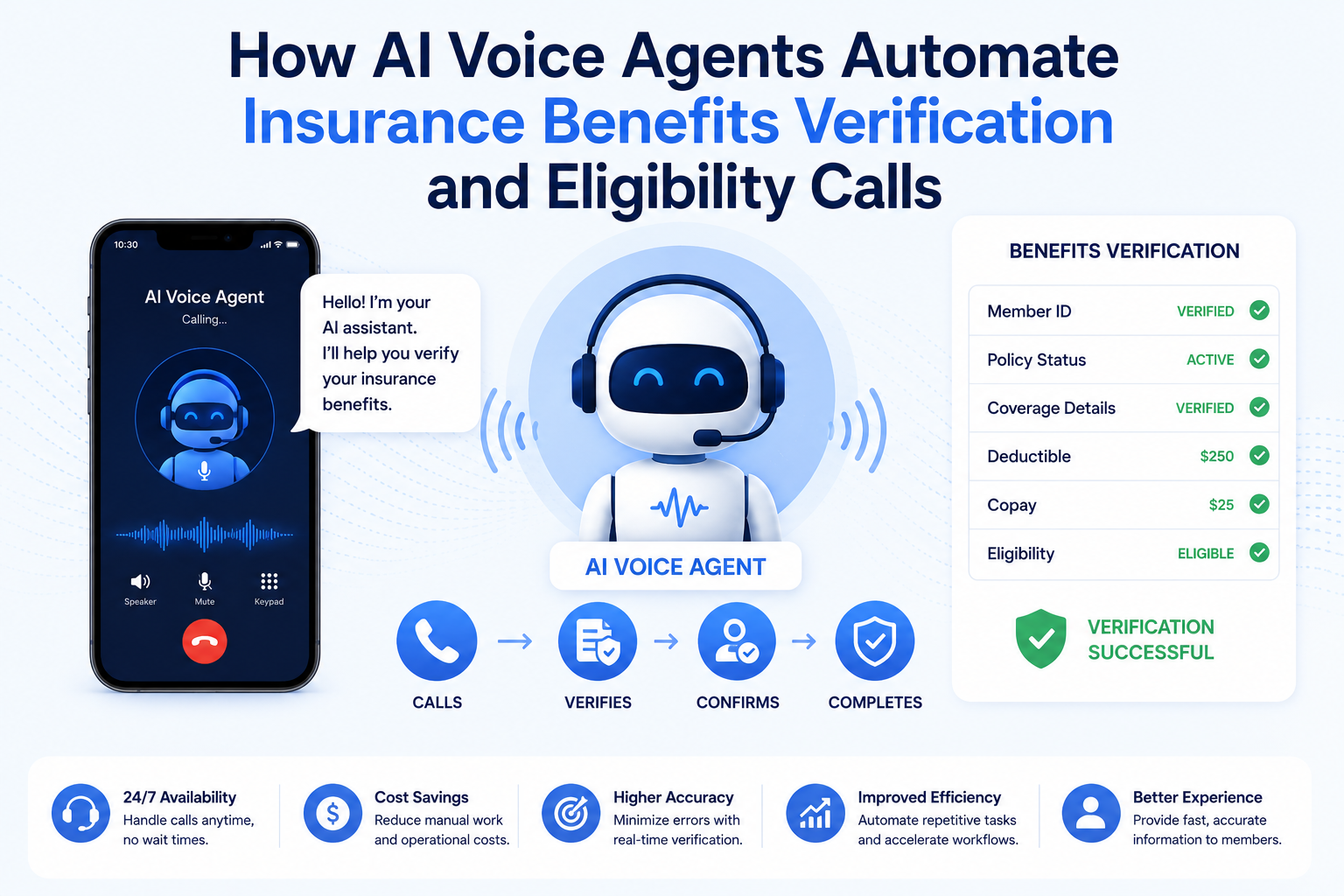
AI voice agents specifically address these remaining phone-based verification scenarios. Rather than a staff member making the call, an AI agent dials the payer, navigates the IVR system, provides the patient and member information, extracts the eligibility and benefit response, and returns structured data to the practice management system. The staff member never touches the call.
The Hybrid Strategy That Maximizes Efficiency
The most effective verification automation strategy combines both approaches: EDI real-time eligibility for all payers that support it, and AI voice agents for the remaining payer interactions that require phone-based verification. This combination typically eliminates 85 to 95% of manual verification call volume, leaving only the genuinely complex exceptions that benefit from human handling.
How AI Voice Agents Navigate Payer Phone Systems
Understanding the technical mechanics of how AI voice agents actually make payer calls helps set realistic expectations and identify where failure modes occur.
IVR Navigation and DTMF Tone Sending
Most payer phone systems use interactive voice response (IVR) menus that require the caller to press numbers or say specific words to navigate to the eligibility verification option. AI voice agents handle IVR navigation through a combination of speech recognition to understand menu prompts and DTMF tone generation to select menu options. For payers with consistent IVR structures, agents can be pre-configured with navigation sequences that route directly to eligibility without waiting through irrelevant menu options.
Hold Time Management
Payer hold times are one of the primary costs in manual verification. An AI voice agent waits on hold without consuming human staff time. The agent monitors the audio stream for the cue that a payer representative has answered (typically a specific greeting phrase or audio pattern change) and activates the verification dialogue when the representative comes on the line. Multiple AI agents can run simultaneously across different payer calls, meaning a practice can parallelize its verification queue in a way that is impossible with human callers.
Information Exchange With Payer Representatives
Once connected to a payer representative, the AI voice agent provides the patient's member ID, date of birth, provider NPI, and date of service in response to the representative's prompts. It listens to the representative's verbal benefit information, transcribes it using speech recognition, extracts structured data elements (deductible amount, co-pay, network status, etc.), and returns those elements to the practice management system. The agent can also ask targeted follow-up questions if a specific benefit element is not provided in the initial response.
The Voice Quality Requirement for Payer Interactions
AI voice agents making payer verification calls need to sound natural enough that payer representatives respond normally rather than treating the call as anomalous. A robotic-sounding voice may trigger payer IVR confusion or cause representatives to behave differently than they would with a human caller. Neural TTS quality from platforms like ElevenLabs, Google WaveNet, and Amazon Polly Neural provides the voice naturalness needed for these interactions to proceed normally.
Documented Outcomes: What AI Verification Automation Delivers
The case for AI verification automation is built on specific, measurable outcomes that have been documented across production deployments.
Verification Time Reduction
The most immediate and measurable outcome is the reduction in time per verification. An AI voice agent completes a payer verification call in the same wall-clock time as a human caller but consumes zero staff time during hold and call handling. When multiple AI agents run in parallel, a practice's daily verification queue can be processed in a fraction of the time previously required. Practices report completing their full next-day verification batch overnight, arriving in the morning with complete eligibility data already in the system rather than starting the day with a manual calling queue.
Clean Claim Rate Improvement
When eligibility data is complete and accurate before the appointment, billing teams can generate cleaner claims with correct payer information, accurate benefit details, and properly set patient financial responsibility. Practices implementing AI verification automation consistently report clean claim rate improvements of 8 to 18 percentage points, reducing the costly rework associated with denied and rejected claims. At an average rework cost of $25 to $118 per denied claim, the revenue cycle financial impact of clean claim rate improvement is substantial.
Case Study: Large Primary Care Network
A primary care network with 22 locations and an average of 800 patient visits per day deployed a combined EDI plus AI voice agent verification strategy in 2025. After 6 months of full deployment:
- Manual verification call volume reduced by 87% across the network
- Billing coordinator time on verification reduced from 6.2 hours per day per location to 0.8 hours
- Clean claim rate on first submission improved from 78% to 91%
- Claim denial rate due to eligibility issues dropped from 11% to 3.2%
- Estimated annual revenue cycle savings across the network: $2.3 million
Patient Financial Experience Improvement
Complete eligibility data before the appointment allows practices to provide accurate cost estimates to patients. Patients who know their financial responsibility before arriving for care are better prepared, more likely to make co-pay payments at the point of service, and less likely to dispute bills after the fact. Research from Experian Health shows that 75% of patients want to know their cost estimate before a healthcare appointment, and practices that provide this information see higher patient financial satisfaction scores and lower balance due after service.
Technical and Operational Challenges in AI Verification Deployment
AI verification automation is not plug-and-play. Several specific challenges arise in production deployments that need to be anticipated and addressed in implementation design.
Payer IVR Variability and Change
Different payers have different IVR structures, and a single payer may change its IVR menus without notice. An AI verification agent configured for a specific payer's IVR navigation sequence will fail if that sequence changes. Robust AI verification platforms maintain continuously updated payer navigation configurations and alert operators when navigation failures indicate an IVR change. This ongoing maintenance responsibility is a real operational cost that vendor pricing should be evaluated against.
ASR Accuracy on Benefit Information
Extracting accurate benefit data from a payer representative's verbal response requires high ASR accuracy on the specific vocabulary of insurance benefits, including deductible amounts, plan types, network tier names, and coverage percentages. Payer representative speech also varies in quality: some speak clearly with proper pacing, while others speak quickly, use internal jargon, or have accents that affect recognition accuracy. AI verification systems should be configured to escalate to human review when confidence on extracted financial data is below threshold, since an incorrect deductible amount in the system is worse than an uncompleted verification.
Practice Management System Integration
The extracted verification data needs to flow directly into the practice management system in structured fields, not as a free-text note that billing staff must manually parse and re-enter. Native integrations with common practice management systems like Epic, Cerner, Athena, eClinicalWorks, and NextGen are the standard expectation. Custom API integrations add implementation time and ongoing maintenance burden that should be factored into total cost of ownership.
Prior Authorization Escalation
When verification reveals that a planned procedure requires prior authorization, the AI agent must flag this clearly and route to human staff for follow-up. Prior authorization requires clinical documentation and cannot be completed by an AI agent. The verification agent's job in this scenario is to detect the requirement, capture the payer's authorization phone number and submission requirements, and create a task for the authorization team with all the information needed to complete the process.
Compliance Considerations for AI Payer Calls
AI voice agents making calls to payer organizations raise several compliance questions that should be reviewed before deployment.
Disclosure Requirements
Several states require disclosure when a call is being conducted by an automated or AI system. While insurance verification calls to payer organizations are business-to-business calls rather than consumer calls, some payers have their own policies on AI-generated calls that may require disclosure or may restrict AI callers from certain types of interactions. Review applicable state AI call disclosure requirements and check your major payers' published policies before deploying AI verification agents that make outbound calls to those payers.
HIPAA Data Handling in the Verification Pipeline
The AI verification call handles patient PHI: member ID, date of birth, and potentially diagnosis codes for prior authorization purposes. The AI platform, speech recognition provider, and data storage layer for verification results must all operate under appropriate HIPAA safeguards with signed Business Associate Agreements. Cloud infrastructure from Microsoft Azure, Google Cloud, and Amazon Web Services offer HIPAA-eligible configurations, but your specific vendor deployment must be confirmed compliant rather than assumed to be.
Documentation and Audit Trail
AI verification calls should generate a complete audit trail: timestamp of the call, payer called, patient for whom verification was conducted, benefit information extracted, and confidence scores on extracted data elements. If a claim is denied based on incorrect eligibility information, the ability to demonstrate that the practice conducted verification and what information was returned protects the practice in appeals and dispute processes. This documentation requirement should be a standard feature of any AI verification platform rather than a custom implementation.
The Broader Voice AI Ecosystem in Revenue Cycle Management
Insurance verification is one of several revenue cycle functions where AI voice agents are generating meaningful efficiency gains. Understanding the broader picture helps practices develop a coherent automation strategy rather than deploying point solutions.
Claims Status Inquiry Calls
Beyond eligibility verification, billing teams make substantial call volume to payers to check the status of submitted claims. These claim status calls follow a similar pattern to verification calls: navigate IVR, provide claim information, extract status response. AI voice agents handle claim status inquiries with the same efficiency gains as eligibility verification, and many AI verification platforms are extending into claim status as a natural adjacent capability.
Patient-Facing Voice AI for Financial Communication
The same voice AI infrastructure that calls payers on behalf of practices can also communicate verified benefit information to patients. An AI voice agent that calls a patient 48 hours before their appointment to confirm their co-pay, explain their deductible status, and answer basic coverage questions reduces financial surprises and improves point-of-service collection rates. This patient-facing function requires a natural, warm voice that patients trust. Voice synthesis platforms like VoxClone AI provide the voice cloning and neural synthesis capabilities that make these patient-facing calls feel genuinely conversational rather than transactional. You can explore these capabilities through the VoxClone AI app on Google Play.
Prior Authorization Voice Assistance
Prior authorization is the most complex and costly area of insurance administration, consuming an average of 16 hours per physician per week according to the American Medical Association. While full prior authorization cannot be completed by an AI voice agent, AI can handle the initial information-gathering calls to confirm submission requirements, identify the appropriate submission pathway, and collect the payer's required clinical criteria before routing to a clinical team for the substantive authorization process.
What AI Insurance Verification Will Look Like by 2028
The trajectory of AI in insurance verification is moving from reactive verification to predictive revenue cycle management.
Predictive Eligibility Monitoring
Rather than verifying eligibility only before each appointment, next-generation systems will monitor patient coverage on a continuous basis, detecting plan changes, coverage terminations, and benefit period resets before they affect scheduled appointments. A patient whose coverage terminates between their booking date and their appointment date will be flagged automatically weeks before the visit rather than discovered at check-in, giving the practice time to address the coverage gap proactively.
Intelligent Benefit Navigation for Patients
AI systems will move beyond simply verifying coverage to actively navigating benefit structures on behalf of patients. The system will identify the lowest co-pay pathway for a needed procedure, flag when a referral from a primary care provider would reduce the specialist cost-share, and help patients understand their benefit year timing to maximize coverage for planned care. This kind of benefit navigation has historically been available only through high-end healthcare navigation services, but AI will make it accessible at the point of scheduling for all patients.
Real-Time Payer API Expansion
CMS regulations requiring payers to implement FHIR-based member access and provider APIs will gradually reduce the universe of verifications that require phone calls. As payer API coverage expands, the role of AI voice agents will shift toward the increasingly narrow set of complex, exception-driven verification scenarios that structured APIs cannot yet handle. By 2028, voice-based AI verification calls will be less common but more specialized, handling the genuinely complex situations that benefit most from conversational flexibility.
Implementation Checklist for Revenue Cycle Teams
Use this checklist to evaluate and deploy AI insurance verification automation effectively.
- Audit your current payer mix to identify which payers support EDI real-time eligibility versus which require phone verification
- Measure your current manual verification time per call and total daily verification hours as a baseline
- Confirm HIPAA BAA coverage for all AI platform vendors in the verification pipeline
- Review applicable state AI call disclosure requirements for outbound calls to payer organizations
- Confirm native practice management system integration rather than free-text data return
- Evaluate confidence scoring and escalation design for low-confidence extracted benefit data
- Assess payer IVR navigation update frequency and vendor maintenance commitment for navigation scripts
- Define the prior authorization detection and escalation workflow before go-live
- Run a pilot on a single payer or payer group for 30 days before expanding to full payer list
- Establish clean claim rate and denial rate tracking to measure post-deployment revenue cycle impact
Conclusion
Insurance verification is one of the most concrete opportunities for AI to deliver measurable financial and operational value in healthcare administration. The task is highly repetitive, time-consuming, and accuracy-critical. These characteristics make it exactly the kind of work that AI handles well and that human staff would rather not do.
The combination of EDI real-time eligibility for major payers and AI voice agents for phone-based verification scenarios delivers the most complete automation coverage. Together, these approaches can eliminate 85% to 95% of manual verification call volume, reduce labor costs by tens of thousands of dollars annually per location, improve clean claim rates by double-digit percentage points, and give patients accurate financial information before their appointments rather than surprising them after.
The challenges are real but manageable: payer IVR variability, ASR accuracy on financial data, integration requirements, and compliance architecture all need deliberate attention. Organizations that deploy with proper pilots, build in appropriate escalation paths, and maintain their payer configurations consistently see the outcomes the technology promises.
The billing coordinator who started this article with 40 verification calls on her list should not be making those calls. Technology has been capable of replacing that workflow for years. Organizations that have not yet deployed it are leaving both cost savings and revenue recovery on the table every working day.
Tags:
#InsuranceVerification #AIVoiceAgents #HealthcareAI #RevenueCycle #EligibilityVerification #VoiceAI #VoxCloneAI #HealthTech #BenefitsVerification #MedicalBilling #HIPAA #HealthcareAutomation