
Conversational Intelligence for Enterprise Sales: Optimizing CRM, Coaching, and Revenue Growth
Your top sales rep just closed a $400,000 deal. You want to know exactly what they said in the discovery call that moved the prospect from skeptical to signed. You want to replicate that across your other 30 reps. In the old model, you would ask them to debrief, get a partial recollection filtered through memory and ego, and hope something useful transfers. Most of what actually made that call work stays locked inside a Zoom recording that nobody reviews.
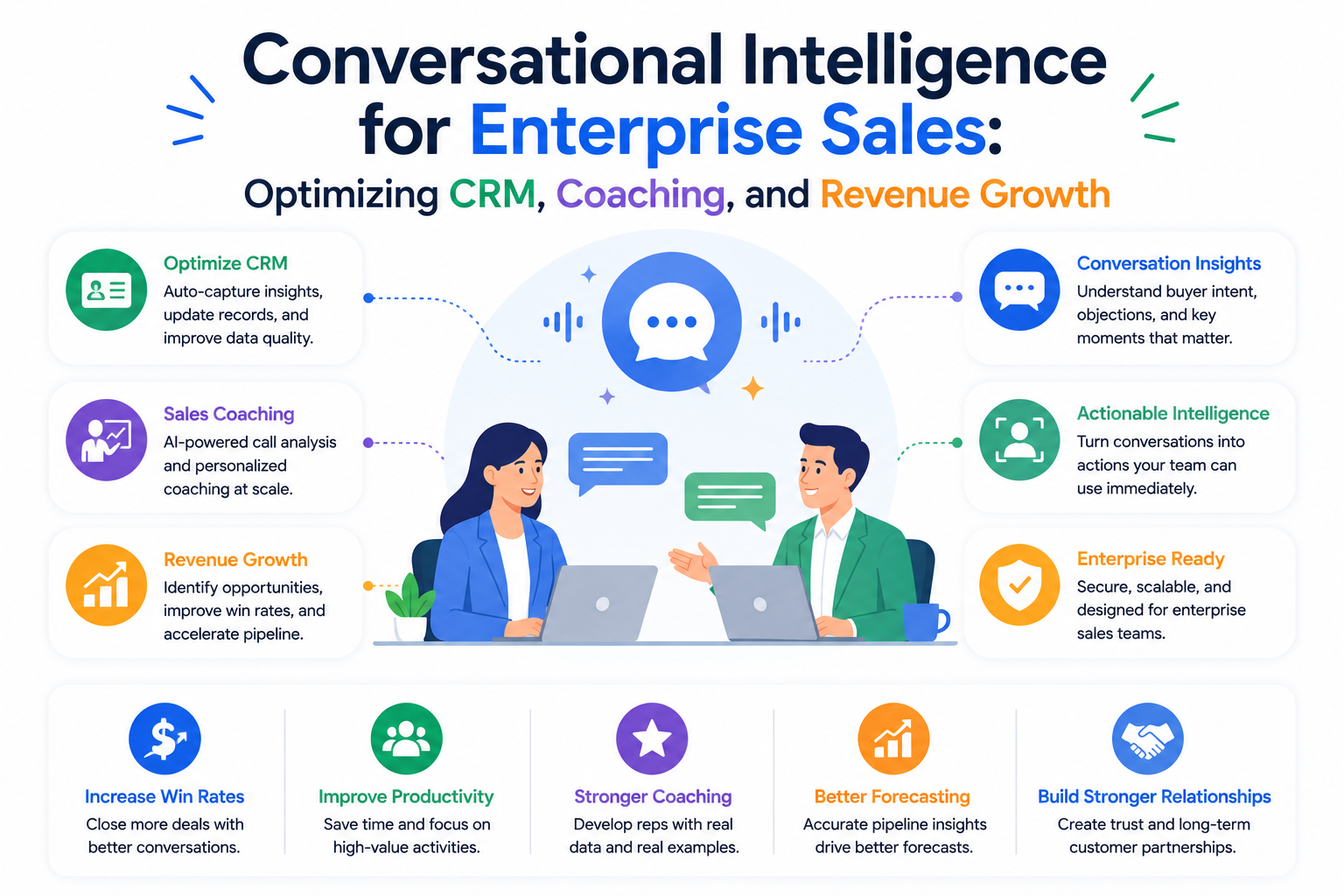
Conversational intelligence changes that equation entirely. It analyzes every sales call across your team, identifies the patterns that correlate with closed deals, surfaces the exact phrases and techniques your best performers use, and feeds that back into coaching and training with specificity that a quarterly performance review never could. The insights are not anecdotal. They are drawn from thousands of conversations, scored against real outcomes.
This is why enterprise sales teams are investing heavily in conversational intelligence right now. The technology has matured to a point where it delivers measurable revenue impact, not just interesting analytics dashboards. This article explains how it works, which companies are leading the space, and how to actually extract value from a deployment rather than just adding another tool to the stack.
What Conversational Intelligence Actually Is
The term gets used loosely, so it is worth being precise. Conversational intelligence is the application of AI to analyze spoken and written sales conversations, extract structured insights, and connect those insights to business outcomes like win rate, deal size, and sales cycle length.
Beyond Call Recording
Call recording has existed for decades. Conversational intelligence is fundamentally different because it does not just store audio. It processes language, identifies speakers, extracts topics and sentiment, tracks specific behaviors like talk-to-listen ratios and question frequency, and then correlates all of this against deal outcomes. The difference between a call recorder and a conversational intelligence platform is roughly the difference between a security camera and a forensic analyst reviewing the footage.
The Core Data It Produces
A mature conversational intelligence platform generates several distinct categories of structured output from each sales call:
- Transcription: Full text of the conversation with speaker attribution
- Topic tagging: Identification of key subjects discussed, including competitor mentions, pricing objections, and product features raised
- Sentiment scoring: Assessment of prospect engagement and emotional response at different points in the call
- Behavioral metrics: Talk time ratios, interruption frequency, question count, monologue length
- CRM data extraction: Automatic identification of next steps, commitments, and deal information mentioned verbally but not yet logged
Why Enterprise Sales Is the Right Home for This Technology
Enterprise sales has characteristics that make conversational intelligence particularly valuable. Deals are large enough that small improvements in win rate produce significant revenue impact. Sales cycles are long, involving multiple conversations across months, which creates rich data for analysis. And sales teams are typically large enough that coaching at scale is a genuine operational challenge rather than something a manager can handle through individual observation alone.
Gartner research indicates that by 2026, conversational intelligence tools will be standard practice in over 50% of B2B enterprise sales organizations. The technology has moved from early adopter novelty to mainstream revenue infrastructure.
The CRM Problem That Conversational Intelligence Solves
Ask any sales leader about their CRM data quality and the response is usually some variation of: the data is there but we cannot trust it. CRM hygiene is a perennial problem in enterprise sales, and conversational intelligence addresses the root cause more effectively than any process enforcement approach has.
Why CRM Data Is Unreliable
Sales reps are hired to sell, not to do data entry. Manual CRM updates after calls are incomplete for structural reasons: reps are moving to the next activity, their memory of what was discussed degrades quickly, and the incentive for careful logging is indirect while the effort is immediate. Research from Salesforce indicates that salespeople spend only 28% of their week actually selling, with administrative tasks including CRM updates consuming a disproportionate share of non-selling time without producing reliably accurate data.
Automatic CRM Population From Call Content
Conversational intelligence platforms extract structured data directly from call transcripts and push it to the CRM without the rep having to log anything. When a prospect mentions "we need this in place before the fiscal year ends in March," the system extracts a close date signal and updates the opportunity record. When a rep commits to sending a proposal by Friday, the system creates a task. When a competitor is mentioned by name, the competitive intelligence field is populated automatically.
This is not a minor efficiency gain. It is a structural improvement in data quality that compounds over time. Teams using automatic CRM population from call intelligence report 40% to 60% improvements in CRM field completion rates, which makes forecasting more accurate and pipeline analytics more actionable.
Deal Risk Identification Through Conversational Signals
Conversational intelligence can identify deal risk signals that never make it into CRM fields under any manual logging regime. A prospect who has gone from enthusiastic in the first call to increasingly passive response patterns across three subsequent calls is telling you something about the deal. A rep who has not asked a single qualification question across two discovery calls is telling you something about their pipeline quality. These signals, visible in conversation data, are invisible in CRM records.
Sales Coaching at Scale: What the Data Makes Possible
Coaching is the highest-leverage activity a sales manager can do. Research from the Sales Management Association consistently shows that reps who receive regular, structured coaching outperform peers who do not by 19% on quota attainment. The problem is time. A manager with 10 to 15 direct reports cannot observe enough calls to coach effectively using traditional approaches.
Moving From Observation to Analysis
With conversational intelligence, a manager does not need to listen to 10 calls per week to understand how their team is performing. The platform surfaces the relevant moments: the call where the rep talked for 78% of the time on a discovery call that was supposed to be prospect-led, the three consecutive calls where competitor objections were raised and handled poorly, the call where a rep closed a deal with a technique worth replicating. Managers coach from data rather than from the subset of calls they happen to have time to review.
Identifying What Top Performers Do Differently
This is where conversational intelligence delivers one of its most actionable outputs. By comparing the call patterns of top-quartile performers against the rest of the team, platforms can identify specific, coachable behaviors that correlate with winning deals. Common findings across deployments include:
- Top performers ask 2.6 times more questions during discovery calls than average performers
- Winning deals involve discussion of business impact within the first 10 minutes at significantly higher rates than losing deals
- Reps who explicitly confirm next steps verbally at the end of calls have 28% higher follow-through rates from prospects
- Deals that include multiple stakeholders on at least one call close at higher average values and faster cycle times
Ramp Time Acceleration for New Hires
New sales hire ramp time is one of the most expensive variables in enterprise sales operations. A rep who takes 9 months to reach full productivity represents significant deferred revenue compared to one who ramps in 6 months. Conversational intelligence accelerates ramp by giving new hires direct access to a library of calls showing exactly how experienced reps handle different stages and objections, tied to outcome data showing which approaches work. Companies using call intelligence for onboarding report ramp time reductions of 20% to 35%, which translates directly to earlier revenue contribution.
The Leading Platforms in Conversational Intelligence for Sales
The market has consolidated around a small number of purpose-built platforms, alongside capabilities being added by broader CRM vendors.
Gong
Gong is the category leader in revenue intelligence, having grown from a call analytics tool into a full revenue intelligence platform covering pipeline analytics, forecasting, and rep coaching. Gong processes tens of millions of sales interactions annually and has built one of the largest datasets of sales conversation patterns correlated to deal outcomes. Their AI models trained on this dataset power insights that no individual company's data alone could produce.
Chorus (ZoomInfo)
Chorus, acquired by ZoomInfo in 2021, integrates deeply with ZoomInfo's broader B2B data platform, which gives it unique context about the prospects being discussed in calls. Sales reps using Chorus can see firmographic and technographic data about a prospect alongside the call transcript, allowing for richer deal analysis than call data alone provides.
Salesforce Einstein Conversation Insights
Salesforce has built conversational intelligence directly into the Einstein AI suite, which has the significant advantage of native integration with Salesforce CRM. For organizations already standardized on Salesforce, Einstein Conversation Insights removes the integration overhead that third-party platforms require, though purpose-built tools like Gong remain ahead on pure analytics depth.
Microsoft Copilot for Sales
Microsoft's Copilot for Sales, integrating Teams meeting intelligence with Dynamics 365 and Microsoft 365, brings conversational intelligence directly into the Microsoft ecosystem. For enterprises standardized on Microsoft infrastructure, this represents a compelling path to call intelligence without deploying a separate vendor relationship.
Revenue Impact: What Actual Deployments Show
The business case for conversational intelligence rests on hard outcomes data, not marketing claims. Here is what the documented evidence actually shows.
Win Rate Improvement
Multiple enterprise deployments have documented win rate improvements of 15% to 25% following conversational intelligence adoption, though isolating the technology's contribution from other sales improvements happening simultaneously is methodologically complex. Gong's own published customer data cites an average of 21% improvement in win rates among customers who actively use their coaching and deal intelligence features, compared to customers who have access but do not use these features.
Forecast Accuracy
One of the clearest impacts is on forecast accuracy. Teams using AI-driven pipeline analysis report forecast accuracy improvements from a typical range of 60% to 70% up to 85% to 90%. For organizations where inaccurate forecasts create operational and financial planning problems, this improvement has value that extends beyond the sales organization.
Case Study: Mid-Market SaaS Company
A B2B SaaS company with a 45-person enterprise sales team deployed Gong in 2024 across their full team. After 12 months, they documented the following outcomes compared to the prior year:
- Average rep ramp time decreased from 7.2 months to 5.1 months
- Win rate on enterprise deals above $100,000 improved from 18% to 23%
- CRM data completeness on key opportunity fields improved from 64% to 91%
- Sales manager time spent on call review dropped by 40% while coaching quality scores from reps improved
- Quarterly forecast accuracy improved from 68% to 87%
Where ROI Is Hardest to Attribute
The honest caveat is that conversational intelligence rarely operates in isolation. Teams that see strong results typically combine the technology with improved coaching processes, sales methodology reinforcement, and management accountability changes. The technology amplifies good processes but does not substitute for them. Organizations that deploy call intelligence without changing how managers use the data see significantly lower returns.
Challenges and What to Watch Out For
Conversational intelligence deployments fail in predictable ways. Knowing the common failure patterns upfront saves significant time and credibility cost.
Rep Resistance and Privacy Concerns
Recording and analyzing sales calls requires explicit consent from both the rep and the prospect in most legal jurisdictions. Beyond the legal requirement, reps sometimes experience call intelligence as surveillance rather than support, particularly if the initial framing by management emphasizes monitoring rather than coaching. Organizations that frame the technology around rep benefit, specifically helping you close more deals and earn more, see dramatically higher adoption rates than those that frame it around management visibility.
Data Quality Requirements for Meaningful Insights
Conversational intelligence produces meaningful insights only when call volume is sufficient to identify statistically reliable patterns. A team with five reps doing 20 calls per month does not have enough data to draw reliable conclusions about what behaviors drive win rates. The technology scales with call volume, and smaller teams may need to wait until their data set is large enough before pattern-level insights become trustworthy.
Integration Complexity with Legacy CRM Setups
Enterprise CRM environments are rarely clean. Custom fields, modified workflows, non-standard object configurations, and data quality issues in existing records all create friction when connecting a conversational intelligence platform to extract and write data accurately. Budget time and technical resources for integration work, and do not assume an out-of-the-box connector will handle a customized Salesforce instance without adjustment.
The most common reason conversational intelligence deployments underperform is not the technology. It is that managers receive better data about rep performance and then continue to coach the same way they always have. The data is only as valuable as what you do with it.
The Next Two to Three Years: Where This Technology Is Heading
Conversational intelligence is moving from a post-call analysis tool toward a real-time and predictive capability. The next phase of development has several distinct threads.
Real-Time In-Call Assistance
Current platforms analyze calls after they end. The next generation is moving toward real-time assistance during calls: surfacing relevant case studies when a prospect raises a specific objection, flagging when a rep has been talking for too long without asking a question, prompting with relevant questions based on what the prospect has said so far. This requires much lower latency AI processing than post-call analysis, but the technical barriers are falling fast.
AI-Generated Sales Outreach Personalized From Call Data
Follow-up emails generated automatically from call content, referencing the specific concerns the prospect raised, the use cases they mentioned, and the next steps agreed in the conversation, are already being used by early adopters. The quality is improving rapidly. By 2027, expect AI-generated post-call follow-up to become standard practice rather than an experimental feature.
Voice AI for Outbound Sales Prospecting
The same voice AI infrastructure that powers analysis of human sales calls is increasingly being applied to AI-driven outbound prospecting calls. Platforms generating natural-sounding, personalized voice outreach at scale are emerging, raising the question of how much of the early sales funnel can be handled by AI agents before human reps take over for complex qualification and closing conversations. Voice synthesis platforms like VoxClone AI are part of this emerging infrastructure, providing the natural-sounding voice generation that makes AI-driven outreach effective rather than obviously synthetic. You can explore these capabilities directly through the VoxClone AI app on Google Play.
Practical Guidance for Enterprise Sales Leaders
If you are evaluating conversational intelligence for your sales organization, here is the framework that consistently separates successful deployments from expensive underperformances.
Define the Business Outcome First, Not the Feature List
Before evaluating platforms, be specific about what outcome you are trying to move. Ramp time reduction, win rate improvement, forecast accuracy, or CRM hygiene are each valid business cases but they prioritize different features and require different implementation approaches. Picking a platform and then searching for ROI is backwards. Start with the number you want to move and work backward to the capabilities that could plausibly move it.
Change How Managers Use Their Time Alongside the Technology
Conversational intelligence frees managers from listening to full call recordings but it does not automatically make them better coaches. Build explicit manager workflows around the data the platform surfaces. Define how many calls per rep per week managers are expected to review through the platform, what coaching frameworks they should apply to what they find, and how coaching conversations should be structured and documented.
Run a Genuine Pilot Before Full Deployment
Select 8 to 12 reps representing your normal performance distribution, not just your best performers. Run the platform for 90 days with real management engagement around the coaching features. Measure the outcomes you defined at the outset. A real pilot with measurement tells you far more than a vendor demo and reference calls with cherry-picked customers.
- Define the specific revenue metric you want to improve before selecting a platform
- Confirm legal consent requirements for call recording in all operating jurisdictions
- Frame the technology for reps around their benefit, not management monitoring
- Audit CRM integration requirements before signing a vendor contract
- Build explicit manager workflows around platform-surfaced insights
- Run a 90-day pilot with a representative rep sample before full rollout
- Measure defined outcomes at 90 days, 6 months, and 12 months post-deployment
Conclusion
Conversational intelligence has crossed the line from an interesting analytics tool into genuine revenue infrastructure for enterprise sales organizations. The ability to systematically analyze what happens in sales conversations, connect it to outcomes, and feed it back into coaching and CRM data at scale addresses problems that enterprise sales leaders have managed through intuition and selective observation for decades.
The documented outcomes are real. Win rate improvements of 15% to 25%, ramp time reductions of 20% to 35%, CRM completeness improvements of 40% to 60%, and forecast accuracy gains that move organizations from 65% to above 85%. These are not typical-results-may-vary claims. They are the consistent pattern from organizations that deploy the technology with genuine management engagement.
The technology is not magic and it does not replace good sales process, skilled managers, or talented reps. What it does is make the good things your best people do visible, repeatable, and teachable at a scale that individual observation never could reach. That is a genuinely meaningful advantage in competitive enterprise markets where the difference between winning and losing a deal often comes down to which team executed a complex conversation better.
Tags:
#ConversationalIntelligence #EnterpriseSales #SalesCoaching #RevenueGrowth #CRMOptimization #SalesAI #VoiceAI #VoxCloneAI #SalesTechnology #RevenueIntelligence #B2BSales #SalesLeadership