
Conformer Models for ASR: Accuracy Benchmarks, Performance, and Trade-Offs
Published July 20, 2026 · VoxClone AI
Imagine you're building a voice application that needs to transcribe customer calls in real time, across accents, background noise, and multiple languages, while keeping word error rates low enough that nobody notices a machine is doing the listening. That exact problem is what pushed Google's speech team to publish the Conformer architecture in 2020, and years later it still sits under a large share of production speech recognition systems.
If you've spent any time comparing ASR engines for a product decision, you've probably run into the name Conformer more than once. It shows up in research papers, in open-source toolkits like NVIDIA NeMo and ESPnet, and in the encoders behind several commercial transcription APIs. This article breaks down what the architecture actually does, what the benchmark numbers really mean, and where the accuracy-versus-speed trade-off tends to bite teams that skip the fine print.
Background and Context: Why ASR Needed a Better Architecture
For most of the 2010s, speech recognition systems leaned on recurrent networks, mainly LSTMs, stacked with attention layers. They worked, but they were slow to train and struggled to model very long dependencies in audio. When Transformers took over natural language processing, researchers naturally tried applying them to speech too.
Where Pure Transformers Fell Short
Transformers are excellent at capturing long-range context through self-attention, but they're comparatively weak at picking up fine-grained, local patterns, the kind of short acoustic events that make up phonemes and syllables. Convolutional networks are the opposite: great at local feature extraction, but limited in how far their receptive field can stretch without stacking many layers.
The Hybrid Idea Behind Conformer
Google's 2020 paper, Conformer: Convolution-augmented Transformer for Speech Recognition, proposed sandwiching a convolution module inside a Transformer-style block. The result captures both local and global patterns in one pass, rather than forcing one mechanism to do a job it's not suited for. That combination is the entire reason Conformer models outperformed both pure Transformer and pure convolutional baselines on standard benchmarks.
The design caught on fast. Within a couple of years, Conformer encoders were showing up in Google's production speech stack, in NVIDIA's Riva and NeMo toolkits, and in open frameworks like ESPnet and WeNet, which meant smaller teams could adopt the same architecture without building it from scratch.
Inside the Conformer Architecture
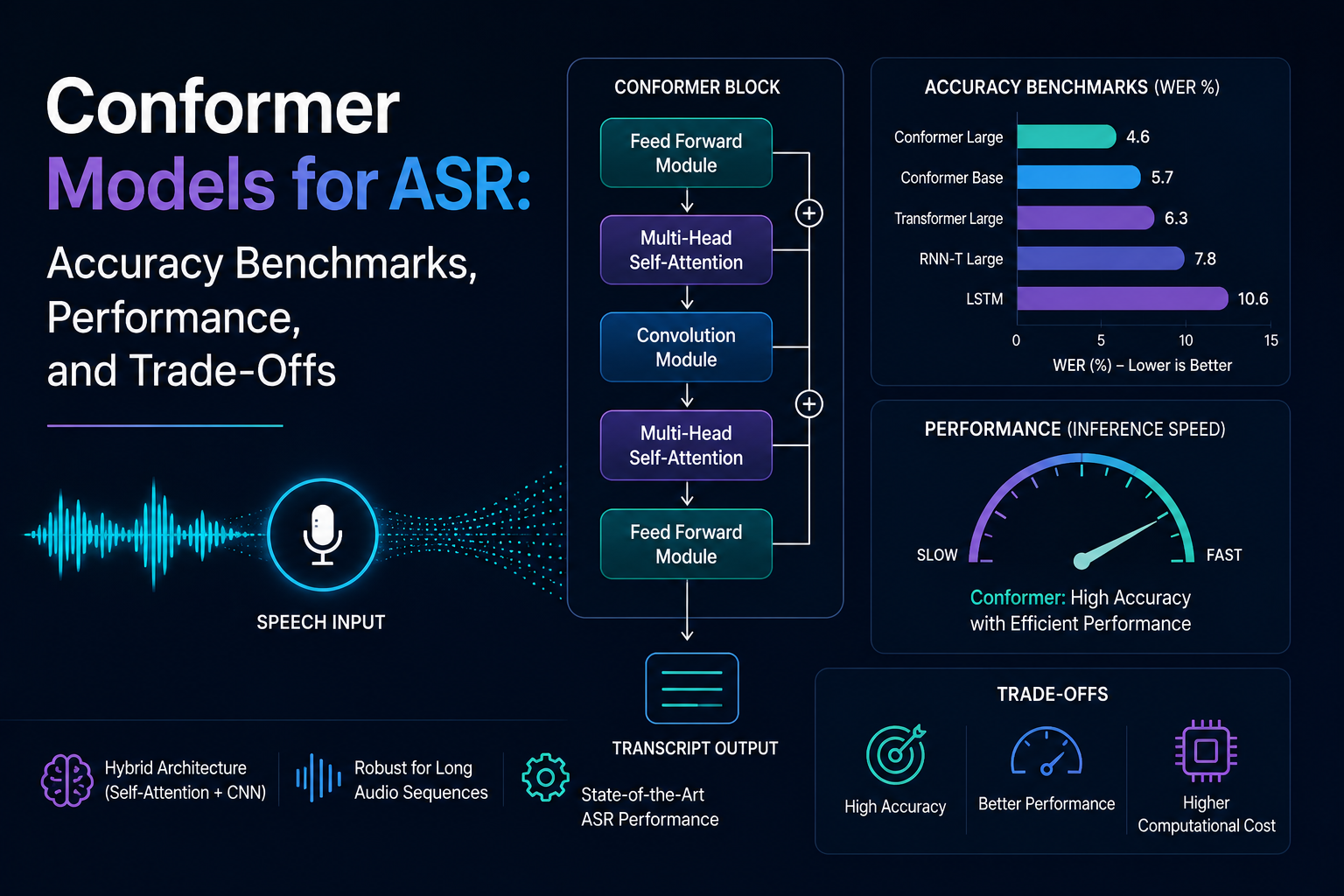
A Conformer block isn't just a Transformer with a convolution layer bolted on. It's a specific arrangement of four sub-modules, and the order matters.
The Macaron Feed-Forward Layers
Each block starts and ends with a half-step feed-forward network, an idea borrowed from the Macaron-Net architecture. Splitting the feed-forward computation this way, rather than using one full-strength layer, gave the original authors a small but consistent accuracy gain in their ablation studies.
Multi-Headed Self-Attention
Sitting in the middle is a standard multi-headed self-attention module with relative positional encoding, the same mechanism used in Transformer-XL. This is what lets the model relate a sound at the start of an utterance to one several seconds later, useful for things like resolving ambiguous words based on sentence-level context.
The Convolution Module
Right after attention comes a convolution module built from a gated linear unit, a depthwise convolution, and batch normalization. This is the piece that gives Conformer its name and its edge on local acoustic detail, things like plosive consonants and short transitions between phonemes that pure attention tends to smear over.
The core insight of the Conformer paper is simple to state and hard to execute well: local and global context aren't competing signals, they're complementary ones, and a single block should model both.
Stack 16 to 17 of these blocks together, depending on model size, and you get the full encoder used in most Conformer-based ASR systems today.
Accuracy Benchmarks Across Major ASR Datasets
LibriSpeech is still the reference point most papers use, largely because it's clean, public, and split into a test-clean set (higher quality recordings) and a harder test-other set (more challenging accents and audio conditions).
Original Conformer Results by Model Size
The original paper trained three sizes of Conformer, small, medium, and large, and reported word error rate (WER) both with and without an external language model.
| Model | Parameters | WER Clean (no LM) | WER Other (no LM) | WER Clean (with LM) | WER Other (with LM) |
|---|---|---|---|---|---|
| Conformer (S) | 10.3M | 2.7% | 6.3% | 2.1% | 5.0% |
| Conformer (M) | 30.7M | 2.3% | 5.0% | 2.0% | 4.3% |
| Conformer (L) | 118.8M | 2.1% | 4.3% | 1.9% | 3.9% |
What Happens When You Scale Further
Later work pushed Conformer encoders well past 118M parameters. Google's Universal Speech Model, published in 2023, used a Conformer-based encoder scaled up to roughly 2 billion parameters and trained on around 12 million hours of audio spanning more than 100 languages. Scale helps most on low-resource languages and noisy audio, less on already-clean English benchmarks where returns diminish fast.
Speed, Latency, and Real-Time Performance Trade-Offs
Accuracy numbers only tell half the story. For any production system, the question that actually decides your architecture is how fast the model runs, and whether it can run in a streaming fashion at all.
Real-Time Factor (RTF)
RTF measures how long it takes to process audio relative to its duration. An RTF of 0.2 means one minute of audio takes 12 seconds to transcribe. Small Conformer models optimized for inference on modern GPUs commonly land in the 0.02 to 0.05 range, while larger variants with beam search decoding can climb toward 0.2 to 0.3, still well under real time, but noticeably heavier on compute per request.
Streaming vs. Offline Decoding
The base Conformer architecture uses full self-attention, which looks at the entire utterance at once, fine for offline transcription but a problem for live captioning or voice assistants. Streaming variants solve this with chunked attention and causal convolution, typically trading a small accuracy hit, often 0.3 to 0.6 percentage points of WER, for first-token latency under 300 milliseconds.
Choosing a Size Tier for Your Use Case
| Tier | Parameters | Best For | Typical Latency | Accuracy Tier |
|---|---|---|---|---|
| Small | ~10M | Edge devices, mobile apps | Under 100ms per chunk | Good |
| Medium | ~30M | Balanced cloud APIs | 150 to 200ms | Very Good |
| Large | 120M+ | Call centers, captioning | 250 to 400ms | Best |
Conformer vs Other ASR Architectures
Conformer isn't the only serious option, and it's worth knowing where it wins and where it doesn't.
Conformer vs Transformer-Transducer and RNN-Transducer
Transducer architectures, whether built on Transformers or LSTMs, are designed for streaming from the ground up. Conformer encoders are often paired with a transducer decoder, called a Conformer-Transducer, to get the best of both worlds: strong local and global feature extraction from the encoder, and native streaming from the transducer loss.
Conformer vs Self-Supervised Models Like wav2vec 2.0
Meta's wav2vec 2.0, pretrained on unlabeled audio then fine-tuned, reached around 1.8% WER on test-clean with a language model, edging out a similarly sized Conformer on that specific benchmark. The catch is data efficiency versus deployment readiness: wav2vec 2.0's advantage shows up mainly in low-label settings, while Conformer tends to be simpler to deploy as a streaming system out of the box.
Conformer vs Whisper
OpenAI's Whisper takes a different bet entirely: massive weakly labeled multilingual training data over architectural cleverness. Whisper large-v3, at roughly 1.55 billion parameters, is remarkably robust across accents, noise, and languages, but it's built for offline or chunked batch transcription, not tight real-time streaming, and its compute cost per request is far higher than a comparably accurate Conformer model.
| Architecture | Typical Params | LibriSpeech Clean WER | Streaming | Relative Inference Cost |
|---|---|---|---|---|
| Conformer (L) | 118.8M | 2.1% | Strong | Medium |
| RNN-Transducer | ~120M | ~2.6% | Strong | Medium |
| wav2vec 2.0 Large (LM) | 317M | 1.8% | Weak | High |
| Whisper large-v3 | 1.55B | ~2.7% (varies by domain) | Weak | Very High |
Real-World Applications and Case Studies
Benchmarks are useful, but production deployments tell you more about where the trade-offs actually bite.
Call Center Transcription
Contact centers processing thousands of calls daily generally favor medium-to-large Conformer variants run offline in batch, since a few hundred extra milliseconds per call doesn't matter but accuracy on compliance-sensitive keywords does. Word error rates in the 4 to 8% range are common on real call audio, well above the polished LibriSpeech numbers, because of crosstalk, compression artifacts, and domain-specific vocabulary.
Voice Assistants and Live Captioning
Here, latency usually wins over the last half point of WER. Small streaming Conformer models, sometimes under 20M parameters after pruning or quantization, are common on-device choices for smart speakers and captioning tools, where a 200 millisecond delay is noticeable but a 2% accuracy gap often isn't.
ASR as the Front End for Voice AI Pipelines
Conformer-based ASR also matters beyond pure transcription. Platforms building voice cloning and text-to-speech products need reliable transcripts to align training data and validate output quality. At VoxClone AI, accurate speech-to-text is part of the quality pipeline that keeps cloned voices sounding natural rather than garbled. If you want to test the full workflow from your phone, the VoxClone AI app is also available for download on the Google Play Store.
Challenges and Solutions
Conformer models solve a lot, but they introduce their own set of headaches once you move past the demo stage.
Compute Cost at Scale
Self-attention scales quadratically with sequence length, so long-form audio, an hour-long meeting recording, for instance, can get expensive fast. Chunked or local attention variants address this directly, trading a small amount of long-range context for a manageable memory footprint.
Streaming Implementation Complexity
Converting an offline Conformer to a streaming one isn't a config flag, it typically means retraining with causal convolutions and limited attention context. Teams that underestimate this step often end up with a model that performs well in benchmarks but stutters or lags in production.
Domain Mismatch
A model trained on clean audiobook narration, like LibriSpeech, will underperform on accented, noisy, or jargon-heavy audio unless it's fine-tuned on data that looks like your actual use case. The single biggest predictor of real-world accuracy usually isn't model architecture, it's how closely your fine-tuning data matches your production audio. Domain adaptation with even a few hundred hours of representative audio typically closes a meaningful chunk of that gap.
Future Trends, Practical Takeaways, and Conclusion
Where Conformer-Based ASR Is Headed
Over the next two to three years, expect three shifts to keep accelerating: multilingual foundation encoders trained once and adapted to dozens of languages, tighter fusion between ASR and speaker diarization so transcripts come with speaker labels by default, and continued pruning and quantization work that pushes large Conformer accuracy down into small, on-device footprints. Companies including Microsoft, NVIDIA, and Amazon continue investing in production-grade Conformer and Conformer-hybrid pipelines, while TTS-focused platforms such as ElevenLabs and Murf increasingly depend on the same accurate transcription layer to support voice cloning and dubbing workflows.
Practical Takeaways
- Pick a Conformer size based on your latency budget first, then optimize accuracy within that budget, not the other way around.
- Test on audio that resembles your actual production conditions, not just LibriSpeech, before trusting any benchmark number.
- If you need streaming, plan for a dedicated streaming-trained variant from day one rather than retrofitting an offline model.
- Budget extra fine-tuning time for domain-specific vocabulary, since generic pretrained WER rarely survives contact with specialized terminology.
Conclusion
Conformer models earned their place in production ASR by solving a real architectural gap: neither pure attention nor pure convolution modeled speech as well on their own. The benchmark numbers, sub-2% WER on clean English audio at the large size, are genuinely strong, but the number that matters most for your project is rarely the headline figure. It's the latency your users will tolerate, the domain your audio actually comes from, and how much compute you're willing to spend per minute of speech. Get those three answered first, and choosing the right Conformer variant becomes a much simpler decision.
#ConformerModels #SpeechRecognition #ASR #VoiceAI #MachineLearning #DeepLearning #SpeechToText #VoiceTechnology #AIResearch #VoxCloneAI