
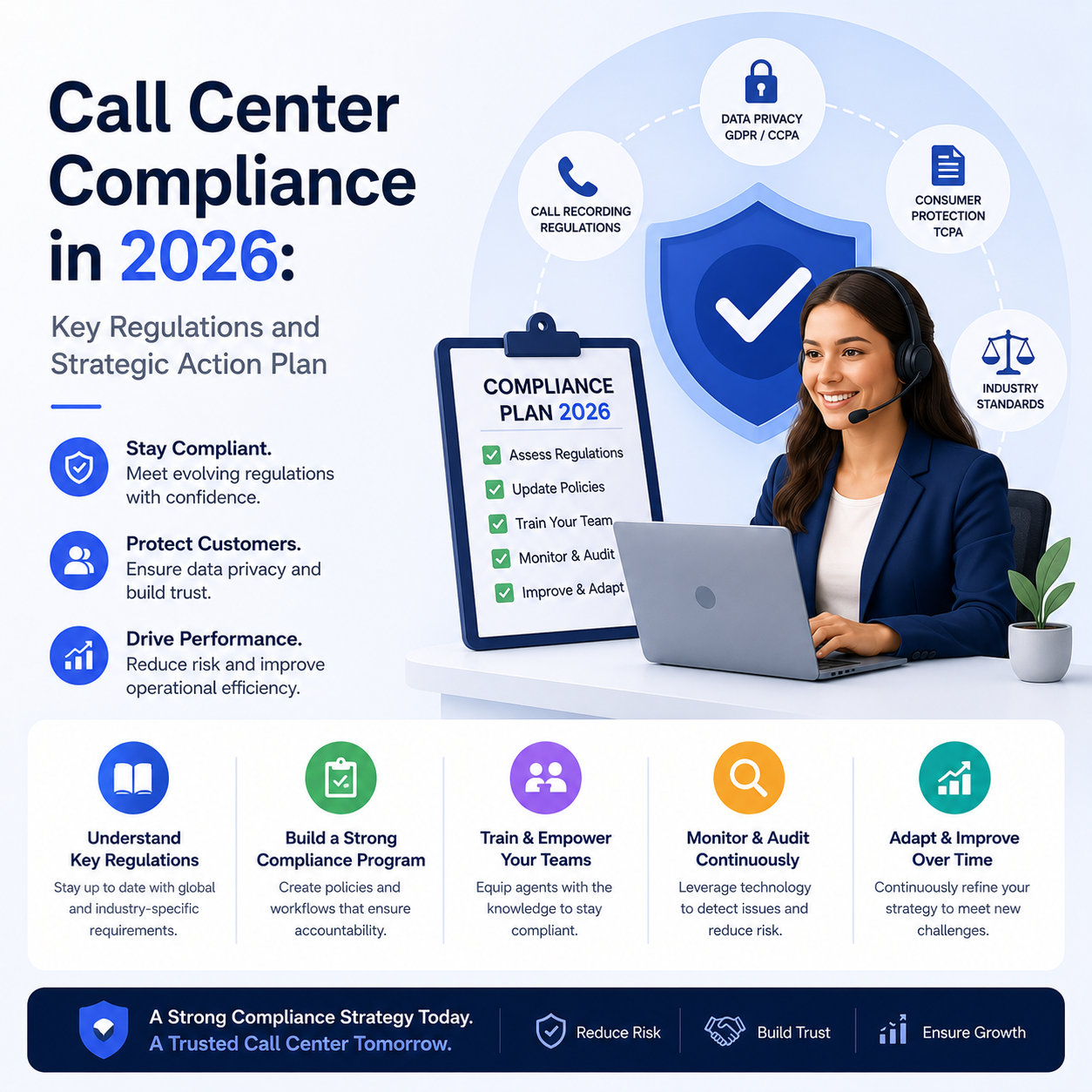
Call Center Compliance in 2026: Key Regulations and Strategic Action Plan
Your call center records every conversation. That is standard practice. But consider what each of those recordings actually contains: names, account numbers, health details, financial information, and sometimes the kind of personal disclosures people only make when they think they are speaking privately. Now consider how many of those recordings are stored, where they are stored, who can access them, and whether your organization can demonstrate all of that in a regulatory audit that starts Monday morning. If any part of that chain is unclear, you are not alone, and you are not in a comfortable position.
Call center compliance has never been more complex. In 2026, contact center operations are navigating a web of overlapping regulations that spans consumer protection, data privacy, AI-generated voice disclosure, and cross-border data transfer rules. The FCC's updated TCPA rules, GDPR enforcement actions that now regularly produce eight-figure fines, the EU AI Act's requirements for AI-driven communication systems, and a growing list of state and national privacy laws have collectively raised the compliance bar to a level that many organizations are struggling to clear.
This article is a practical guide to where that bar actually sits in 2026, which regulations matter most for your operation, and what a credible strategic response looks like. No buzzword bingo. Just the specifics you need to operate with confidence.
The Compliance Stakes in 2026: What Has Actually Changed
If you are working from a compliance framework that was last updated in 2022 or 2023, you are operating with an outdated map. The regulatory ground has shifted significantly, and several developments in 2025 and early 2026 have direct implications for call center operations.
The FCC's TCPA Overhaul and What It Means for Outbound Calls
The Telephone Consumer Protection Act (TCPA) has been enforced since 1991, but the FCC's 2024 ruling fundamentally changed the consent architecture for outbound calling. Prior to the ruling, a single written consent could cover multiple entities in a lead generation chain. The FCC closed that loophole. As of January 2025, each seller must obtain individual, one-to-one consent before placing automated calls or texts to a consumer. Consent obtained through a shared lead form that lists multiple companies no longer qualifies.
The financial exposure here is not theoretical. TCPA violations carry statutory damages of $500 per call for negligent violations and $1,500 per call for willful violations. In 2024, TCPA class action settlements totaled over $312 million across the insurance, financial services, and retail sectors. A single outbound campaign built on improperly obtained consent can generate thousands of individual violations simultaneously.
GDPR Enforcement Has Matured Into a Revenue-Scale Risk
European data protection authorities issued over 2.1 billion euros in GDPR fines in 2024, up from 1.6 billion euros the prior year. More importantly, the focus of enforcement has shifted from high-profile tech companies to mid-market operators, including contact centers processing EU resident data. The Irish Data Protection Commission, the CNIL in France, and Italy's Garante have all opened investigations into call recording practices in the past 18 months. If your call center handles calls involving EU residents, GDPR applies to you regardless of where your operation is based.
The EU AI Act's New Requirements for AI in Customer Contact
The EU AI Act, in force since August 2024 with phased application through 2026, introduces specific requirements for AI systems used in customer-facing interactions. Call centers using AI for call routing, sentiment analysis, agent coaching, or automated voice responses must now assess whether their systems fall under the Act's "limited risk" or "high risk" categories and meet the corresponding transparency and documentation requirements. AI systems that interact directly with consumers through voice must implement disclosure obligations: the customer must know they are interacting with an AI system.
"The regulatory question for AI in call centers is no longer whether disclosure is required. It is whether your disclosure is specific enough, delivered at the right moment, and documented well enough to survive scrutiny."
Core Regulatory Frameworks Every Call Center Must Know
Compliance is not a single regulation. It is a set of overlapping frameworks that apply depending on your industry, your geography, and the nature of the calls you handle. Here is the current map.
TCPA and the Do Not Call Registry
The TCPA governs automated calls and texts in the United States. The National Do Not Call Registry, maintained by the FTC, currently contains over 249 million registered phone numbers. Calling a registered number without an established business relationship or explicit consent is a per-call violation. Beyond the registry, the TCPA requires that calls using an automatic telephone dialing system (ATDS) or a prerecorded voice have prior express written consent for most commercial purposes. The definition of ATDS has been litigated extensively, and the safest operational assumption is that any system capable of generating or storing numbers and dialing them without human intervention qualifies.
GDPR and Cross-Border Data Flows
For call centers operating across international boundaries, GDPR is the most technically demanding framework to satisfy. The key requirements for contact center operations include: a documented lawful basis for processing each category of personal data; clear retention policies that are actually enforced, not just written; the ability to fulfill subject access requests within 30 days; and adequate safeguards for any data transferred outside the European Economic Area. The last point has grown more complex following the invalidation of various transfer mechanisms over the years. Organizations relying on Standard Contractual Clauses (SCCs) should verify they are using the 2021 versions and that their transfer impact assessments are current.
HIPAA for Healthcare Contact Centers
Any call center handling calls on behalf of a healthcare covered entity is operating as a business associate under HIPAA. That means a signed Business Associate Agreement (BAA), administrative safeguards covering workforce training and access controls, technical safeguards for any system that touches Protected Health Information (PHI), and physical safeguards for the facilities where calls are handled. HIPAA enforcement actions in 2024 included a $4.75 million settlement against a healthcare provider whose contact center vendor improperly disclosed PHI, a reminder that the covered entity remains liable even when a vendor is at fault.
PCI DSS for Payment Processing in Call Centers
PCI DSS v4.0, which became the mandatory standard in March 2025, introduced significant changes for call centers that process payment card data. Requirements 4.2.1 and 12.3.2 specifically address the risks of cardholder data exposure during phone-based transactions. Organizations must now demonstrate that they have assessed the risk of agents capturing card data through unauthorized means (screen capture, personal devices, written notes) and have implemented controls accordingly. Pause-and-resume recording during payment capture, or secure IVR-based card capture that bypasses agent interaction entirely, are the two most common technical approaches to satisfying this requirement.
| Regulation | Primary Scope | Key Call Center Obligation | Max Penalty |
|---|---|---|---|
| TCPA | US automated calls/texts | One-to-one written consent | $1,500 per violation |
| GDPR | EU resident personal data | Lawful basis, retention limits, transfer safeguards | 4% of global annual turnover |
| HIPAA | US healthcare PHI | BAA, technical and admin safeguards | $1.9M per violation category/year |
| PCI DSS v4.0 | Payment card data globally | Secure card capture, agent controls | $100,000/month (card brand fines) |
| EU AI Act | AI systems in EU market | AI disclosure, risk documentation | 35M euros or 7% global turnover |
AI Voice Technology and Compliance: A New Layer of Obligation
The adoption of AI voice technology in call centers has outpaced the development of clear compliance frameworks. That gap is closing fast, and the direction of travel is clear: more disclosure, more documentation, and more accountability for how AI systems interact with consumers.
Disclosure Requirements for AI-Generated Voice
Multiple jurisdictions now require that consumers be informed when they are interacting with an AI system rather than a human agent. The EU AI Act makes this explicit for systems that interact directly with people through voice or text. Several US states, including California, Colorado, and Illinois, have passed or are passing legislation requiring disclosure of AI use in consumer interactions. The FCC has taken the position that AI-generated voice in robocalls requires clear identification, a stance reinforced by its February 2024 ruling that AI-generated voices in robocalls are covered by existing TCPA prohibitions.
For call centers using AI voice assistants, automated IVR systems, or AI-powered agent support tools that generate voice output, the practical compliance question is straightforward: at what point in the interaction does the consumer know they are dealing with an AI, and is that disclosure logged? If the answer to either part is unclear, that is a gap that needs closing before the next audit.
Voice Cloning and Synthetic Voice in Commercial Calling
Voice cloning technology, which allows organizations to create synthetic voice personas that sound like real people, introduces a specific set of compliance questions. Using a cloned voice of a real individual without their consent in commercial communications is covered by existing laws on impersonation and fraud in most jurisdictions. Using a synthetic AI voice that is clearly disclosed as AI-generated occupies a different and generally permissible category, provided the required disclosures are made.
Organizations building AI voice agents for customer service should document clearly whether they are using a synthetic AI persona (permissible with disclosure) or a cloned version of a real person's voice (requiring explicit consent from the individual whose voice is being used). Platforms like VoxClone AI offer voice cloning capabilities for legitimate use cases where consent is obtained properly, including branding consistency, accessibility tools, and content production workflows.
Call Recording Consent Across Jurisdictions
Call recording consent requirements vary by jurisdiction and are routinely misunderstood. In the United States, federal law requires at minimum one-party consent, meaning the call can be recorded as long as one party (typically the call center) is aware of the recording. However, 12 US states require two-party or all-party consent, including California, Florida, Pennsylvania, and Washington. A California-based consumer calling a Texas-based call center is protected by California law, not Texas law. The safest operational approach, and the one most organizations in regulated industries have adopted, is all-party consent notification on every call regardless of the caller's location.
Data Retention, Access, and the Call Recording Compliance Problem
Call recordings are both a compliance asset and a compliance liability. You need them for quality assurance, dispute resolution, and regulatory audit purposes. You also need to control who can access them, how long they are kept, and what happens when a customer exercises their right to deletion.
Retention Requirements by Framework
Different regulatory frameworks impose different minimum retention periods, and those minimums do not always align. HIPAA requires retention of documentation related to PHI for a minimum of 6 years. MiFID II requires retention of call recordings related to financial transactions for 5 years, extendable to 7 for certain instrument types. PCI DSS does not mandate retention of call recordings but does require that cardholder data captured during a call is not retained unless there is a specific documented business need. GDPR, by contrast, treats retention minimization as a core data protection principle and expects organizations to delete data once the purpose for which it was collected is fulfilled.
The practical result is that many call centers end up with a retention policy that satisfies the most demanding requirement in their industry (typically 6 to 7 years for regulated financial services) but fails to account for the GDPR right to erasure. Customers who request deletion of their data cannot always have call recordings deleted if those recordings are subject to a mandatory retention obligation, but the organization must be able to explain and document why the retention obligation overrides the deletion request.
Access Control and Audit Trails
Knowing who has accessed a call recording, and when, is a compliance requirement under multiple frameworks. HIPAA's access control requirements are explicit. GDPR's accountability principle implies that access to personal data must be logged. PCI DSS requires audit logs for all access to cardholder data environments. In practice, many call center recording systems lack granular access logging at the recording level, logging access at the system level but not tracking which specific recordings were accessed by which agents or supervisors. That gap becomes significant when a data subject access request requires you to tell a customer what has been done with their data.
Encryption and Storage Security
Call recordings stored in unencrypted or weakly encrypted form represent a direct compliance risk under virtually every relevant framework. The current minimum standard for at-rest encryption is AES-256. For recordings that contain payment card data, healthcare information, or other sensitive categories, encryption should be applied at the recording level, not just at the storage bucket or drive level, so that individual recordings cannot be accessed even by an administrator who has storage-level access but not the recording-specific decryption key.
State and Regional Privacy Laws: The Patchwork Problem
Beyond the major federal and international frameworks, call centers operating in the United States face a growing patchwork of state privacy laws that have no federal equivalent to harmonize them.
The Current State Law Landscape
As of mid-2026, over 20 US states have enacted comprehensive privacy legislation, each with variations in scope, consumer rights, and enforcement mechanisms. California's CPRA, Virginia's VCDPA, Colorado's CPA, and Connecticut's CTDPA are among the most mature, but Texas, Florida, Oregon, Montana, and several others have added their own frameworks. The differences matter operationally: opt-out mechanisms, data broker registration requirements, and the definition of sensitive personal data vary across these laws in ways that require state-specific compliance adjustments.
Illinois BIPA and Biometric Data in Voice AI
Illinois's Biometric Information Privacy Act (BIPA) is the most litigation-prone privacy law in the United States for voice AI applications. BIPA requires written consent before collecting or using a biometric identifier, which courts have interpreted to include voiceprints. A call center that uses voice biometric authentication, or any AI system that creates a voiceprint of a caller, must comply with BIPA if any Illinois residents are calling. The statute's per-violation damages structure has produced massive class action exposure. BIPA settlements in voice-related cases averaged $92 million between 2022 and 2024.
India's DPDPA and International Outsourcing
India hosts a significant portion of the global call center industry. The Digital Personal Data Protection Act (DPDPA), enforced from 2025, applies to the processing of personal data of Indian data principals, as well as to data processed outside India if it is connected to offering goods or services to individuals in India. For BPO operations in India handling calls for international clients, DPDPA compliance adds a layer of obligations around consent, data fiduciary responsibilities, and cross-border transfer approvals that many operations are still working to integrate into their existing compliance programs.
| State / Jurisdiction | Key Law | Specific Call Center Impact | Enforcement Since |
|---|---|---|---|
| California | CPRA / CCPA | Opt-out of sale, data deletion rights, sensitive data rules | 2020 / 2023 |
| Illinois | BIPA | Voiceprint consent, biometric data handling | 2008 |
| Florida | FDBR | All-party call recording consent | 2024 |
| Texas | TDPSA | Sensitive data processing limits, opt-out rights | 2024 |
| India | DPDPA | Consent management, cross-border transfer rules | 2025 |
Challenges Organizations Face and How to Address Them
Understanding what regulations require is one problem. Building an organization that consistently meets those requirements at operational scale is a different and harder problem. Here is where most call centers run into trouble.
Consent Management at Volume
Consent is the foundation of compliant outbound calling. The practical challenge is that consent must be obtained, documented, timestamped, and retrievable on demand, for every consumer in your database, for every specific purpose for which you may contact them. At a call center handling millions of contacts, this is not a paperwork problem. It is an engineering and data governance problem. Organizations that try to manage consent through spreadsheets or manual processes routinely discover gaps when they need to produce consent records in response to a complaint or investigation.
The solution is a dedicated consent management platform that integrates with your CRM and contact systems. Leading CRM platforms like Salesforce and Microsoft Dynamics now offer consent management modules, and standalone solutions from vendors like OneTrust and TrustArc provide more granular control for complex multi-channel operations. The system needs to be the authoritative record of consent status, automatically blocking contacts when consent is withdrawn or expired, rather than relying on agents to check manually.
Agent Training and Behavioral Compliance
Technology controls can enforce many compliance requirements, but agent behavior remains a significant compliance variable. Over 60% of TCPA complaints involve agent behavior that violated script requirements or consent protocols rather than technology failures, according to a 2024 PACE Association survey. Agents who override Do Not Call flags, who fail to deliver required disclosures, or who capture cardholder data through unauthorized means create violations that no compliance system can prevent if the human behavior circumvents it.
Effective behavioral compliance requires training that goes beyond annual certification. Scenario-based training refreshers, real-time agent guidance tools that prompt required disclosures during calls, and quality monitoring that specifically looks for compliance-critical behaviors rather than just call quality metrics all contribute to consistent agent-level compliance.
Vendor and Third-Party Risk
Most call centers rely on third-party technology vendors for recording, analytics, AI, and CRM systems. Each of those vendors processes data on your behalf and creates compliance obligations that flow back to you. A 2024 Ponemon Institute study found that 59% of organizations had experienced a data breach caused by a third-party vendor. For healthcare call centers, that statistic translates directly into HIPAA Business Associate liability. The compliance answer is a vendor risk management program that includes privacy and security assessments at onboarding, contractual data processing terms, and periodic re-assessment rather than a one-time check.
"Compliance programs that only audit internal systems while trusting vendor assurances at face value are leaving their largest risk exposure unexamined. Your vendor's breach is your breach."
Future Trends: What Call Center Compliance Looks Like Through 2028
The regulatory direction is not difficult to read. More disclosure requirements, stricter enforcement, and expanding scope for existing frameworks are all trends that have been consistent over the past five years and show no sign of reversing.
Federal Privacy Legislation in the United States
The American Privacy Rights Act (APRA) passed the House in 2024 but stalled in the Senate. A federal privacy law remains a realistic possibility by 2027, and when it arrives, it will likely preempt some but not all state laws, creating a new compliance mapping exercise for organizations currently navigating the state patchwork. The trajectory of federal privacy proposals suggests a law that includes: a national Do Not Call-style consent requirement for voice communications, preemption of some TCPA provisions, and explicit requirements around AI-generated voice disclosure.
AI Regulation Expanding Beyond the EU
The EU AI Act has created a template that other jurisdictions are examining. The UK's AI Safety Institute, Canada's proposed Artificial Intelligence and Data Act (AIDA), and several US state-level AI bills are all moving in the same direction: requirements for transparency, accountability, and human oversight of AI systems in consumer-facing applications. For call centers, this means the disclosure and documentation requirements currently imposed by the EU AI Act are likely to expand to cover a larger portion of your customer base within two to three years.
Voice AI Tools for Compliance Monitoring
The compliance challenge is also generating compliance solutions. AI-powered speech analytics tools that monitor 100% of calls for compliance-critical language, required disclosures, and prohibited practices are becoming standard infrastructure rather than premium add-ons. Companies including NICE, Verint, and Google Cloud Contact Center AI offer compliance monitoring capabilities that can flag potential violations in near real time, giving supervisors the ability to intervene before a call ends rather than discovering the violation during a post-call audit. For individual creators and teams building voice content, tools like VoxClone AI provide accessible voice AI capabilities with clear consent-based workflows, reflecting the industry direction toward transparency in voice AI applications.
Strategic Action Plan: What to Actually Do in 2026
A compliance gap analysis is only useful if it leads to action. Here is a practical six-step framework for building or strengthening your call center compliance program in 2026.
Step 1: Map Your Data and Your Obligations
You cannot comply with obligations you have not identified. Start with a data mapping exercise that documents every category of personal data your call center processes, the legal basis for processing each category, where the data is stored, who has access, how long it is retained, and which regulatory frameworks govern it. This map does not need to be a complex tool. A well-maintained spreadsheet that is reviewed quarterly is more useful than an automated data discovery tool that was set up once and never updated.
Step 2: Audit Your Consent Infrastructure
For every outbound calling program, verify that consent records exist, are retrievable within minutes rather than days, and cover the specific communication channel and purpose for which you are using them. Run a sample audit: take 50 recent outbound calls to US consumers and pull the consent records for each. If you cannot retrieve clean consent documentation for more than 90% within 24 hours, your consent management infrastructure is a liability.
Step 3: Review Your AI Disclosure Practices
- Inventory every AI system that interacts with customers through voice or text.
- Confirm that each system has a documented disclosure mechanism that informs customers they are interacting with AI.
- Verify that disclosures are delivered at the start of the interaction, not buried in terms and conditions.
- Ensure disclosure delivery is logged and auditable.
- Assess whether any system falls under the EU AI Act's high-risk or limited-risk categories and document the assessment.
Step 4: Strengthen Vendor Contracts and Assessments
Every vendor that processes personal data on your behalf needs a current data processing agreement. For healthcare clients, every vendor touching PHI needs a signed BAA. Conduct a risk-tiered assessment: vendors with access to large volumes of sensitive data get a full security questionnaire and annual review; lower-risk vendors get a lighter-touch annual confirmation that their terms and practices have not materially changed.
Step 5: Build Compliance Into Quality Monitoring
If your quality assurance process scores calls primarily on customer satisfaction and call handling metrics without specific compliance checkpoints, you are measuring the wrong things from a risk management perspective. Add mandatory compliance checkpoints to your QA scorecard: was the required recording disclosure delivered, was the AI system identified if applicable, was the payment capture process followed correctly. Track these scores separately from general quality scores and report them to senior leadership with the same frequency as financial and operational metrics.
Step 6: Test Your Incident Response
GDPR requires notification of personal data breaches to the relevant supervisory authority within 72 hours of becoming aware of the breach. HIPAA requires notification within 60 days for breaches affecting 500 or more individuals, with immediate reporting to the media in some states. Running a tabletop exercise that simulates a call recording data breach will quickly reveal whether your team knows their roles, whether your notification templates are current, and whether your incident response plan is a document on a shelf or an operational capability.
| Action | Priority | Owner | Target Timeline |
|---|---|---|---|
| Data and obligation mapping | Critical | Privacy / Legal | 30 days |
| Consent infrastructure audit | Critical | Compliance / IT | 30 days |
| AI disclosure review | High | Legal / Technology | 45 days |
| Vendor contract refresh | High | Procurement / Legal | 60 days |
| QA compliance scorecard update | Medium | Operations / Compliance | 60 days |
| Incident response tabletop exercise | Medium | Security / Legal / Ops | 90 days |
Conclusion
Call center compliance in 2026 is not a project with an end date. It is an ongoing operational function that requires the same investment of attention and resources as any other critical business process. The regulatory frameworks governing outbound calling, data privacy, AI voice disclosure, and cross-border data transfer have all expanded in scope and enforcement intensity over the past three years. That trajectory is not reversing.
The organizations that manage this well are not the ones with the thickest compliance binders. They are the ones that have mapped their obligations clearly, built consent and disclosure requirements into their operational systems rather than treating them as afterthoughts, and established the monitoring and incident response capabilities to catch problems before regulators do. That requires investment, but the math is straightforward: the cost of a proactive compliance program is consistently lower than the cost of a single significant enforcement action.
Start with the six-step action plan outlined above. Focus on consent, disclosure, and data mapping in the first 30 days. Build from there. Compliance at this level of complexity is not achieved in a single sprint, but the organizations that start moving in the right direction now will be in a fundamentally different position when the next wave of regulatory tightening arrives.
For teams and creators working with voice AI technology in compliant, consent-based workflows, you can also explore accessible voice tools by downloading the VoxClone AI app from the Google Play Store, a free Android app that brings voice cloning, text-to-speech, and speech-to-text capabilities together in one place.
#CallCenterCompliance #TCPA2026 #GDPR #DataPrivacy #AIVoice #EUAIAct #VoxCloneAI #ContactCenter #HIPAA #PCIdss #GooglePlayStore #RegulatoryCompliance