
AI Phone Agents for Patient Intake: Streamlining Pre-Appointment Workflows
A new patient calls a specialty clinic to schedule their first appointment. The front desk puts them on hold to check insurance eligibility, then transfers them to a different staff member to collect medical history details, then back again to confirm the appointment slot and read out preparation instructions. Total call time: 18 minutes. Staff time consumed: nearly all of it. The patient hangs up less than fully confident they have the right information, and the clinic has burned administrative capacity it cannot afford to spare.
This is patient intake in most healthcare settings today. It is fragmented, labor-intensive, and creates frustration for both patients and staff. The information collected during the intake process is essential for care quality, but the method of collecting it has not changed meaningfully in decades despite the fact that the technology to automate much of it has matured considerably.
AI phone agents are changing this. Not by replacing the human relationship at the core of healthcare, but by taking over the structured, repeatable information-gathering tasks that consume administrative time without requiring clinical judgment. This article examines how AI phone agents work in patient intake, what they can and cannot handle, the compliance requirements that govern them, and what the documented outcomes look like in production deployments.
What Patient Intake Actually Involves and Where It Breaks Down
Patient intake is not a single task. It is a sequence of information-gathering and verification steps that must be completed before a patient arrives for care. Understanding the full scope of what intake involves explains both where AI can help and where it still needs human backup.
The Standard Pre-Appointment Workflow
A complete pre-appointment intake workflow typically includes: insurance eligibility verification and benefit confirmation, demographic data collection and update for returning patients, chief complaint or reason for visit documentation, current medication reconciliation, allergy documentation, medical history updates, appointment preparation instructions specific to the visit type, co-pay and financial responsibility communication, and parking or location logistics for patients visiting for the first time.
Each of these steps has historically required a staff member on the phone or a patient filling out paper forms at the front desk. The first model is slow and expensive. The second creates a crowded waiting room and delays the encounter start time.
The Cost of the Current Model
Research from the Medical Group Management Association consistently shows that administrative costs represent between 25% and 35% of total practice revenue, with patient intake workflows accounting for a significant share of that overhead. A typical front desk staff member can handle 40 to 60 intake-related calls per day at full capacity, which is insufficient for practices with high new patient volumes or complex intake requirements.
Where Information Quality Breaks Down
Beyond cost and capacity, intake quality is inconsistent. Information collected by phone is dependent on the skill and availability of the staff member taking the call. Rushed calls produce incomplete medication lists. End-of-day calls produce lower-quality documentation than morning calls. Staff turnover means experienced intake staff are regularly replaced by new hires still learning the process. AI phone agents apply the same structured intake protocol to every call, regardless of volume, time of day, or staff availability.
The intake process is where clinical data collection meets administrative process. The clinical value of good intake data is high, but the method of collecting it has been stuck in a 1990s model for three decades. AI phone agents are the first technology to genuinely change that.
How AI Phone Agents Handle Patient Intake
Modern AI phone agents for patient intake are significantly more capable than the automated phone trees of the 2000s. The current generation conducts genuine conversational interactions, adapts to patient responses in real time, and integrates results directly into clinical and administrative systems.
The Inbound Call Flow
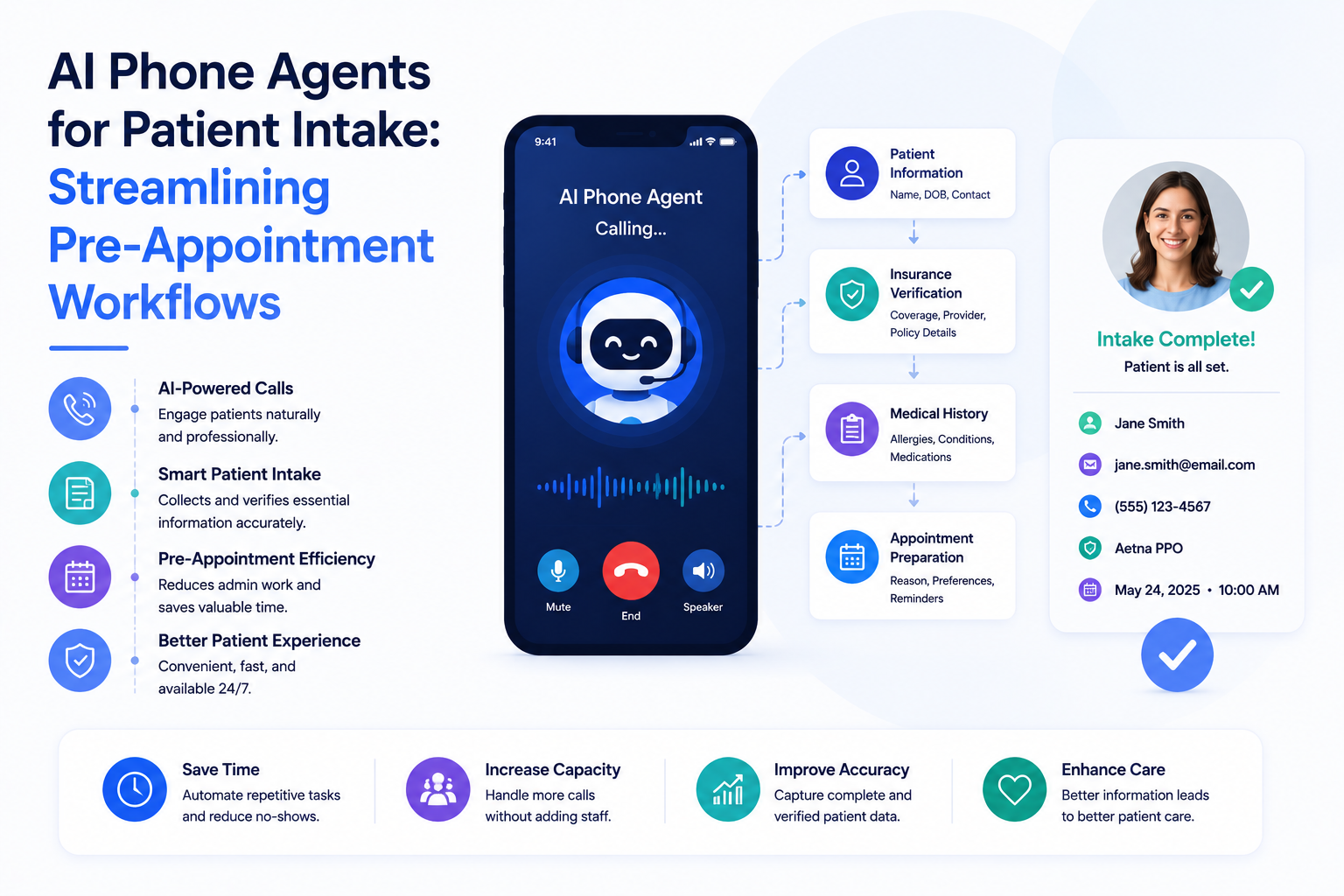
When a patient calls to schedule an appointment with an AI-enabled practice, the AI phone agent handles the full intake sequence. It confirms the patient's identity, retrieves their demographic record if they are an existing patient, captures the reason for visit, checks insurance eligibility in real time through payer API connections, collects or updates medication and allergy information through a structured conversational flow, delivers appointment-specific preparation instructions, and confirms the appointment details before ending the call.
For new patients, the same flow expands to include full demographic data collection. The conversational interface allows patients to provide this information naturally, with the AI agent confirming each piece before moving to the next, rather than forcing patients to navigate a form interface that many find frustrating.
Outbound Pre-Appointment Calls
AI phone agents also conduct outbound pre-appointment calls to patients already on the schedule. These calls confirm the appointment, collect any outstanding intake information, verify insurance updates since the last visit, and deliver preparation instructions. The outbound call is triggered automatically at a defined interval before the appointment, typically 48 to 72 hours, ensuring every patient receives consistent pre-appointment communication regardless of staff availability.
EHR and Practice Management Integration
The intake data collected by AI phone agents is only useful if it flows directly into the clinical and administrative systems where it will be used. Well-implemented AI intake systems use FHIR API connections to write demographic data, medication lists, allergies, and reason-for-visit documentation directly to the EHR, and update the practice management system with insurance verification results and appointment status. This eliminates the manual data entry step that consumes significant administrative time when intake information is collected by phone but not automatically recorded.
What AI Can Handle and Where It Still Needs Human Backup
Effective AI phone agent deployment requires honest assessment of what the technology handles well versus where human oversight remains essential. Overpromising on AI capability is as problematic as underdeploying it.
What AI Phone Agents Handle Well
Structured data collection with defined response types is where AI phone agents excel. Collecting a date of birth, confirming a home address, reading back a medication list and asking for additions or corrections, delivering preparation instructions, confirming appointment time and location: all of these follow predictable patterns with a limited set of possible patient responses that the AI can handle confidently. These tasks represent a substantial portion of the pre-appointment phone workload in most practices.
Insurance eligibility verification through automated payer connections is another high-value AI capability. Real-time eligibility checks that take a staff member 3 to 5 minutes per patient can be completed in seconds by an AI system with payer API access, and the results feed directly into the billing workflow.
Where Human Judgment Remains Necessary
Clinical triage is not an AI phone agent function. If a patient calling to schedule a routine follow-up mentions symptoms that suggest a more urgent need, that conversation must reach a clinical professional. The AI agent's role is to recognize the signals that require escalation and transfer smoothly, not to assess clinical urgency independently. Complex insurance situations, billing disputes, and patients who are distressed or confused also benefit from human handling, and the escalation design must make those transfers feel seamless rather than frustrating.
The most effective AI intake deployments handle 60 to 80% of pre-appointment calls fully autonomously, with the remaining 20 to 40% routed to human staff for situations requiring clinical judgment, complex problem resolution, or patient preference for human interaction.
The Escalation Design Imperative
How the AI transitions to human staff when needed is as important as what the AI handles autonomously. A patient who feels trapped in an AI interaction that cannot address their concern will disengage and form a negative impression of the practice. Smooth escalation, where the AI summarizes what it has collected so far and transfers to staff who pick up the context without requiring the patient to repeat themselves, is the standard that successful deployments consistently achieve.
Voice Quality and Patient Experience in AI Intake Calls
The experience of the pre-appointment call shapes the patient's perception of the practice before they ever walk through the door. A cold, robotic voice conducting a mechanical information-collection exercise is not a neutral experience. It creates a first impression that affects the entire care relationship.
Why Natural Voice Is Not Optional
Healthcare interactions carry an inherent emotional weight. Patients are often anxious about the appointment they are calling about. An AI voice that sounds warm, patient, and natural significantly reduces that anxiety compared to one that sounds mechanical and transactional. Research in healthcare communication consistently shows that communication tone affects patient compliance with preparation instructions and reported satisfaction with the care experience, even before the patient has been seen clinically.
Neural text-to-speech systems from ElevenLabs, Google WaveNet, and Amazon Polly Neural have advanced to the point where patients frequently cannot identify AI-generated voices as synthetic during telephone interactions. This quality threshold is the minimum acceptable standard for healthcare intake calls, where the patient relationship is at stake.
Brand-Consistent Voice Identity
Healthcare organizations with multiple locations and high patient call volumes benefit from maintaining a consistent voice identity across all AI phone interactions. A patient calling any of a health system's 15 locations should have a similar audio experience, with the same recognizable voice persona, the same tone, and the same interaction cadence. Platforms like VoxClone AI enable health systems to clone and maintain a specific voice persona at scale, ensuring that every patient call reflects a consistent brand experience rather than using a generic off-the-shelf synthetic voice that sounds identical to every other healthcare organization using the same platform.
Language and Cultural Adaptation
In markets with diverse patient populations, AI phone agents that conduct intake in the patient's preferred language dramatically improve data quality and patient experience simultaneously. A patient providing their medication list in Spanish rather than halting English will give more complete and accurate information. Practices serving bilingual populations should treat multilingual AI capability as a clinical quality issue, not a convenience feature.
Compliance Architecture for AI Patient Intake
Patient intake phone calls collect protected health information in a context governed by multiple regulatory frameworks. Getting the compliance architecture right is not optional.
HIPAA Requirements for AI-Collected PHI
Any AI phone agent collecting patient information, including demographics, insurance details, medication lists, and reason for visit, is handling PHI and must operate under appropriate HIPAA safeguards. All vendors in the processing chain, including the AI platform, speech recognition provider, and cloud infrastructure, must have signed Business Associate Agreements. Data must be transmitted and stored with encryption, access must be logged, and retention policies must be documented and enforced.
Microsoft Azure, Google Cloud, and Amazon Web Services all offer HIPAA-eligible configurations for their AI and cloud services. Most enterprise AI phone agent platforms for healthcare operate on one of these three cloud infrastructures. Confirm the specific configuration of your vendor's deployment before signing a contract.
TCPA and Outbound Call Compliance
AI outbound intake calls operate under the same Telephone Consumer Protection Act framework as reminder calls. The established business relationship exemption generally covers outbound calls to existing patients for appointment-related purposes. New patient calls require more careful consideration: an outbound pre-intake call to a patient who scheduled online but has not had prior contact with the practice should be reviewed with legal counsel to confirm TCPA compliance posture before deployment.
Data Accuracy and Clinical Liability
AI-collected intake data enters the clinical record and will be relied upon by clinicians making care decisions. The accuracy of AI-transcribed medication names, allergy information, and clinical history is therefore not just a data quality question. It is a patient safety question. Deployments must build in verification steps for high-risk data elements: the AI agent should read back collected medication names and ask for explicit patient confirmation before those medications are recorded in the clinical system. Medication name misrecognition is one of the highest-risk accuracy failures in AI intake systems, and it should be treated as such in system design.
Documented Outcomes From Production AI Intake Deployments
The case for AI phone agents in patient intake is not built on projections. Production deployments across a range of practice settings have documented measurable outcomes.
Administrative Time Savings
Practices deploying AI phone agents for intake consistently report that 60 to 75% of pre-appointment administrative call volume is handled entirely by the AI, with staff involvement only for escalations and complex cases. For a practice receiving 150 intake-related calls per day, this represents recovering 90 to 110 staff calls that previously required human handling. At 5 to 8 minutes per call, that is 7 to 15 hours of staff time daily that can be redirected to in-person patient support, prior authorization work, or other high-value administrative functions.
Intake Data Completeness
An unexpected and consistently documented outcome of AI intake is improved data completeness. AI agents apply the same structured intake protocol to every call and do not skip questions under time pressure. A study comparing AI-collected and staff-collected intake data across 12,000 patient encounters found that AI-collected records had complete medication lists 91% of the time versus 74% for staff-collected records, and complete allergy documentation 88% of the time versus 71%. This completeness improvement has downstream effects on clinical safety and billing accuracy.
Case Study: Multispecialty Group Practice
A multispecialty group with 28 physicians across 4 locations deployed an AI phone intake system in 2025. After 6 months of full deployment, the practice documented:
- Front desk staff call volume reduced by 62% without reducing patient access or satisfaction
- Average intake data completeness improved from 71% to 89% of required fields
- Insurance eligibility denial rate at billing dropped by 23% due to real-time verification at scheduling
- Patient satisfaction scores for the scheduling experience improved 17 percentage points
- Staff reported spending significantly more time on in-person patient support and less on phone administration
Revenue Cycle Impact
Real-time insurance eligibility verification at the point of scheduling has a direct impact on clean claim rates. When insurance information is verified before the appointment rather than discovered to be problematic at billing, practices can address coverage issues proactively, collect accurate co-pay estimates, and avoid the costly post-service billing disputes that degrade revenue cycle performance. Practices report clean claim rate improvements of 8 to 15 percentage points following implementation of AI intake with real-time eligibility verification.
Deployment Considerations and Common Failure Modes
AI phone agent deployments in patient intake follow recognizable patterns of success and failure. The failures are almost always in implementation design rather than underlying technology capability.
Inadequate Escalation Design
The most common deployment failure is an AI system that does not escalate gracefully. Patients who cannot get an answer to an unusual question and cannot easily reach a human become frustrated and disengage. A well-designed escalation system should trigger at the patient's first explicit request for a human, at any clinical symptom mention, and at any point where the AI confidence in understanding the patient's input drops below a threshold. The escalation should summarize what has already been collected so the receiving staff member does not restart the conversation from scratch.
EHR Integration Gaps
An AI intake system that collects information but does not write it directly to the EHR or practice management system requires staff to manually process and enter the collected data, which eliminates most of the efficiency gain. Confirming that your AI intake platform has native integration with your specific EHR and practice management configuration, not just a generic API capability, is essential before deployment. The difference between a pre-built integration and a custom API build is often six to twelve months of implementation work.
Inadequate Pilot Scope
Deploying AI intake across an entire practice simultaneously surfaces problems at scale before they can be addressed. Run a pilot with a specific provider schedule or a defined appointment type for 30 to 60 days, measure the outcomes against your baseline metrics, identify the gaps, fix them, and then expand. Every major AI intake implementation that runs a proper pilot before full deployment sees better long-term outcomes than those that go straight to system-wide rollout.
What AI Patient Intake Will Look Like by 2028
The trajectory of AI phone agent capability is steep. The gap between what current systems do and what they will do in two years is substantial.
Predictive Intake Personalization
Next-generation AI intake systems will use prior visit data to personalize each intake call. For a returning patient with diabetes being seen for a routine follow-up, the system will proactively ask about blood glucose monitoring, recent readings, and any new symptoms, because the patient's history indicates these are the clinically relevant intake questions for this visit type. The intake conversation becomes genuinely customized rather than applying a generic template to every patient.
Real-Time Benefit Navigation
Insurance benefit complexity is a persistent source of patient confusion and practice frustration. Future AI intake systems will not just verify eligibility. They will explain the patient's specific benefits for the upcoming visit in plain language: your co-pay for this type of visit is $35, your deductible remaining for the year is $450, this procedure is covered at 80% after deductible. Delivering this information proactively at scheduling prevents financial surprises that reduce patient satisfaction and create billing disputes.
Longitudinal Pre-Visit Engagement
The intake conversation of 2028 will not be a single call. It will be a multi-touchpoint engagement sequence: an initial scheduling call capturing basic information, a follow-up message confirming insurance verification results and financial responsibility, a reminder call with preparation instructions, and a same-day check-in confirmation. Voice AI platforms like VoxClone AI, with their voice cloning and synthesis capabilities, are increasingly relevant to healthcare organizations building this kind of multi-touchpoint patient outreach with a consistent, natural-sounding brand voice. Explore these capabilities through the VoxClone AI app on Google Play.
Implementation Checklist for Healthcare Organizations
Use this checklist to structure your AI phone agent evaluation and deployment process for patient intake.
- Map your current intake workflow in detail before selecting a platform to ensure the AI can cover each step
- Confirm HIPAA BAA coverage for all vendors in the processing chain
- Verify TCPA compliance posture for both inbound handling and outbound pre-intake calls
- Confirm native EHR and practice management integration for your specific system configuration
- Audit voice quality by listening to platform sample calls through your telephony hardware
- Define the escalation triggers and design the context-carrying transfer to human staff
- Build medication name and allergy read-back verification into the intake flow
- Run a pilot limited to one provider schedule or appointment type for 30 to 60 days
- Establish baseline metrics before launch: call completion rate, data completeness, eligibility denial rate, staff call volume
- Define a patient feedback mechanism for the first 90 days to surface experience issues early
Conclusion
Patient intake is one of the most labor-intensive, inconsistently executed, and clinically consequential workflows in any healthcare practice. The information collected before a patient walks through the door affects care quality, billing accuracy, and patient experience simultaneously. Yet the methods used to collect it have remained largely unchanged for decades.
AI phone agents offer a genuinely different approach. They handle structured information collection at scale and with consistency that human-staffed calling cannot match at equivalent cost. They verify insurance in real time. They deliver preparation instructions reliably. They collect medication and allergy information with documented completeness rates that exceed staff-collected benchmarks. And they free the clinical and administrative staff they replace from repetitive tasks so those people can do work that genuinely benefits from human judgment.
The implementation decisions that separate successful from failed deployments are not complicated. Escalation design. EHR integration. Voice quality. Pilot before full rollout. Medication verification. These are solvable problems that require upfront attention rather than retrofitting.
The 18-minute intake call that started this article is not an inevitable feature of healthcare administration. It is a process waiting for a better tool.
Tags:
#AIPhoneAgents #PatientIntake #HealthcareAI #PreAppointmentWorkflow #VoiceAI #VoxCloneAI #PatientEngagement #MedicalAdministration #HealthTech #HIPAA #EHRIntegration #HealthcareAutomation