
You just wrapped a demo for a new voice-enabled application. The founder smiles, the stakeholders nod, and the sample clips sound like a Hollywood voice actor sitting in a treated studio. Then you push the integration to a staging environment with real-world users. Within 48 hours, the ticket queue explodes. The voice lags by 1.8 seconds on cellular networks, financial acronyms sound like gibberish, concurrent API calls trigger rate-limit blocks, and your cloud provider invoice jumps by 400%. What went wrong?
You hit the classic production wall in Text-to-Speech (TTS) engineering. Selecting a TTS engine based solely on pre-rendered audio demos is one of the most frequent traps engineering teams fall into. In 2026, voice AI models from giants like Google, Microsoft, OpenAI, ElevenLabs, Murf, and Amazon Polly offer remarkable expressiveness, but acoustic realism is only 15% of the production equation. The remaining 85% involves latency budgets, streaming protocol overhead, cost scaling curves, multi-lingual normalization, and security compliance.
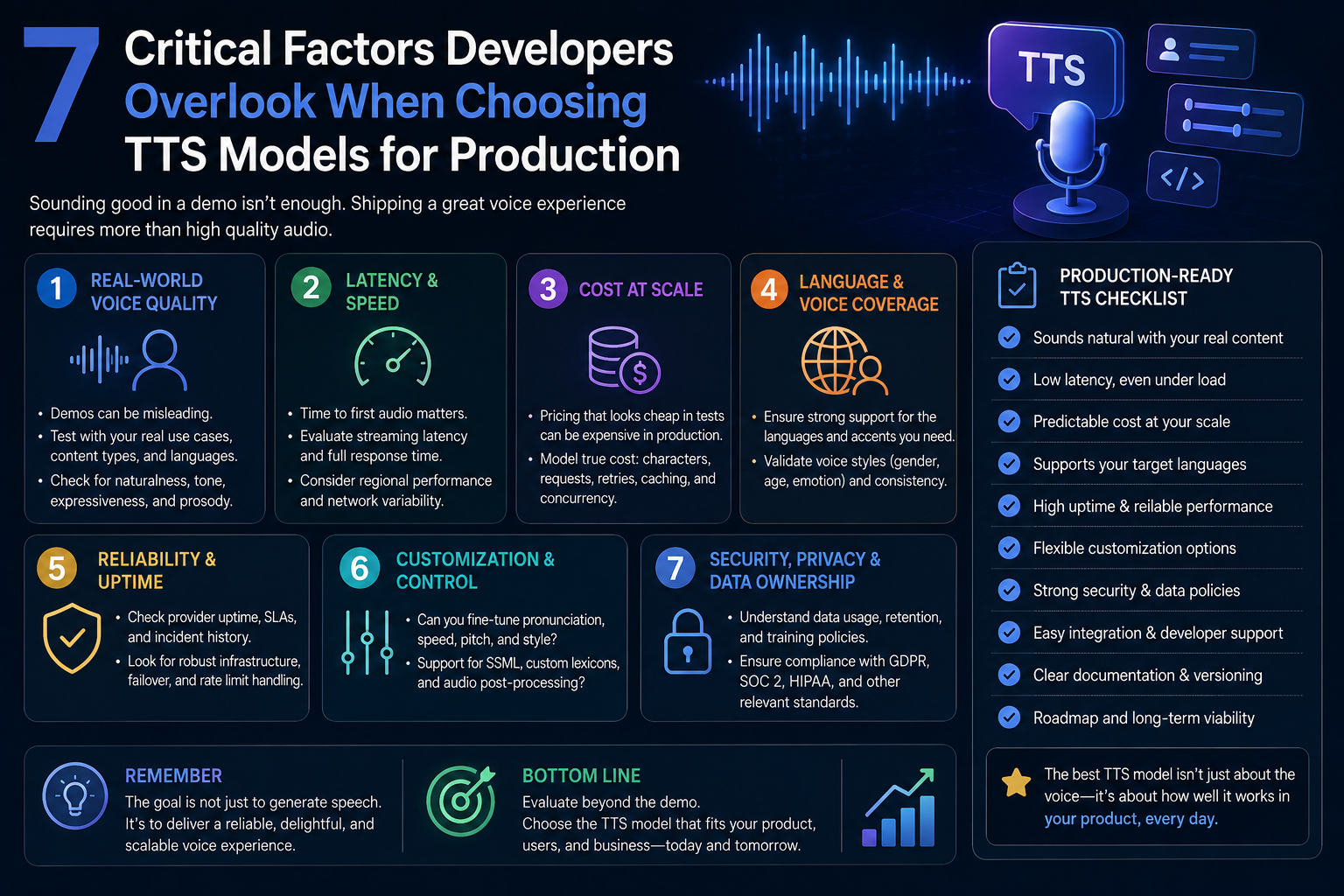
1. Background and Context: The Shift from Demos to Real-World Production
In early neural TTS generations, developers evaluated engines through simple mean opinion scores (MOS). A human testing panel listened to sample audio files generated in ideal laboratory settings and rated naturalness on a scale from 1.0 to 5.0. If a voice scored above 4.2, it received the green light for integration. However, modern interactive applications—ranging from conversational AI agents and real-time gaming NPCs to automated fintech support lines—place demands on speech models that static MOS tests completely miss.
Why Modern Voice Architectures Demand Rigorous Auditing
Today's conversational pipelines combine Automatic Speech Recognition (ASR), Large Language Models (LLMs), and TTS synthesis engines. In a multi-turn voice interaction, your total round-trip time budget is roughly 600ms to 800ms before a human caller perceives an awkward pause. If your LLM takes 350ms to generate tokens, your ASR consumes 150ms, and your TTS engine takes 450ms to return an audio buffer, you have already failed the latency threshold.
Enterprise developers must audit TTS models across real-world operational dimensions. Selecting a model requires balancing raw audio quality against hard infrastructure constraints. Let us dive into the seven critical factors developers consistently overlook during architectural reviews.
2. Factor 1: First-Byte Latency (TTFB) vs. Total Audio Duration Latency
When vendor marketing pages boast "sub-200ms latency," they are almost always referring to Time to First Byte (TTFB) under non-concurrent test conditions. TTFB measures how quickly an API endpoint returns the initial chunk of audio data after receiving a text payload. While TTFB matters, relying on it as your sole metric creates severe architectural bottlenecks.
The Chunking and Buffer Allocation Trap
In interactive applications, total latency depends on how your server processes incoming audio buffers. If a model has a stellar TTFB of 120ms but generates subsequent chunks at less than 1.0x real-time factor (RTF), the playback buffer starves, causing stuttering, crackling, or abrupt playback halts on mobile client devices.
- Real-Time Factor (RTF): The ratio of synthesis execution time to generated audio duration. An RTF below 0.2 is mandatory for smooth real-time streaming.
- Audio Chunk Size: Receiving tiny 10ms PCM chunks increases network overhead, while large 500ms chunks create perceptual latency gaps for the end user.
- Network Protocol Overhead: Standard HTTP REST POST requests introduce TCP handshake delays per sentence. Production systems require WebSockets, gRPC, or WebRTC streaming conduits to maintain open channels.
3. Factor 2: WebSocket, gRPC, and WebRTC Streaming Overhead
A common mistake during prototype development is making individual HTTP POST requests for every synthesized sentence. While REST endpoints work fine for pre-rendering blog audio or generating offline podcast clips, they fail under interactive live chat conditions.
Evaluating Streaming Conduits
When choosing a provider, evaluate how their architecture handles real-time bidirectional streaming. WebSockets provide a significant improvement over REST, but gRPC and WebRTC offer far lower packet header overhead and better multiplexing across unstable cellular connections.
| Protocol Type | Average Connection Latency | Packet Header Overhead | Best Use Case |
|---|---|---|---|
| REST (HTTP/2 POST) | 250ms – 450ms per request | High (Requires full HTTP headers per turn) | Batch processing, offline audio generation, static content |
| WebSockets (WS/WSS) | 80ms – 150ms persistent | Low (2-14 bytes frame header) | Web-based AI agents, browser voice apps, interactive chat |
| gRPC over HTTP/2 | 40ms – 90ms persistent | Ultra-Low (Protobuf binary encoding) | Server-to-server voice microservices, mobile backends |
| WebRTC DataChannels | 20ms – 60ms direct peer/relay | Minimal (UDP-based sub-protocol) | Sub-300ms ultra-low latency conversational agents |
4. Factor 3: Text Normalization, Heteronyms, and SSML Support
How does your candidate model handle raw, unformatted text? In production, users enter typos, non-standard abbreviations, dates, currencies, and technical numbers. If a model lacks robust pre-processing text normalization, your voice agent will mispronounce basic business data.
The Challenge of Homographs and Specialized Terms
Consider the word read in "I will read the report" versus "I read the report yesterday." Or the word lead in "lead the team" versus "lead pipe." Without context-aware grapheme-to-phoneme (G2P) processing, speech models make errors in over 5% of sentences containing common homographs.
Ensure your chosen vendor supports strict Speech Synthesis Markup Language (SSML) standards, specifically the <phoneme>, <sub>, and <say-as> tags. When evaluating custom voice providers, test whether they allow custom phoneme dictionary mapping using the International Phonetic Alphabet (IPA). Platforms like VoxClone AI streamline this by providing developer-friendly API endpoints for custom voice cloning and automated phonetic dictionary overrides, preventing embarrassing mispronunciations in production.
5. Factor 4: Concurrency Scaling, Rate Limits, and Regional Availability
During local development, your application makes one request at a time. In production, a marketing campaign or morning traffic spike might trigger 500 concurrent voice synthesis sessions. Many developers choose a provider based on pricing per million characters, only to discover too late that the provider's default rate limits cap them at 10 concurrent requests.
Questions to Ask Before Signing an Enterprise Agreement
- What is the default concurrent session limit per API key, and what is the cost tier to scale to 500+ threads?
- Does the vendor offer multi-region edge deployment (e.g., US-East, EU-Central, AP-South) to keep latency low for international users?
- How does the API handle rate-limit breaches? Does it return a clean 429 status code with retry headers, or does it drop connections silently?
6. Factor 5: Voice Consistency Across Long-Form Audio and Session Drifting
A voice model might sound flawless during a 5-second sample test. But what happens when that same voice reads a 12-page document or maintains a 20-minute support call? Many neural TTS models suffer from session drift—a phenomenon where pitch, emotional tone, speaking rate, or background noise characteristics shift noticeably as output length increases.
Evaluating Acoustic Stability
Autoregressive models that generate audio token-by-token can occasionally enter feedback loops. This causes the voice to hallucinate strange murmurs, slurred syllables, or sudden emotional shifts from neutral to frantic. Non-autoregressive architectures provide far higher stability for long-form content, though sometimes at a slight cost in peak emotional expressiveness.
"Session drift in long-form synthesis is the silent killer of user engagement. If your AI narrator changes its accent or pitch mid-chapter, listeners immediately disengage from the experience."
7. Factor 6: Hidden Cost Scaling Curves and Tokenomics
TTS pricing structures vary wildly across the industry. Some vendors bill per character, others per audio second generated, and others per API compute unit. Understanding your true cost-per-user-session requires analyzing these pricing models under production load conditions.
| Provider / Model Class | Base Pricing Model | Estimated Cost per 100K Characters | Hidden Cost Vectors to Monitor |
|---|---|---|---|
| Legacy Cloud (Google, AWS, Azure) | $15.00 – $16.00 per 1M chars | $1.50 – $1.60 | SSML processing fees, custom voice hosting, egress bandwidth |
| Premium Generative (ElevenLabs, OpenAI) | $150.00 – $200.00 per 1M chars | $15.00 – $20.00 | Unused tier quota expiry, high cost for multi-turn conversations |
| Developer-First (e.g., VoxClone AI) | Optimized Volume Tiering | Scales down with usage volume | Transparent pricing, flat-rate voice cloning options |
| Open-Source Self-Hosted (Coqui, Bark, XTTS) | GPU Infrastructure Costs (AWS EC2 / RunPod) | Variable ($0.50 – $3.00 based on GPU efficiency) | Idle GPU server costs, DevOps maintenance, cold-start scaling |
Calculating the Real Cost of Voice Agent Loops
In a conversational AI system where a user chats for 10 minutes, the application generates roughly 1,200 words of spoken response (~7,000 characters). At premium rates of $200 per million characters, a single 10-minute user session costs $1.40 in TTS fees alone. If your product charges users $10 per month, three long conversations will obliterate your gross margins. Matching your pricing model to your usage patterns is crucial before launching.
8. Factor 7: Data Privacy, Zero Retention, and IP Ownership
The final overlooked factor is data privacy. When your application streams text prompts to a third-party TTS vendor, that text often contains sensitive customer records, medical notes, or proprietary business intelligence.
Auditing Vendor Security Postures
Ensure your chosen TTS vendor provides explicit enterprise guarantees around data handling:
- Zero Data Retention (ZDR): Guarantees that submitted text prompts and generated audio buffers are purged from RAM immediately after rendering, rather than stored on server disks for model retraining.
- HIPAA and SOC 2 Type II Compliance: Essential for applications processing protected health information (PHI) or financial transactions.
- Custom Voice IP Rights: Clear legal terms establishing that your enterprise retains 100% ownership over cloned voice assets and custom model weights. Using platforms like VoxClone AI ensures your custom voice profiles remain secure, isolated, and protected by strict enterprise privacy boundaries.
9. Real-World Applications: Production Performance Case Studies
Let us look at two real-world case studies demonstrating how addressing these seven factors changes business outcomes.
Case Study 1: Logistics Voice Agent Deployment
A national logistics platform built an automated phone agent to dispatch delivery updates to 25,000 drivers daily. Their initial prototype used a popular generative voice model connected over standard REST endpoints. The system suffered from 1.4-second response pauses, and driver call drop rates hovered at 28%.
By switching to a low-latency gRPC streaming architecture, implementing server-side text normalization for street addresses, and utilizing a developer-friendly voice provider with guaranteed concurrency tiers, the team reduced response latency to 380ms. Call drop rates plummeted to 3.2%, saving the logistics enterprise over $850,000 annually in support escalation costs.
Case Study 2: E-Learning Platform Cost Optimization
An educational tech startup pre-rendered 40,000 course lectures using a premium character-billed API. Their first monthly cloud invoice came in at $48,000—more than three times their projected infrastructure budget.
By auditing their content pipeline, the engineering team realized that 60% of their text consisted of static boilerplate intros, transitions, and course navigation prompts. They implemented a hybrid caching layer paired with targeted voice cloning, lowering monthly audio generation costs to $11,200 while preserving voice quality for students.
10. Future Trends: What to Expect in TTS Tech (2026-2028)
As voice AI technology continues its rapid evolution through 2028, three key technical shifts will transform how developers integrate TTS engines into production software.
Native Multimodal Speech-to-Speech Models
The industry is rapidly shifting away from fragmented ASR-LLM-TTS pipelines toward unified speech-to-speech transformers. These models process raw audio tokens natively, eliminating intermediate text conversion steps and cutting end-to-end conversation latency below 250ms while preserving pitch, tone, and whisper nuances.
On-Device Small Voice Models (SLMs)
Hardware acceleration on mobile devices and edge appliances is making local TTS execution viable. By 2028, lightweight speech models running locally on consumer hardware will handle routine voice responses with zero cloud latency and total offline privacy, reserving cloud API calls for complex emotional or multi-lingual synthesis.
11. Practical Takeaways for Engineering Teams
Before pushing your next voice AI project to production, run your architecture through this actionable audit checklist:
- Benchmark RTF and TTFB under load: Test candidate engines with 50+ concurrent streaming connections rather than single isolated API requests.
- Implement a server-side text normalization layer: Sanitize input text, expand shorthand, and format numbers before passing payloads to the voice API.
- Establish a multi-region fallback strategy: Set up secondary cloud providers or local caching mechanisms to maintain availability during primary API outages.
- Calculate worst-case cost curves: Model your monthly API costs based on heavy power users rather than average session lengths.
- Enforce Zero Data Retention agreements: Ensure your vendor agreement complies with your industry's data privacy mandates (HIPAA, SOC 2, GDPR).
12. Conclusion
Building a successful voice-enabled application requires evaluating what happens after the initial audio sample plays. By looking beyond pre-rendered demos and rigorously auditing latency protocols, concurrency boundaries, text normalization pipelines, and cost scaling curves, software teams can deploy TTS models that perform reliably at scale.
Focus on your infrastructure limits early, design for real-time performance, and choose voice partners that provide the flexibility, control, and privacy guarantees your production environment demands.
#TTS #VoiceAI #SoftwareEngineering #SpeechSynthesis #VoxCloneAI #VoiceCloning #TechStrategy #EnterpriseAI #DeveloperGuide #RealTimeVoice